Home
Class 12
MATHS
If f(x)=x^3+4x^2+lambdax+1 is a monotoni...

If `f(x)=x^3+4x^2+lambdax+1` is a monotonically decreasing function of `x` in the largest possible interval `(-2,-2/3)dot` Then `lambda=4` (b) `lambda=2` `lambda=-1` (d) `lambda` has no real value

Text Solution

Verified by Experts
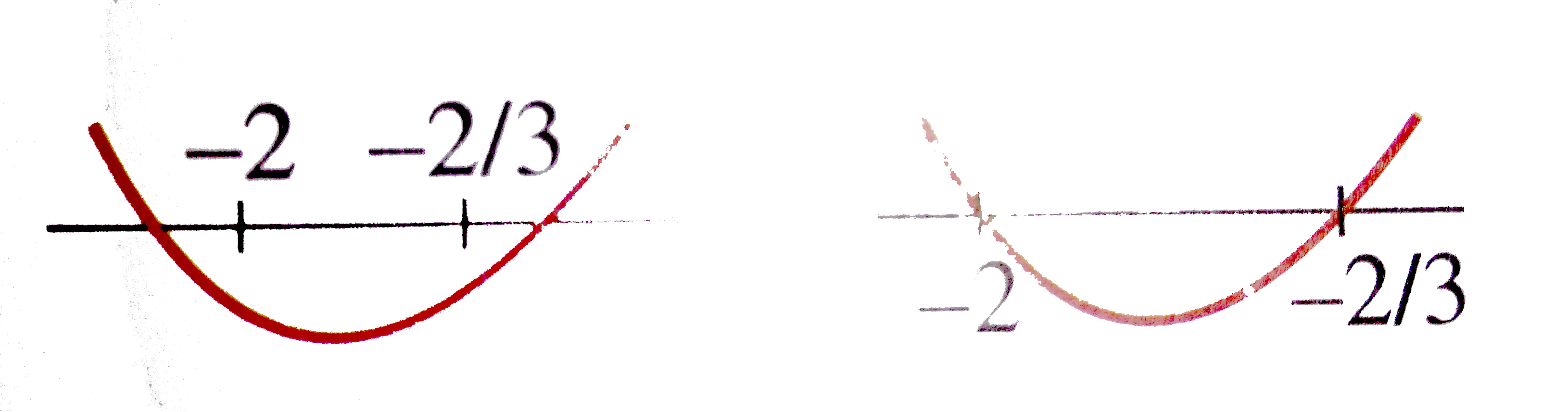
Here `f'(x) le 0`
`rArr" "3x^(2)+ 8x + lamda0 AA x in (-2, -(2)/(3))`
Then the situations for `f'(x)` are as follows :

Given that `f(x)` decreases in the largest possible interval `(-2, -(2)/(3))`, then `f'(x)=0` must have roots -2 and `-2//3`.
So the product of the roots is `(-2)(-(2)/(3))= (lamda)/(3) rArr lamda=4`.
Promotional Banner

Topper's Solved these Questions

  • GRAPHS OF ELEMENTARY FUNCTIONS

    CENGAGE|Exercise Exercise|34 Videos
  • GRAPHS OF POLYNOMIAL AND RATIONAL FUNCTIONS

    CENGAGE|Exercise Exercises|4 Videos
  • GRAPHS OF TRIGONOMETRIC FUNCTIONS

    CENGAGE|Exercise Exercise|22 Videos

Similar Questions

Explore conceptually related problems

If f(x)=x^3+4x^2+lambdax+1 is a monotonically decreasing function of x in the largest possible interval (-2,-2/3)dot Then (a ) lambda=4 (b) lambda=2 (c) lambda=-1 (d) lambda has no real value

If f(x)= lambdae^(-lambdax),xgt0 is aprobability density function of X then its variance is :

If f(x)=2/(sqrt(3))tan^(-1)((2x+1)/(sqrt(3)))-log(x^2+x+1)(lambda^2-5lambda+3)x+10 is a decreasing function for all x in R , find the permissible values of lambdadot

If in any triangle, the area DeltaABC le(b^(2)+c^(2))/(lambda) , then the largest possible numerical value of lambda is

If y=2 is the directrix and (0,1) is the vertex of the parabola x^2+lambday+mu=0 , then (a) lambda=4 (b) mu=8 (c) lambda=-8 (d) mu=4

f(x)=4tanx-tan^2x+tan^3x ,x!=npi+pi/2, (a)is monotonically increasing (b)is monotonically decreasing (c)has a point of maxima (d)has a point of minima

Find the largest possible domain for the real valued function f defined by f(x)=sqrt(x^(2)-4x+3) .

Find the locus of image of the veriable point (lambda^(2), 2 lambda) in the line mirror x-y+1=0, where lambda is a perimeter.

If f(x)=lambda|sinx|+lambda^2|cosx|+g(lambda) has a period = pi/2 then find the value of lambda

If lambda = - 2 , determine the value of |{:(0,2lambda,1),(lambda^(2),0,3lambda^(2)+1),(-1,6lambda-1 ,0):}|

CENGAGE-GRAPHS OF ELEMENTARY FUNCTIONS -Exercise
  1. If f(x)=x^3+4x^2+lambdax+1 is a monotonically decreasing function of x...

    Text Solution

    |

  2. Draw the graph of y= (1)/((1//x)).

    Text Solution

    |

  3. (a) Draw the graph of f(x) = ={{:(1",",, |x| ge 1), ((1)/(n^(2)) ",",,...

    Text Solution

    |

  4. Sketch the regions which points satisfy |x+y| ge 2.

    Text Solution

    |

  5. Sketch the region satisfying |x| lt |y|.

    Text Solution

    |

  6. Let f:R→R:f(x)=(x+1) and g:R→R:g(x)=(x^2−2). Write down the formulae f...

    Text Solution

    |

  7. Draw the graph of y= (x-1)/(x-2).

    Text Solution

    |

  8. The following figure shows the graph of f(x) =ax^(2)+bx +c, then find ...

    Text Solution

    |

  9. The entire graph of the equation y=x^2+k x-x+9 in strictly above the x...

    Text Solution

    |

  10. If x^2+2a x+a<0AAx in [1,3], the find the values of adot

    Text Solution

    |

  11. Draw the graph of f(x) = x|x|.

    Text Solution

    |

  12. Draw the graph of the function: Solve |(x^2)/(x-1)|lt=1 using the grap...

    Text Solution

    |

  13. Draw the graph of y = |x^(2) - 2x|-x.

    Text Solution

    |

  14. Draw the graph of y =2^(x)"," x^(2)-2x le 0

    Text Solution

    |

  15. Find the roots of the equation by factorization: 2x^2-x-1

    Text Solution

    |

  16. Divide 16(x^2yz + xy^2z+xyz^2) by 4xyz

    Text Solution

    |

  17. Find the set of real value(s) of a for which the equation |2x+3|+2x-3|...

    Text Solution

    |

  18. Draw the graph of y=|x|.

    Text Solution

    |

  19. Draw the graph of y=1/(log(e)x)

    Text Solution

    |

  20. Find the number of real solutions to the equation log(0.5)x=|x|.

    Text Solution

    |

  21. Draw the graph of f(x)= x+ [x], where [*] denotes the greatest integer...

    Text Solution

    |

