Home
Class 12
MATHS
Two sides of a rhombus lying in the firs...

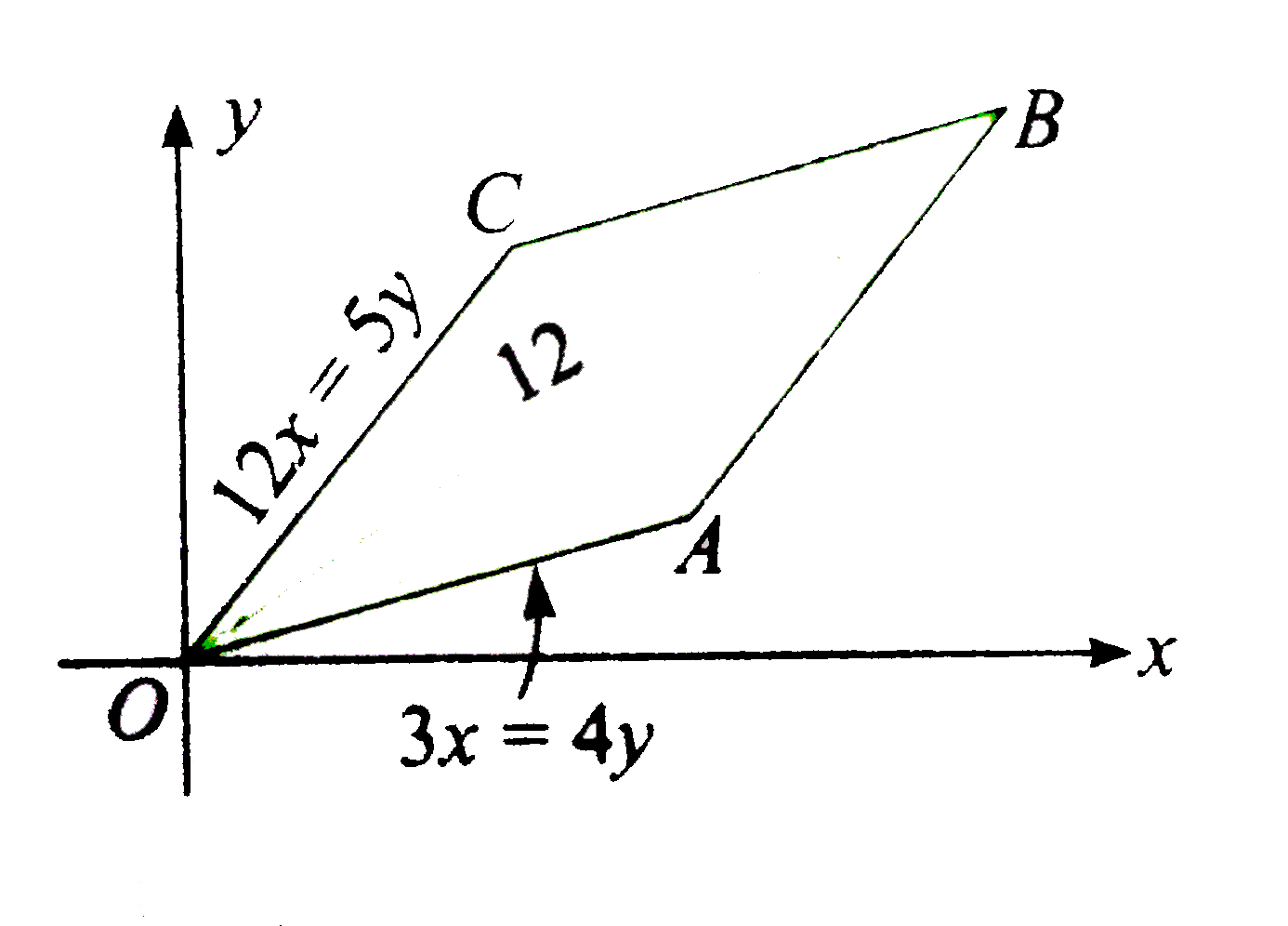
Two sides of a rhombus lying in the first quadrant are given by `3x-4y=0a n d12 x-5y=0` . If the length of the longer diagonal is 12, then find the equations of the other two sides of the rhombus.

Text Solution

Verified by Experts


OB is along the acute angle bisector of the given lines: 3x-4y=0 and 12x-5y =0.
The equation of acute angle bisector is
`(3x-4y)/(5) = -(12-5y)/(13)`
or 9x-7y=0
`therefore "Slope of OB" = tan theta = (9)/(7)`
Now, OB= 12.
Therefore, the coordinates of B are
`(12 "cos" theta, 12 "sin" theta) -= (12(7)/(sqrt(130)), 12(9)/(sqrt(130))) -= ((84)/(sqrt(130)), (108)/(sqrt(130)))`
AB is passing through B and is parallel to OC.
Therefore, the equation of AB is
`y-(108)/(sqrt(130)) = (12)/(5)(x-(84)/(sqrt(130)))`
BC is passing through B and is parallel to OA.
Therefore, the equation of BC is `y-(108)/(sqrt(130)) = (3)/(4)(x-(84)/(sqrt(130)))`

Promotional Banner

Topper's Solved these Questions

  • STRAIGHT LINES

    CENGAGE|Exercise Exercise 2.1|23 Videos
  • STRAIGHT LINES

    CENGAGE|Exercise Exercise 2.2|4 Videos
  • STRAIGHT LINE

    CENGAGE|Exercise Multiple Correct Answers Type|8 Videos
  • THEORY OF EQUATIONS

    CENGAGE|Exercise JEE Advanced Previous Year|9 Videos

Similar Questions

Explore conceptually related problems

If the two consecutive sides of a parallelogram are 4x+5y=0 and 7x+2y=0 . If the equation of one diagonal is 11 x+7y=9, find the equation of the other diagonal.

The lenghts of the diagonals of a Rhombus are 12 cm and 16 cm. Find the side of the rhombus.

If (-4,7) is one vertex of a rhombus and if the equation of one diagonal is 5x-y+7=0, then find the equation of another diagonal.

The side of a rhombus is 13 cm and the length of one diagonal is 24 cm. Find the length of other diagonal?

Two equal sides of an isosceles triangle are given by 7x-y+3=0 and x+y=3 , and its third side passes through the point (1,-10) . Find the equation of the third side.

If (-4,7) is one vertex of a rhombus and if the equation of one diagonal is 5x - y + 7 =0 , then find the equation of another diagonal.

Find the area of the region lying in the first quadrant and bounded by y = 4x^(2) , x = 0, y = 1 and y = 4.

Find the area lying in the first quadrant and bounded by the curve y=x^3 and the line y=4xdot
