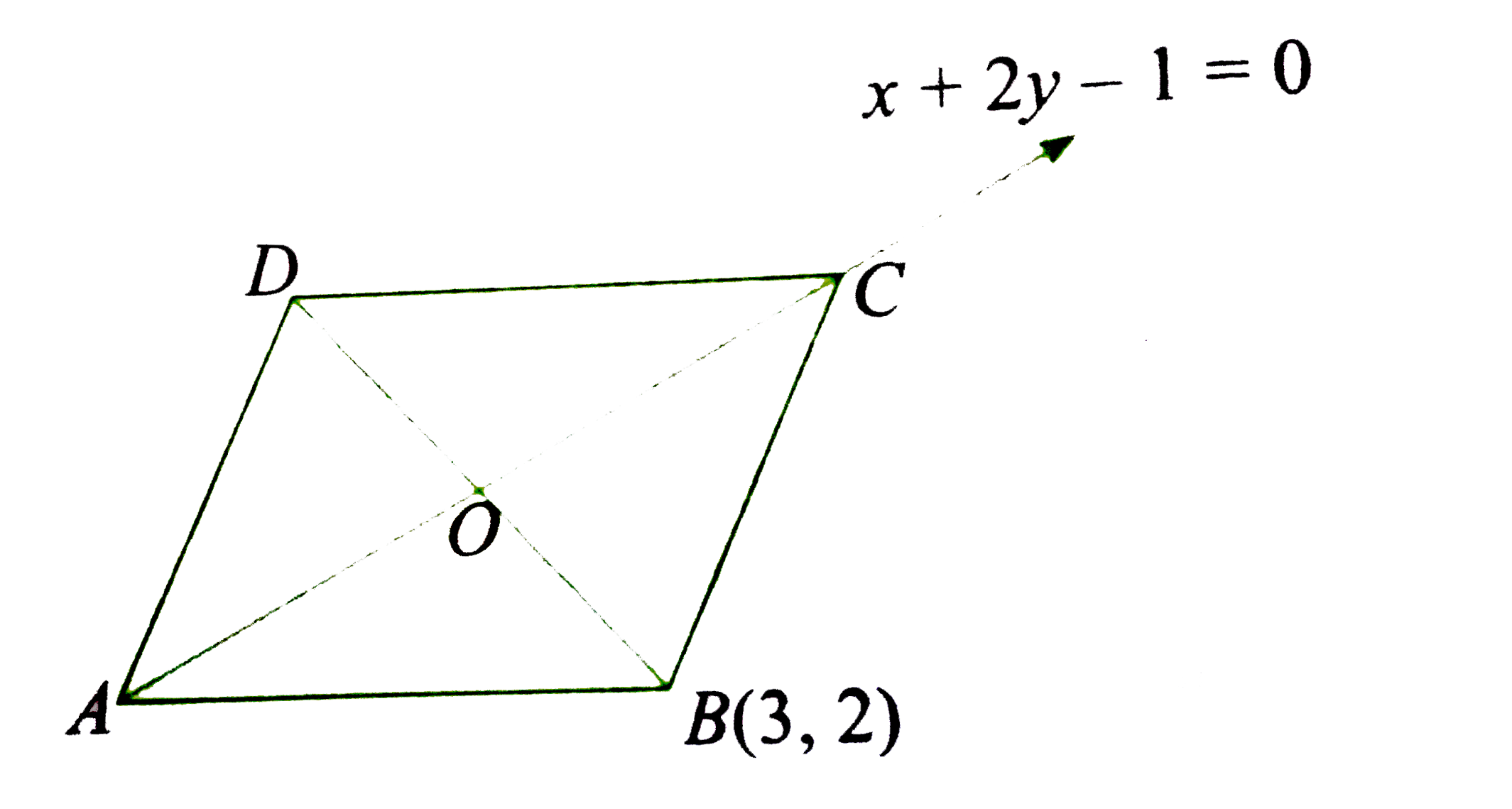
Since diagonal is member of both the given families of line, it will pass through the points (1,0) and (-1,1) which are points where given family of lines are concurrent.
So, equation of diagonal AC is x+2y-1=0.
Clearly, point (3,2) does not satisfy this diagonal.
`therefore "Let" B -= (3,2).`
Diagonal BD is perpendicular to AC.
So, equation of diagonal BD is 2x-y-4=0.
Point of intersection of diagonal AC and BD is O `((9)/(5), (-2)/(5)).`
Since O is midpoint of BD, D `-=((3)/(5),-(14)/(5)).`
`"Now", OD = (6)/(sqrt(5)). So, BD = (12)/(sqrt(5))=d_(1)`
`"Area of rhombus " =(1)/(2)d_(1) xx d_(2) = 12sqrt(5) " " ("where " d_(2) " is length of diagonal AC")`
`therefore d_(2) = 10 " units"`
This is the length of diagonal AC.
Slope of AC `=-(1)/(2) = "tan" theta, "where" theta` is inclination of AC with x-axis.
Since OA=OC=5, using parametic from of straight line, we have
`A,C -= ((9)/(5)+-5"cos" theta, -(2)/(5) +- 5 "sin" theta)`
`-= ((9)/(5)+-5(-(2)/(sqrt(5))), -(2)/(5) +- 5 ((1)/(sqrt(5))))`
`-= ((9)/(5)-2sqrt(5), -(2)/(5) + sqrt(5)), ((9)/(5)+2sqrt(5), -(2)/(5) - sqrt(5))`


