Home
Class 12
MATHS
Consider two lines L1a n dL2 given by x-...

Consider two lines `L_1a n dL_2` given by `x-y=0` and `x+y=0` , respectively, and a moving point `P(x , y)dot` Let `d(P , L_1),i=1,2,` represents the distance of point `P` from the line `L_idot` If point `P` moves in a certain region `R` in such a way that `2lt=d(P , P_1)+d(P , L_1)lt=4` , find the area of region `Rdot`

Text Solution

Verified by Experts


`d(P,L_(1)) = (|x-y|)/(sqrt(2))`
`" and " d(P,L_(2)) = (|x+y|)/(sqrt(2))`
Now, we have
`2 le d(P,L_(1))+d(P,L_(2))le 4`
`"or " 2sqrt(2) le |x-y|+|x+y| le 4sqrt(2) " " (1)`
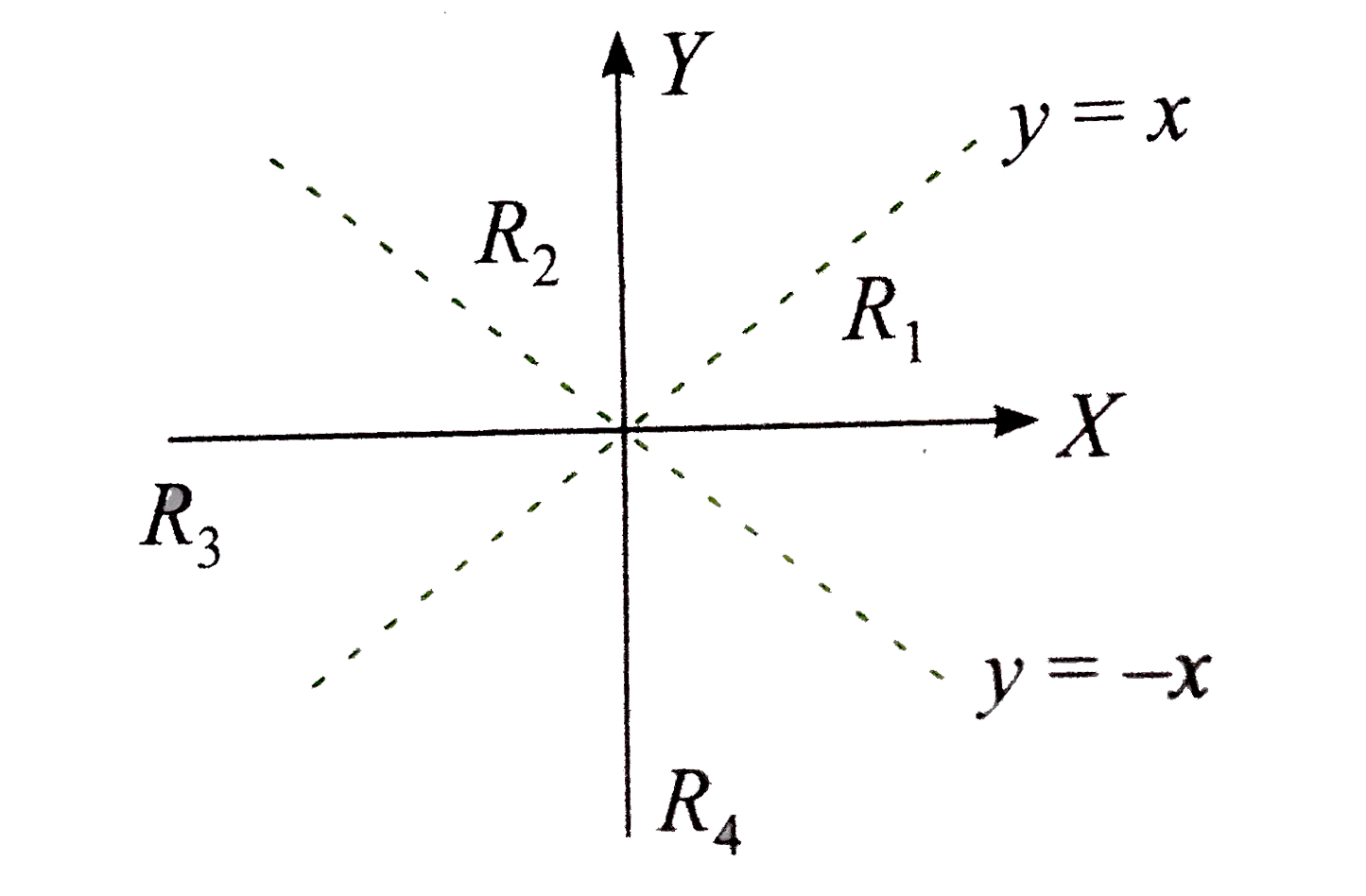
Now, let us consider the four regions, namely, `R_(1),R_(2), R_(3) " and " R_(4), " in the lines " L_(1) " and " L_(2)` dividing the coordinate plane.
`"In" R_(1)," we have " y lt x, y gt-x. "In " R_(2), " we have " y gt x, y gt -x. "Similarly,`
`"In" R_(3)," we have " y gt x, y lt-x. "Finally, in " R_(4), " we have " y lt x, y lt -x.`
Thus , for `R_(2),` (1) becomes.
`2sqrt(2) le x-y+x+y le 4sqrt(2) " or" sqrt(2) le x le 2sqrt(2)`
Similarly, for `R_(2)`, (1) becomes
`2sqrt(2) le y-x+x+y le 4sqrt(2) " or" sqrt(2) le y le 2sqrt(2)`
In `R_(3)` ,(1) will become
`2sqrt(2) le y-x-x-y le 4sqrt(2) " or" -sqrt(2) le x le -2sqrt(2)`
Finally, in `R_(4),` (1) will become
`2sqrt(2) le x-y-x-y le 4sqrt(2)`
`"or " -2sqrt(2) le y le -2sqrt(2)`
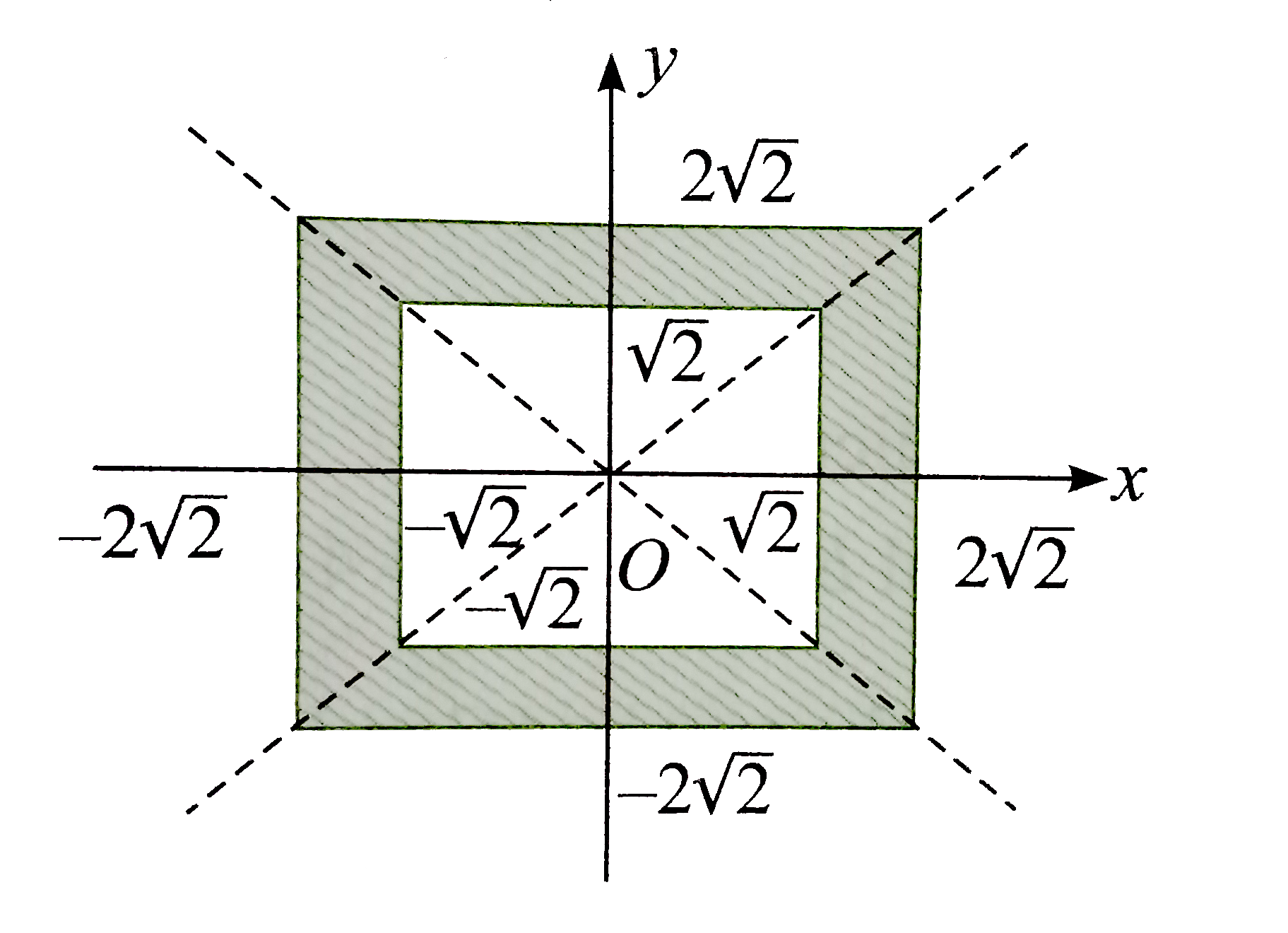
Thus region R will be the region between concentric squares formed by the lines `x=+-sqrt(2), y=+-sqrt(2) " and " x=+-2sqrt(2), y=+-2sqrt(2).`
Thus the required are is `(4sqrt(2))^(2)-(2sqrt(2))^(2) = 24` units.
Promotional Banner

Topper's Solved these Questions

  • STRAIGHT LINES

    CENGAGE|Exercise Exercise 2.1|23 Videos
  • STRAIGHT LINES

    CENGAGE|Exercise Exercise 2.2|4 Videos
  • STRAIGHT LINE

    CENGAGE|Exercise Multiple Correct Answers Type|8 Videos
  • THEORY OF EQUATIONS

    CENGAGE|Exercise JEE Advanced Previous Year|9 Videos

Similar Questions

Explore conceptually related problems

Consider two lines L_1a n dL_2 given by a_1x+b_1y+c_1=0a n da_2x+b_2y+c_2=0 respectively where c1 and c2 !=0, intersecting at point PdotA line L_3 is drawn through the origin meeting the lines L_1a n dL_2 at Aa n dB , respectively, such that PA=P B . Similarly, one more line L_4 is drawn through the origin meeting the lines L_1a n dL_2 at A_1a n dB_2, respectively, such that P A_1=P B_1dot Obtain the combined equation of lines L_3a n dL_4dot

If the point P(a^2,a) lies in the region corresponding to the acute angle between the lines 2y=x and 4y=x , then find the values of adot

If P is any point on the plane l x+m y+n z=pa n dQ is a point on the line O P such that O PdotO Q=p^2 , then find the locus of the point Qdot

If P is any point on the plane l x+m y+n z=pa n dQ is a point on the line O P such that O PdotO Q=p^2 , then find the locus of the point Qdot

For a point P in the plane, let d_1(P)a n dd_2(P) be the distances of the point P from the lines x-y=0a n dx+y=0 respectively. The area of the region R consisting of all points P lying in the first quadrant of the plane and satisfying 2lt=d_1(P)+d_2(P)lt=4, is

For a point P in the plane, let d_1(P)a n dd_2(P) be the distances of the point P from the lines x-y=0a n dx+y=0 respectively. The area of the region R consisting of all points P lying in the first quadrant of the plane and satisfying 2lt=d_1(P)+d_2(P)lt=4, is

A line intersects the straight lines 5x-y-4=0 and 3x-4y-4=0 at A and B , respectively. If a point P(1,5) on the line A B is such that A P: P B=2:1 (internally), find point Adot

Find the coordinates of the foot of the perpendicular drawn from the point P(1,-2) on the line y = 2x +1. Also, find the image of P in the line.

If the lines L_1a n dL_2 are tangents to 4x^2-4x-24 y+49=0 and are normals for x^2+y^2=72 , then find the slopes of L_1 and L_2dot

A line is a drawn from P(4,3) to meet the lines L_1 and l_2 given by 3x+4y+5=0 and 3x+4y+15=0 at points A and B respectively. From A , a line perpendicular to L is drawn meeting the line L_2 at A_1 Similarly, from point B_1 Thus a parallelogram AA_1 B B_1 is formed. Then the equation of L so that the area of the parallelogram AA_1 B B_1 is the least is (a) x-7y+17=0 (b) 7x+y+31=0 (c) x-7y-17=0 (d) x+7y-31=0

