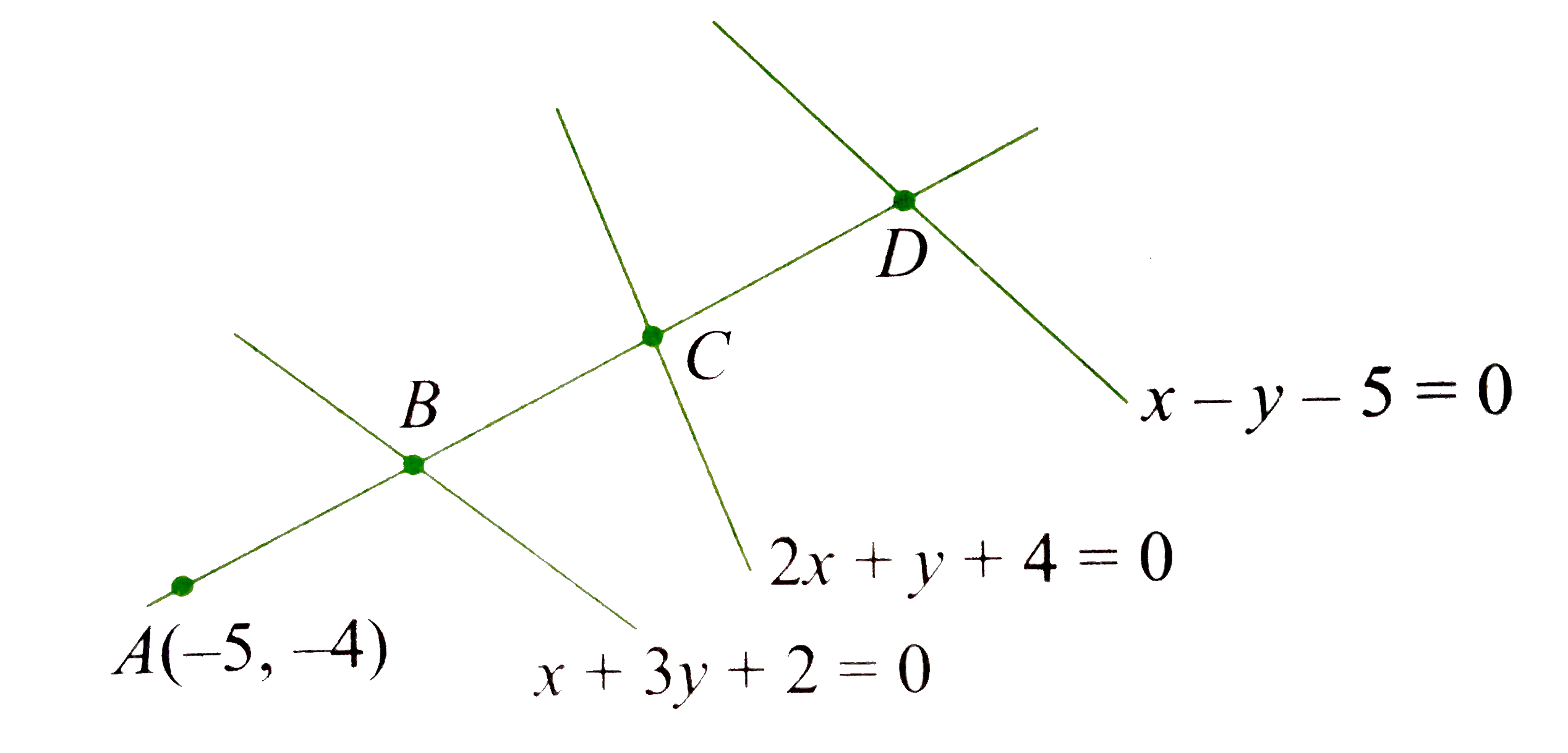
Let `theta` be the inclination of line through A(-5,-4).
Therefore, equation of this line is `(x+5)/("cos" theta) = (y+4)/("sin" theta) = r " " (1)`
Any point on this line at distance r from point A (-5,-4) is given by
`(-5 +r"cos" theta, -4 +r "sin" theta)`
` "If " AB=r_(1), AC=r_(2) "and " AD= r_(3), "then"`
`B(r_(1) "cos" theta -5, r_(1) "sin" theta-4)`
`C(r_(2) "cos" theta -5, r_(2) "sin" theta-4)`
`D(r_(3) "cos" theta -5, r_(3) "sin" theta-4)`
But B lies on x+3y+2 = 0. Therefore,
`r_(1) "cos"theta -5+3r_(1) "sin" theta -12+2=0`
`"or " (15)/("cos" theta + 3"sin" theta) = r_(1)`
`"or " (15)/(AB) = "cos" theta + 3"sin" theta " "` (1)
As C lies on 2x+y+4 = 0, we have
`2(r_(2) " cos" theta-5) + (r_(2) "sin" theta-4)+4=0`
`"or "r_(2) = (10)/(2" cos" theta + "sin" theta)=AC`
`"or " (10)/(AC) = 2" cos" theta + "sin" theta " " ` (2)
Similarly, D lies on x-y-5=0. Therefore,
`r_(3) "cos" theta-5-r_(3)" sin" theta+4-5=0`
`"or " r_(3) = (6)/( "cos" theta - sin" theta) =AD`
`"or " (6)/(AD) = "cos" theta - "sin" theta " " (3)`
Now, given that
`((15)/(AB))^(2) + ((10)/(AC))^(2) = ((6)/(AD))^(2)`
`"or " ("cos" theta+3 " sin" theta)^(2) + (2 "cos" theta+ "sin" theta)^(2) = ("cos" theta-"sin" theta)^(2) " " ["Using" (1), (2), "and" (3)]`
`"or " 4"cos"^(2) theta + 9"sin"^(2) theta + 12 "sin" theta "cos" theta = 0`
`"or " (2 "cos" theta +
3 "sin" theta)^(2) = 0`
`"or tan " theta = -(2)/(3)`
Hence, the equation of the required line is
`y+4 = -(2)/(3) (x+5)`
or 3y+12 = -2x-10
or 2x+3y+22=0


