Home
Class 12
MATHS
The line L1:""y""-""x""=""0 and L2:""2x"...

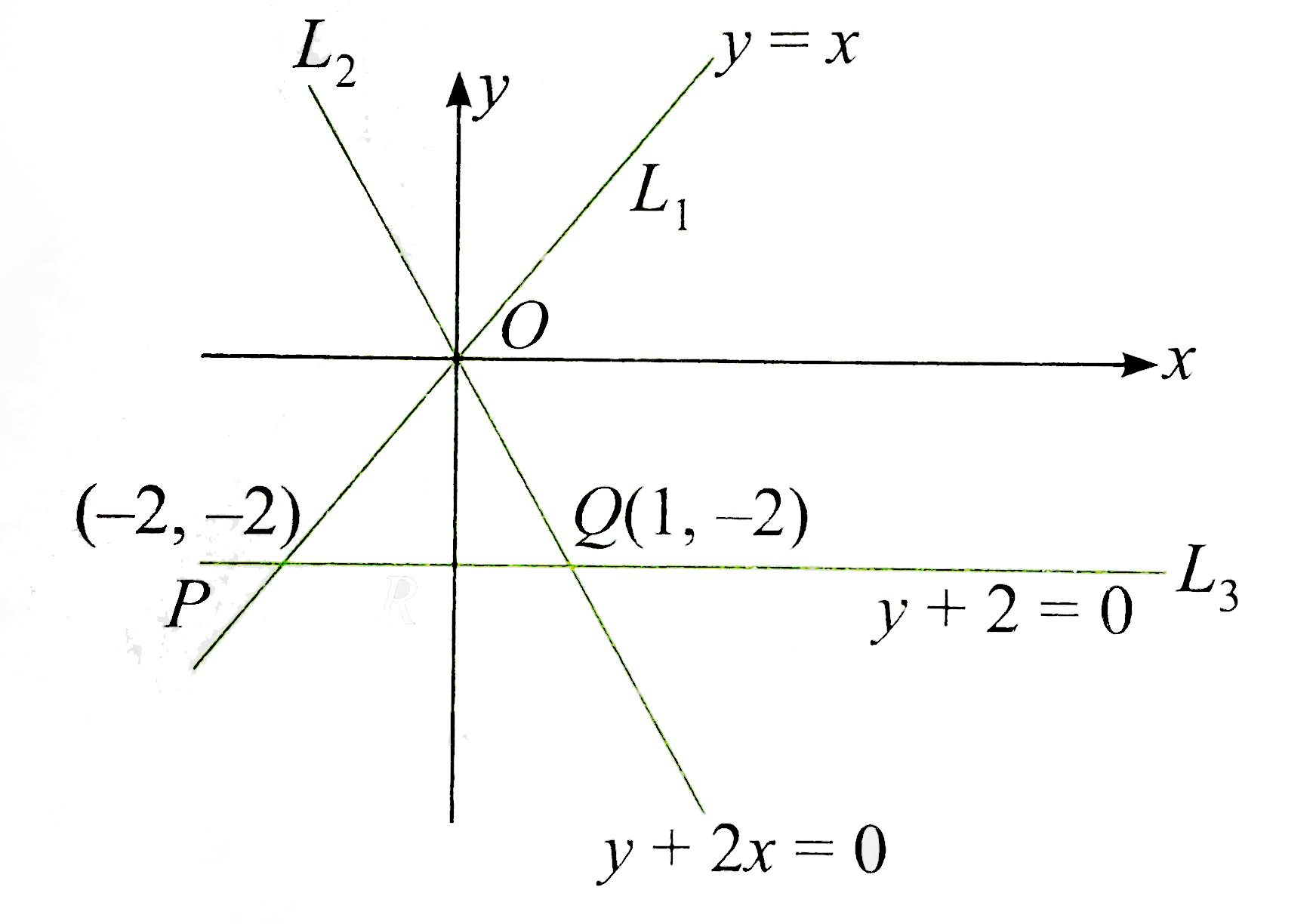
The line `L_1:""y""-""x""=""0` and `L_2:""2x""+""y""=""0` intersect the line `L_3:""y""+""2""=""0` at P and Q respectively. The bisector of the acute angle between `L_1` and `L_2` intersects `L_3` at R. Statement-1 : The ratio `P R"":""R Q` equals `2sqrt(2):""sqrt(5)` Statement-2 : In any triangle, bisector of an angle divides the triangle into two similar triangles. Statement-1 is true, Statement-2 is true ; Statement-2 is correct explanation for Statement-1 Statement-1 is true, Statement-2 is true ; Statement-2 is not a correct explanation for Statement-1 Statement-1 is true, Statement-2 is false Statement-1 is false, Statement-2 is true

A

Statement 1 is true, statement 2 is false.

B

Statement 1 is true, statement 2 is true, statement 2 is the correct explanation of statement1.

C

Statement 1 is true, statement 2 is true, statement 2 is not the correct explanation of statement 1.

D

Statement 1 is false, statement 2 is true.

Text Solution

Verified by Experts

The correct Answer is:
A

Draw lines on coordinate axes as shown here.

From the geometry of angle bisector,
`(PR)/(RQ) = (OP)/(OQ) = (2sqrt(2))/(sqrt(5))`
Promotional Banner

Topper's Solved these Questions

  • STRAIGHT LINES

    CENGAGE|Exercise JEE Advanced Previous Year|4 Videos
  • STRAIGHT LINES

    CENGAGE|Exercise Exercise (Numerical)|13 Videos
  • STRAIGHT LINE

    CENGAGE|Exercise Multiple Correct Answers Type|8 Videos
  • THEORY OF EQUATIONS

    CENGAGE|Exercise JEE Advanced Previous Year|9 Videos

Similar Questions

Explore conceptually related problems

Statement 1 : If -2h=a+b , then one line of the pair of lines a x^2+2h x y+b y^2=0 bisects the angle between the coordinate axes in the positive quadrant. Statement 2 : If a x+y(2h+a)=0 is a factor of a x^2+2h x y+b y^2=0, then b+2h+a=0 Both the statements are true but statement 2 is the correct explanation of statement 1. Both the statements are true but statement 2 is not the correct explanation of statement 1. Statement 1 is true and statement 2 is false. Statement 1 is false and statement 2 is true.

Four numbers are chosen at random (without replacement) from the set {1, 2, 3, ....., 20}. Statement-1: The probability that the chosen numbers when arranged in some order will form an AP Is 1/(85) . Statement-2: If the four chosen numbers from an AP, then the set of all possible values of common difference is {1, 2, 3, 4, 5}. (1) Statement-1 is true, Statement-2 is true; Statement-2 is not the correct explanation for Statement-1 (2) Statement-1 is true, Statement-2 is false (3) Statement-1 is false, Statement-2 is true (4) Statement-1 is true, Statement-2 is true; Statement-2 is the correct explanation for Statement-1

Consider: L_1:2x+3y+p-3=0 L_2:2x+3y+p+3=0 where p is a real number and C : x^2+y^2+6x-10 y+30=0 Statement 1 : If line L_1 is a chord of circle C , then line L_2 is not always a diameter of circle Cdot Statement 2 : If line L_1 is a a diameter of circle C , then line L_2 is not a chord of circle Cdot (A) Both the statement are True and Statement 2 is the correct explanation of Statement 1. (B) Both the statement are True but Statement 2 is not the correct explanation of Statement 1. (C) Statement 1 is True and Statement 2 is False. (D) Statement 1 is False and Statement 2 is True.

Statement 1: An equation of a common tangent to the parabola y^2=16sqrt(3)x and the ellipse 2x^2+""y^2=""4""i s""y""=""2x""+""2sqrt(3) . Statement 2: If the line y""=""m x""+(4sqrt(3))/m ,(m!=0) is a common tangent to the parabola y^2=""16sqrt(3)x and the ellipse 2x^2+""y^2=""4 , then m satisfies m^4+""2m^2=""24 . (1) Statement 1 is false, statement 2 is true (2) Statement 1 is true, statement 2 is true; statement 2 is a correct explanation for statement 1 (3) Statement 1 is true, statement 2 is true; statement 2 is not a correct explanation for statement 1 (4) Statement 1 is true, statement 2 is false

Given : A circle, 2x^2+""2y^2=""5 and a parabola, y^2=""4sqrt(5)""x . Statement - I : An equation of a common tangent to these curves is y="x+"sqrt(5) Statement - II : If the line, y=m x+(sqrt(5))/m(m!=0) is their common tangent, then m satisfies m^4-3m^2+""2""=0. (1) Statement - I is True; Statement -II is true; Statement-II is not a correct explanation for Statement-I (2) Statement -I is True; Statement -II is False. (3) Statement -I is False; Statement -II is True (4) Statement -I is True; Statement -II is True; Statement-II is a correct explanation for Statement-I

Statement 1: If vec A=2 hat i+3 hat j+6 hat k , vec B= hat i+ hat j-2 hat ka n d vec C= hat i+2 hat j+ hat k , then | vec Axx( vec Axx( vec Axx vec B)). vec C|=243 Statement 2: | vec Axx( vec Axx( vec Axx vec B)). vec C|=| vec A|^2|[ vec A vec B vec C]| a. Statement 1 and Statement 2 , both are true and Statement 2 is the correct explanation for Statement 1. b. Statement 1 and Statement 2 , both are true and Statement 2 is not the correct explanation for Statement 1. c. Statement 1 is true but Statement 2 is false. c. Statement 2 is true but Statement 1 is false.

Each question has four choices a,b,c and d out of which only one is correct. Each question contains Statement 1 and Statement 2. Make your answer as: If both the statements are true and Statement 2 is the correct explanation of statement 1. If both the statements are True but Statement 2 is not the correct explanation of Statement 1. If Statement 1 is True and Statement 2 is False. If Statement 1 is False and Statement 2 is True. Statement 1: tan5^0 is an irrational number Statement 2: tan15^0 is an irrational number.

Each question has four choices a,b,c and d out of which only one is correct. Each question contains Statement 1 and Statement 2. Make your answer as: If both the statements are true and Statement 2 is the correct explanation of statement 1. If both the statements are True but Statement 2 is not the correct explanation of Statement 1. If Statement 1 is True and Statement 2 is False. If Statement 1 is False and Statement 2 is True. Statement 1: sinpi/(18) is a root of 8x^3-6x+1=0 Statement 2: For any theta in R ,sin3theta=3sintheta-4sin^3theta

Statement 1: The direction cosines of one of the angular bisectors of two intersecting line having direction cosines as l_1,m_1, n_1a n dl_2, m_2, n_2 are proportional to l_1+l_2,m_1+m_2, n_1+n_2 Statement 2: The angle between the two intersection lines having direction cosines as l_1,m_1, n_1a n dl_2, m_2, n_2 is given by costheta=l_1l_2+m_1m_2+n_1n_2 (a) Statement 1 and Statement 2, both are correct. Statement 2 is the correct explanation for Statement 1. (a) Statement 1 and Statement 2, both are correct. Statement 2 is not the correct explanation for Statement 1. (c) Statement 1 is correct but Statement 2 is not correct. (d) Statement 2 is correct but Statement 1 is not correct.

Each question has four choices a,b,c and d out of which only one is correct. Each question contains Statement 1 and Statement 2. Make your answer as: If both the statements are true and Statement 2 is the correct explanation of statement 1. If both the statements are True but Statement 2 is not the correct explanation of Statement 1. If Statement 1 is True and Statement 2 is False. If Statement 1 is False and Statement 2 is True. Statement 1: The minimum value of 27^(cos2x)81^(sin2x) is 1/(243) Statement 2: The minimum value of acostheta+bsinthetai s-sqrt(a^2+b^2)

