Home
Class 12
MATHS
Two sides of a rhombus are along the lin...

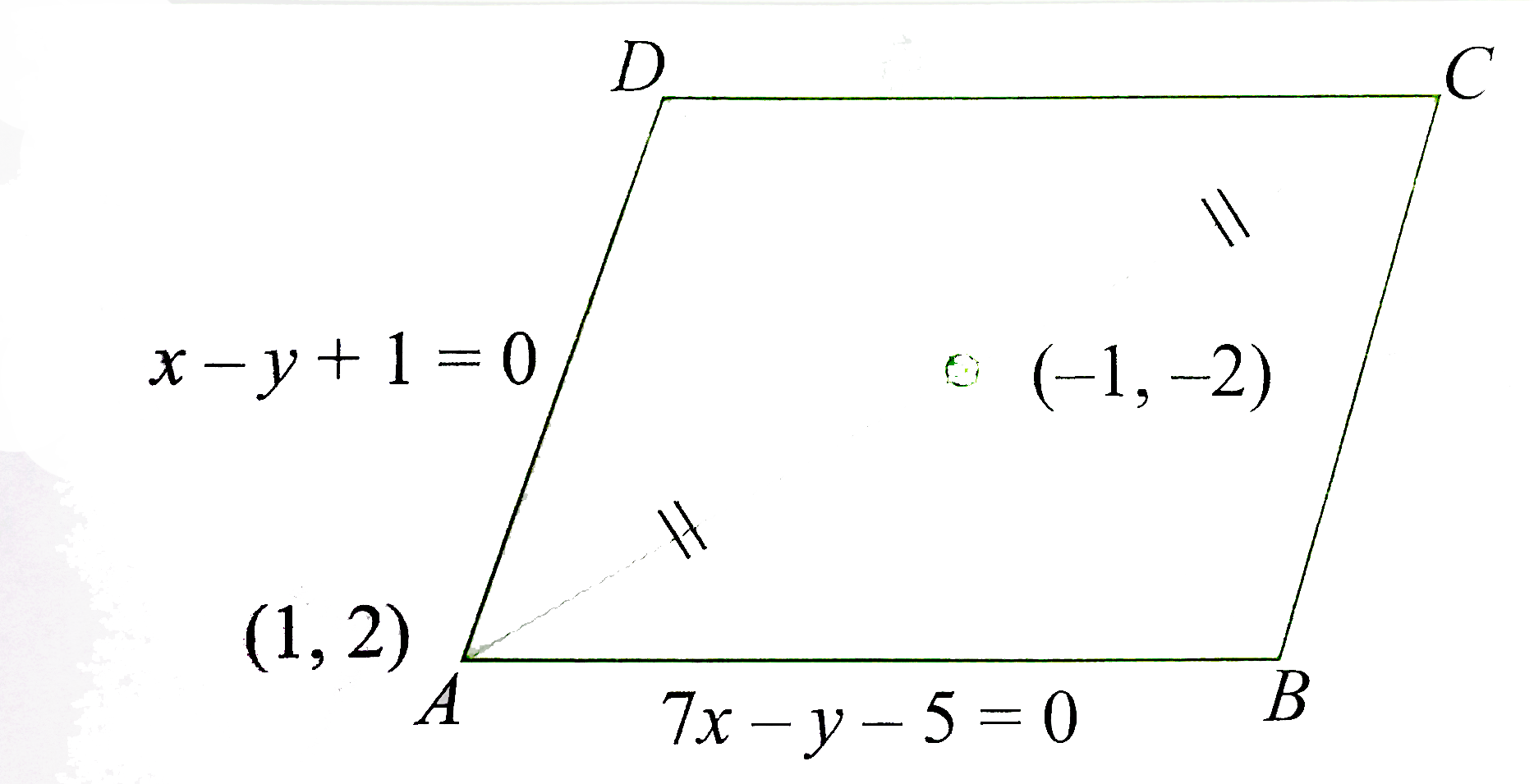
Two sides of a rhombus are along the lines,`x-y+1=0` and `7x-y-5=0` . If its diagonals intersect at `(-1,-2)` , then which one of the following is a vertex of this rhombus ? (1) `(-3,-9)` (2) `(-3,-8)` (3) `(1/3,-8/3)` (4) `(-(10)/3,-7/3)`

A

(-3, -8)

B

`((1)/(3), -(8)/(3))`

C

`((-(10)/(3), -(7)/(3))`

D

(-3, -9)

Text Solution

Verified by Experts

The correct Answer is:
B


On solving equation of AB and AD, vertex A(1, 2)
`because (-1, -2) " is midpoint of " AC, " vertex C is " (-3, -6).`
Line BC is parallel to AD passing through point C, hence its equation is x-y-3 =0
Line DC is parallel to AB passing through ponit C, hence its equation is 7x-y+15=0
Hence other vertices are
`B((1)/(3), -(8)/(3)) " and "D(-(7)/(3), -(4)/(3))`
Promotional Banner

Topper's Solved these Questions

  • STRAIGHT LINES

    CENGAGE|Exercise JEE Advanced Previous Year|4 Videos
  • STRAIGHT LINES

    CENGAGE|Exercise Exercise (Numerical)|13 Videos
  • STRAIGHT LINE

    CENGAGE|Exercise Multiple Correct Answers Type|8 Videos
  • THEORY OF EQUATIONS

    CENGAGE|Exercise JEE Advanced Previous Year|9 Videos

Similar Questions

Explore conceptually related problems

Two sides of a rhombus ABCD are parallel to the lines y = x + 2 and y = 7x + 3 If the diagonals of the rhombus intersect at the point (1, 2) and the vertex A is on the y-axis, then vertex A can be

The sides of a rhombus are parallel to the lines x+y-1=0 and 7x-y-5=0. It is given that the diagonals of the rhombus intersect at (1, 3) and one vertex, A of the rhombus lies on the line y=2x . Then the coordinates of vertex A are (8/5,(16)/5) (b) (7/(15),(14)/(15)) (6/5,(12)/5) (d) (4/(15),8/(15))

Let X ={ 1,2,3,4,5} and Y= {1,3,5,7,9} which of the following is not a relation from X to Y ?

If the two sides of rhombus are x+2y+2=0 and 2x+y-3=0, then find the slope of the longer diagonal.

One side of a rectangle lies along the line 4x+7y+5=0. Two of its vertices are (-3,1)a n d(1,1)dot Find the equations of the other three sides.

Distance of point (2,3) from the line 2x-3y+9=0 along x-y+1=0

Two equal sides of an isosceles triangle are given by 7x-y+3=0 and x+y=3 , and its third side passes through the point (1,-10) . Find the equation of the third side.

One diagonal of a square is 3x-4y+8=0 and one vertex is (-1,1), then the area of square is

State which of the following sets are disjoint. X = {1, 3, 5, 7, 9}, Y = {0, 2, 4, 6, 8, 10}

The point (8,-9) with respect to the lines 2x+3y-4=0 and 6x+9y+8=0 lies on the same side of the lines the different sides of the line one of the line none of these

