Home
Class 12
MATHS
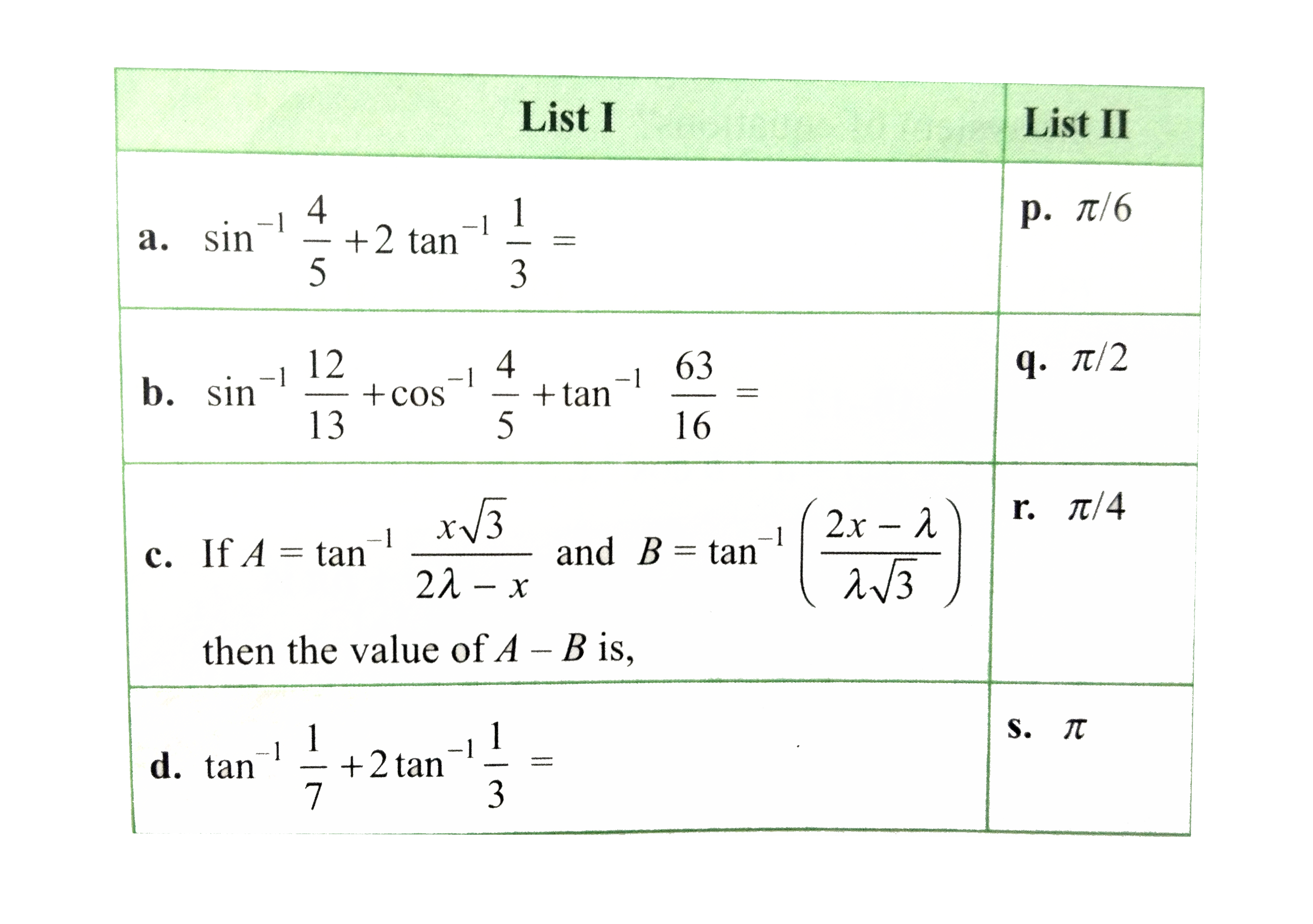
Match the following List I to List II...

Match the following List I to List II

Text Solution

Verified by Experts

The correct Answer is:

`a rarr q; b rarr s; c rarr p; d rarr r`

(a) `sin^(-1).(4)/(5) = tan^(-1).(4)/(3)`
`2 tan^(-1).(1)/(3) = tan^(-1).(3)/(4) = cot^(-1).(4)/(3)`
and `tan^(-1)x + cot^(-1) x = (pi)/(2)`
(b) `tan^(-1).(12)/(5) + tan^(-1).(3)/(4) + tan^(-1).(63)/(16)`
`= pi + tan^(-1).(48 + 15)/(20 - 36) + tan^(-1).(63)/(16)`
`= pi - tan^(-1).(63)/(16) + tan^(-1).(63)/(16) = pi`
(c) `A = tan^(-1).(x sqrt3)/(2 lamda -x) and B = tan^(-1) ((2x - lamda sqrt3))`
Now, `tan (A - B) = (tan A - tan B)/(1 + tan A and B)`
`=((x sqrt3)/(2 lamda-x) - (2x - lamda)/(lamdasqrt3))/(1+(x sqrt3)/(2 lamda -x) (2 x - lamda)/(lamdasqrt3))`
`=(3x lamda + (2x - lamda)(x - 2lamda))/(sqrt3[lamda(2lamda -x) + x (2x - lamda)])`
`=(1)/(sqrt3) [(2x^(2) -2 lamda x + 2 lamda^(2))/(2x^(2) -2 lamda x + 2 lamda^(2))]`
`=(1)/(sqrt3) = tan.(pi)/(6)`
`:. A -B = (pi)/(6)`
(d) `tan^(-1).(1)/(7) + 2 tan^(-1).(1)/(3) = tan^(-1).(1)/(7) + tan^(-1).(2(1)/(3))/(1-(1)/(9))`
`= tan^(-1).(1)/(7) + tan^(-1).(3)/(4)`
`= tan^(-1).((1)/(7) + (3)/(4))/(1-(1)/(7) (3)/(4))`
`= tan^(-1) 1`
`=(pi)/(4)`
Promotional Banner

Topper's Solved these Questions

  • INTRODUCTION TO VECTORS

    CENGAGE|Exercise JEE Previous Year|20 Videos
  • JEE 2019

    CENGAGE|Exercise Chapter 10|9 Videos

Similar Questions

Explore conceptually related problems

Match the following lists :

Match the following lists :

Match the following lists :

Match the following lists :

Match the following lists :

Match the following lists :

Match the following lists :

Match the following lists:

Match the following lists:

Match the following lists:

CENGAGE-INVERSE TRIGONOMETRIC FUNCTIONS-All Questions
  1. Find the principal value of sin^(-1) (1/2)

    Text Solution

    |

  2. The value of int(-(pi)/(2)) ^((pi)/(2)) sin^(2) x cos x dx is

    Text Solution

    |

  3. Match the following List I to List II

    Text Solution

    |

  4. Find the area of the triangle formed by the points A(0, – 1), B(– 2, ...

    Text Solution

    |

  5. Match the following :

    Text Solution

    |

  6. Match the following List I to List II

    Text Solution

    |

  7. Match the following List I to List II

    Text Solution

    |

  8. The solution set of inequality (cot^(-1)x)(tan^(-1)x)+(2-pi/2),cot^(-1...

    Text Solution

    |

  9. If x=sin^(-1)(a^6+1)+cos^(-1)(a^4+1)-tan^(-1)(a^2+1),a in R , then th...

    Text Solution

    |

  10. If the roots of the equation x^(3) -10 x + 11 = 0 are u, v, and w, the...

    Text Solution

    |

  11. The number of values of x for which sin^(-1)(x^2-(x^4)/3+(x^6)/9)+cos^...

    Text Solution

    |

  12. If the domain of the function f(x) = sqrt(3 cos^(-1) (4x) - pi) is [a,...

    Text Solution

    |

  13. If tan^(-1)(x+3/x)-tan^(-1)(x-3/x)=tan^(-1)6/x , then the value of x^4...

    Text Solution

    |

  14. If range of function f(x)=sin^(-1)x+2tan^(-1)x+x^2+4x+1 is [p , q], th...

    Text Solution

    |

  15. The value of "tan"(sin^(-1)("cos"(sin^(-1)x)))"tan"(cos^(-1)(sin(cos^(...

    Text Solution

    |

  16. If the area enclosed by the curves f(x) = cos^(-1) (cos x) and g(x) = ...

    Text Solution

    |

  17. Absolute value of sum of all integers in the domain of f(x)=cot^(-1)sq...

    Text Solution

    |

  18. The least value of (1+sec^(-1)x)(1+c a s^(-1)x) is

    Text Solution

    |

  19. Let cos^(-1)(x)+cos^(-1)(2x)+cos^(-1)(3x)b epidot If x satisfies the e...

    Text Solution

    |

  20. The number of integral values of x satisfying the equation tan^(-1) (3...

    Text Solution

    |
