Home
Class 12
MATHS
If the points (a ,0),(b ,0),(0, c)a n d(...

If the points `(a ,0),(b ,0),(0, c)a n d(0, d)` are concyclic `(a , b , c , d >0)` , then prove that `a b=c ddot`

Text Solution

Verified by Experts
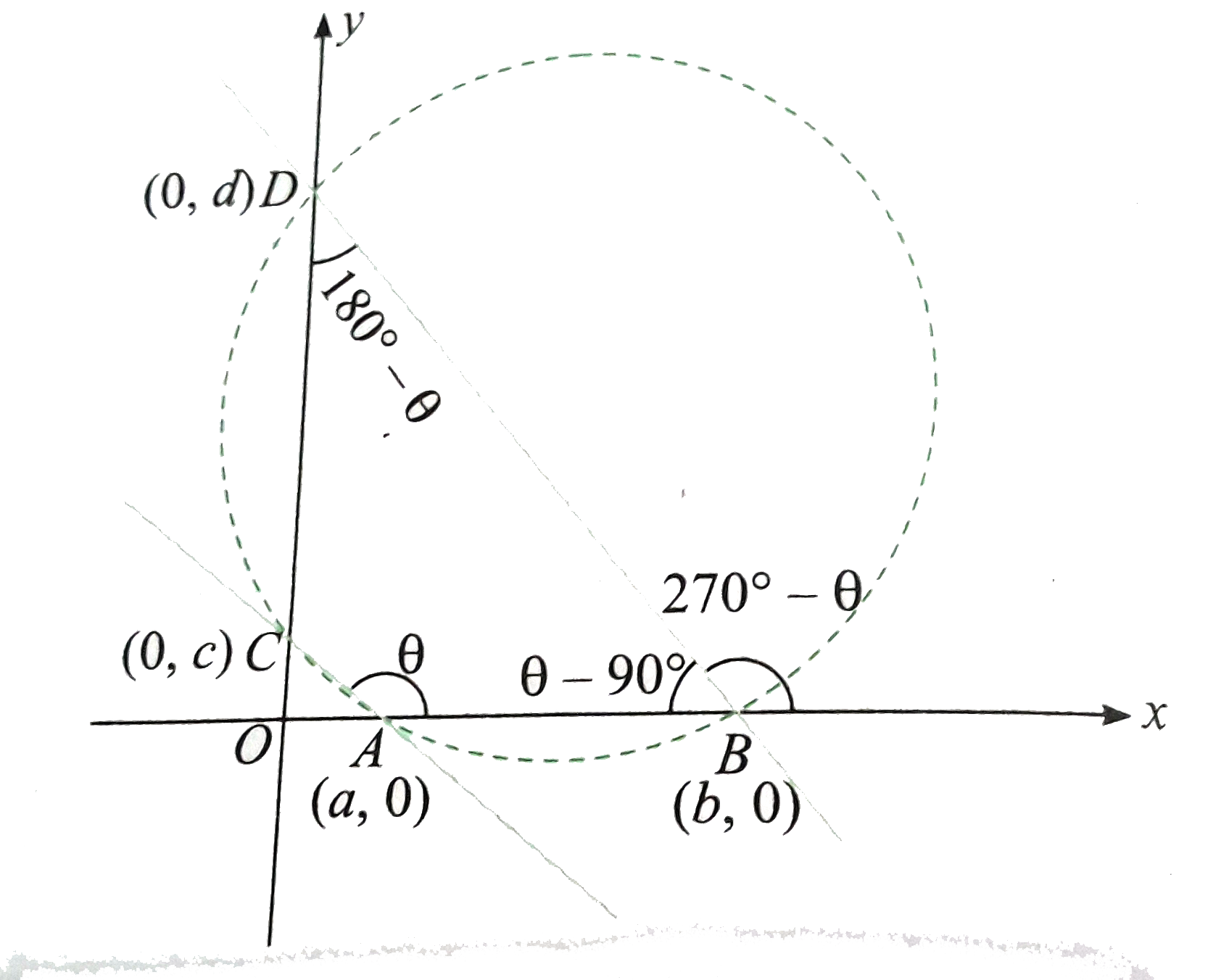
Without loss of generality, assume that `bgtaanddgtc`. SinceABCD is cyclic quadrilateral, sum of oppsite angles is `180^@`.

i.e., `angle BAC+ angle CDB=180^@`
Let ` angleBAC=theta` (=inclination of line AC)
`therefore angle CDB=180^@-theta`
Therefore, inclination of line BD is `270^@-theta` slope of line AC.
`tantheta=-(c)/(a)`
Slope of `BD, tan (270^@-theta)=-(d)/(b)`
or `cot theta=-(d)/(b)`
From (1) and (2), we get
`(tantheta)(cottheta)=(-(c)/(a))(-(d)/(b))`
or `ab=cd`
Promotional Banner

Topper's Solved these Questions

  • COORDINATE SYSYEM

    CENGAGE|Exercise Exercise 1.1|6 Videos
  • COORDINATE SYSYEM

    CENGAGE|Exercise Exercise 1.2|8 Videos
  • COORDINATE SYSTEM

    CENGAGE|Exercise Multiple Correct Answers Type|2 Videos
  • CROSS PRODUCTS

    CENGAGE|Exercise DPP 2.2|13 Videos

Similar Questions

Explore conceptually related problems

If the points (a, 0), (b,0), (0, c) , and (0, d) are concyclic (a, b, c, d > 0) , then prove that ab = cd .

Statement 1 : Points A(1,0),B(2,3),C(5,3),a n dD(6,0) are concyclic. Statement 2 : Points A , B , C ,a n dD form an isosceles trapezium or A Ba n dC D meet at Edot Then E A. E B=E C.E D dot

If the segments joining the points A(a , b)a n d\ B(c , d) subtends an angle theta at the origin, prove that : costheta=(a c+b d)/sqrt((a^2+b^2)(c^2+d^2))

y^(2)=4xandy^(2)=-8(x-a) intersect at points A and C. Points O(0,0), A,B (a,0), and c are concyclic. Tangents to the parabola y^(2)=4x at A and C intersect at point D and tangents to the parabola y^(2)=-8(x-a) intersect at point E. Then the area of quadrilateral DAEC is

Given four points A(2, 1, 0), B(1, 0, 1), C(3, 0, 1) and D(0, 0, 2) . Point D lies on a line L orthogonal to the plane determined by the points A, B and C. The equation of the plane ABC is

Given four points A(2, 1, 0), B(1, 0, 1), C(3, 0, 1) and D(0, 0, 2) . Point D lies on a line L orthogonal to the plane determined by the points A, B and C. The equation of the line L is

Given four points A(2, 1, 0), B(1, 0, 1), C(3, 0, 1) and D(0, 0, 2) . Point D lies on a line L orthogonal to the plane determined by the points A, B and C.

Let A=[(2,1),(0,3)] be a matrix. If A^(10)=[(a,b),(c,d)] then prove that a+d is divisible by 13.

If a circle passes through the point (0,0),(a ,0)a n d(0, b) , then find its center.

If A ,B ,C ,D are angles of a cyclic quadrilateral, then prove that cos A+cos B+cos C+cos D=0

