Home
Class 12
MATHS
Let A B C D be a rectangle and P be any ...

Let `A B C D` be a rectangle and `P` be any point in its plane. Show that `A P^2+P C^2=P B^2+P D^2dot`

Text Solution

Verified by Experts

The correct Answer is:
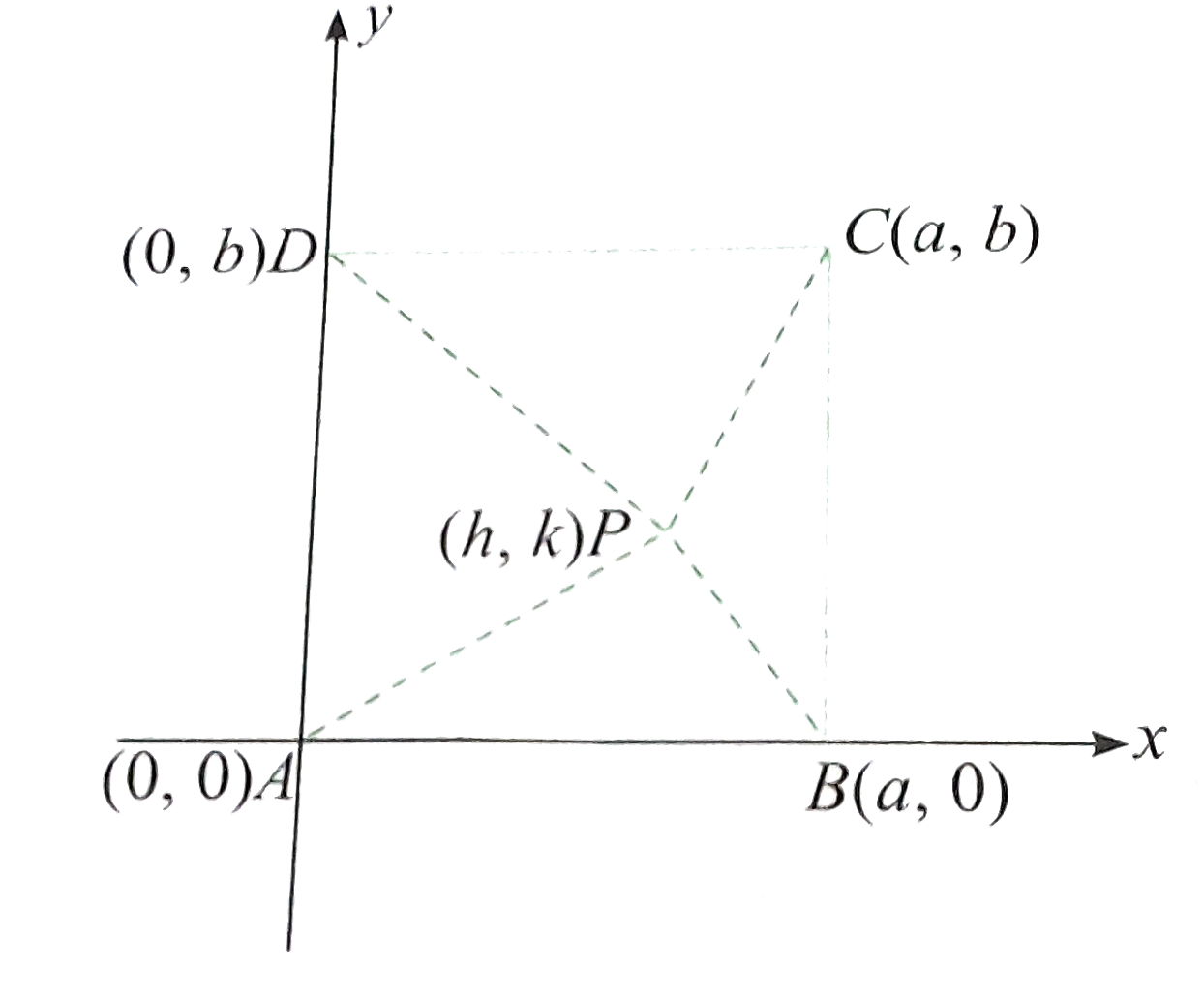
NA

Let `A-=(0,0),B-=(a,0),C-=(a,b)and D-=(0,b)`
Let point P be (h,k).

`therefore PA^2+PC^2=(h-0)^2+(k-0)^2+(h-a)^2+(k-b)^2=2h^2+2k^2-2k^2-2ah-2bk+a^2+b^2`
Also, `PB^2+PD^2=(h-a)^2+(k-0)^2+(h-0)^2+(k-b)^2=2h^2+2k^2-2ah-2bk+a^2+b^2`
Thus, `PA^2+PC^2=PB^2+PD^2`
Promotional Banner

Topper's Solved these Questions

  • COORDINATE SYSYEM

    CENGAGE|Exercise Exercise 1.3|10 Videos
  • COORDINATE SYSYEM

    CENGAGE|Exercise Exercise 1.4|8 Videos
  • COORDINATE SYSYEM

    CENGAGE|Exercise Exercise 1.1|6 Videos
  • COORDINATE SYSTEM

    CENGAGE|Exercise Multiple Correct Answers Type|2 Videos
  • CROSS PRODUCTS

    CENGAGE|Exercise DPP 2.2|13 Videos

Similar Questions

Explore conceptually related problems

Let ABC is be a fixed triangle and P be veriable point in the plane of triangle ABC. Suppose a,b,c are lengths of sides BC,CA,AB opposite to angles A,B,C, respectively. If a(PA)^(2) +b(PB)^(2)+c(PC)^(2) is minimum, then point P with respect to DeltaABC is

Let A (-2,2)and B (2,-2) be two points AB subtends an angle of 45^@ at any points P in the plane in such a way that area of Delta PAB is 8 square unit, then number of possibe position(s) of P is

ABC is a triangle and P any point on BC. if vec P Q is the sum of vec A P + vec P B + vec P C , show that ABPQ is a parallelogram and Q , therefore , is a fixed point.

The coordinates of A ,B ,C are (6,3),(-3,5),(4,-2) , respectively, and P is any point (x ,y) . Show that the ratio of the area of P B C to that of A B C is (|x+y-2|)/7dot

If the angles A,B,C of a triangle are in A.P. and sides a,b,c, are in G.P., then prove that a^2, b^2,c^2 are in A.P.

In a triangle A B C ,Da n dE are points on B Ca n dA C , respectivley, such that B D=2D Ca n dA E=3E Cdot Let P be the point of intersection of A Da n dB Edot Find B P//P E using the vector method.

For any sets A and B, show that P ( A ∩ B ) = P ( A ) ∩ P ( B ) .

Let C_1 and C_2 be parabolas x^2 = y - 1 and y^2 = x-1 respectively. Let P be any point on C_1 and Q be any point C_2 . Let P_1 and Q_1 be the reflection of P and Q, respectively w.r.t the line y = x then prove that P_1 lies on C_2 and Q_1 lies on C_1 and PQ >= [P P_1, Q Q_1] . Hence or otherwise , determine points P_0 and Q_0 on the parabolas C_1 and C_2 respectively such that P_0 Q_0 <= PQ for all pairs of points (P,Q) with P on C_1 and Q on C_2

Let A,B,C be any three mutually exclusive and exhaustive events such that P(B)=(3)/(2)P(A) and P(C)=(1)/(2)P(B) . Find P(A) .

If P is any arbitrary point on the circumcirlce of the equllateral trangle of side length l units, then | vec P A|^2+| vec P B|^2+| vec P C|^2 is always equal to 2l^2 b. 2sqrt(3)l^2 c. l^2 d. 3l^2

