Home
Class 12
MATHS
A particle p moves from the point A(0,4)...

A particle `p` moves from the point `A(0,4)` to the point `10 ,-4)` . The particle `P` can travel the upper-half plane `{(x , y)|yge0}` at the speed of `1m//s` and the lower-half plane `{(x , y)|ylt=0}` at the speed of 2 m/s. The coordinates of a point on the x-axis, if the sum of the squares of the travel times of the upper- and lower-half planes is minimum, are (a)(1, 0) (b) (2, 0) (c) (4, 0) (d) (5, 0)

A

(1,0)

B

(2,0)

C

(4,0)

D

(5,0)

Text Solution

Verified by Experts

The correct Answer is:
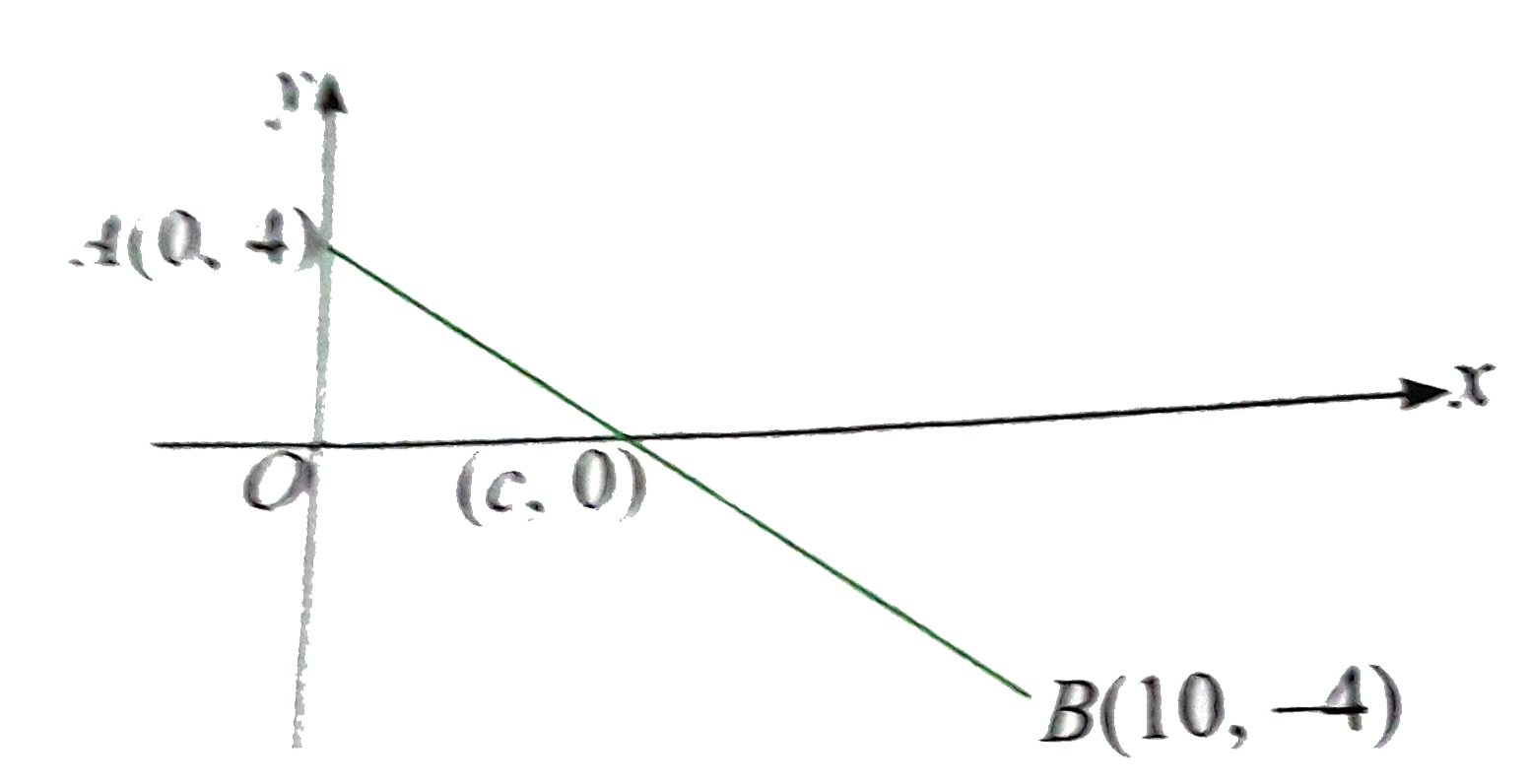
B

Let the point on the the axis be (c,0). Sum of the square of travel times is

`T=((sqrt(c^2+16))/(1))^2+(sqrt((10-c)^2+16)/(2))^2`
`=c^2+16+(116+c^2-20c)/(4)`
`=(5)/(4)c^2-5c+45=(5)/(4)(c^2-4c+36)`
Therefore, T is minimum at `c=2`.
Promotional Banner

Topper's Solved these Questions

  • COORDINATE SYSYEM

    CENGAGE|Exercise Exercise (Multiple)|13 Videos
  • COORDINATE SYSYEM

    CENGAGE|Exercise Exercise (Comprehension)|10 Videos
  • COORDINATE SYSYEM

    CENGAGE|Exercise Exercise 1.6|9 Videos
  • COORDINATE SYSTEM

    CENGAGE|Exercise Multiple Correct Answers Type|2 Videos
  • CROSS PRODUCTS

    CENGAGE|Exercise DPP 2.2|13 Videos

Similar Questions

Explore conceptually related problems

then image of the point (-1,3,4) in the plane x-2y=0

Find the locus of a point, the sum of squares of whose distance from the planes x-z=0,x-2y+z=0 and x+y+z=0 is 36

Find the locus of a point, the sum of squares of whose distance from the planes x-z=0,x-2y+z=0a n dx+y+z=0i s36 .

Find the equation of the image of the plane x-2y+2z-3=0 in plane x+y+z-1=0.

Find the distance of the z-axis from the image of the point M(2-3,3) in the plane x-2y-z+1=0.

If the distance of the point (1,1,1) from the origin is half of its distance from the plane x + y + z + k = 0, then the value of k are

If the perpendicular distance of a point A, other than the origin from the plane x + y + z = p is equal to the distance of the plane from the origin, then the coordinates of A are (A) (p,2p,0) (B) (0,2p,-p) (C) (2p,p,-p) (D) (2p,-p,2p)

Find the coordinates of the foot of the perpendicular P from the origin to the plane 2x-3y+4z-6=0

The number of integral values of m for which the x-coordinate of the point of intersection of the lines 3x+4y=9 and y=m x+1 is also an integer is (a)2 (b) 0 (c) 4 (d) 1

The staight line passing through the point (1,0,-2) and perpendicular to the plane x-2y+5z-7=0 is

CENGAGE-COORDINATE SYSYEM -Exercise (Single)
  1. about to only mathematics

    Text Solution

    |

  2. Which of the following sets of points form an equilateral triangle? (a...

    Text Solution

    |

  3. A particle p moves from the point A(0,4) to the point 10 ,-4) . The pa...

    Text Solution

    |

  4. if x(1),x(2),x(3) as well as y(1),y(2),y(3) are in G.P. with same co...

    Text Solution

    |

  5. O P Q R is a square and M ,N are the middle points of the sides P Qa n...

    Text Solution

    |

  6. A straight line passing through P(3,1) meets the coordinate axes at Aa...

    Text Solution

    |

  7. Let A-=(3,-4),B-=(1,2)dot Let P-=(2k-1,2k+1) be a variable point such ...

    Text Solution

    |

  8. The polar coordinates equivalent to (-3,sqrt3) are

    Text Solution

    |

  9. If the point (x1+t(x2-x1),y1+t(y2-y1)) divides the join of (x1,y1) and...

    Text Solution

    |

  10. P and Q are points on the line joining A(-2,5) and B(3,1) such that A ...

    Text Solution

    |

  11. In triangle ABC, angle B is right angled, AC=2 and A(2,2), B(1,3) then...

    Text Solution

    |

  12. One vertex of an equilateral triangle is (2,2) and its centroid is (-2...

    Text Solution

    |

  13. ABCD is a rectangle with A(-1,2),B(3,7) and AB:BC=4:3. If P is the cen...

    Text Solution

    |

  14. If (2,-3), (6,-5) and (-2,1) are three consecutive vetcies of a rohomb...

    Text Solution

    |

  15. If A and B are square matrix of same order then (A-B)^(T) is:

    Text Solution

    |

  16. Le n be the number of points having rational coordinates equidistant ...

    Text Solution

    |

  17. Draw a triangle ABC of base BC = 5.6 cm, angle A = 40^(@) and the bise...

    Text Solution

    |

  18. If A(0, 0), B(1, 0) and C(1/2,sqrt(3)/2) then the centre of the circle...

    Text Solution

    |

  19. Statement 1: If in a triangle, orthocentre, circumcentre and centroid ...

    Text Solution

    |

  20. about to only mathematics

    Text Solution

    |

