Find the area bounded by (i) y`=log""_(e)|x|andy=0` (ii) `y=|log""_(e)|x||andy=0`
Text Solution
Verified by Experts
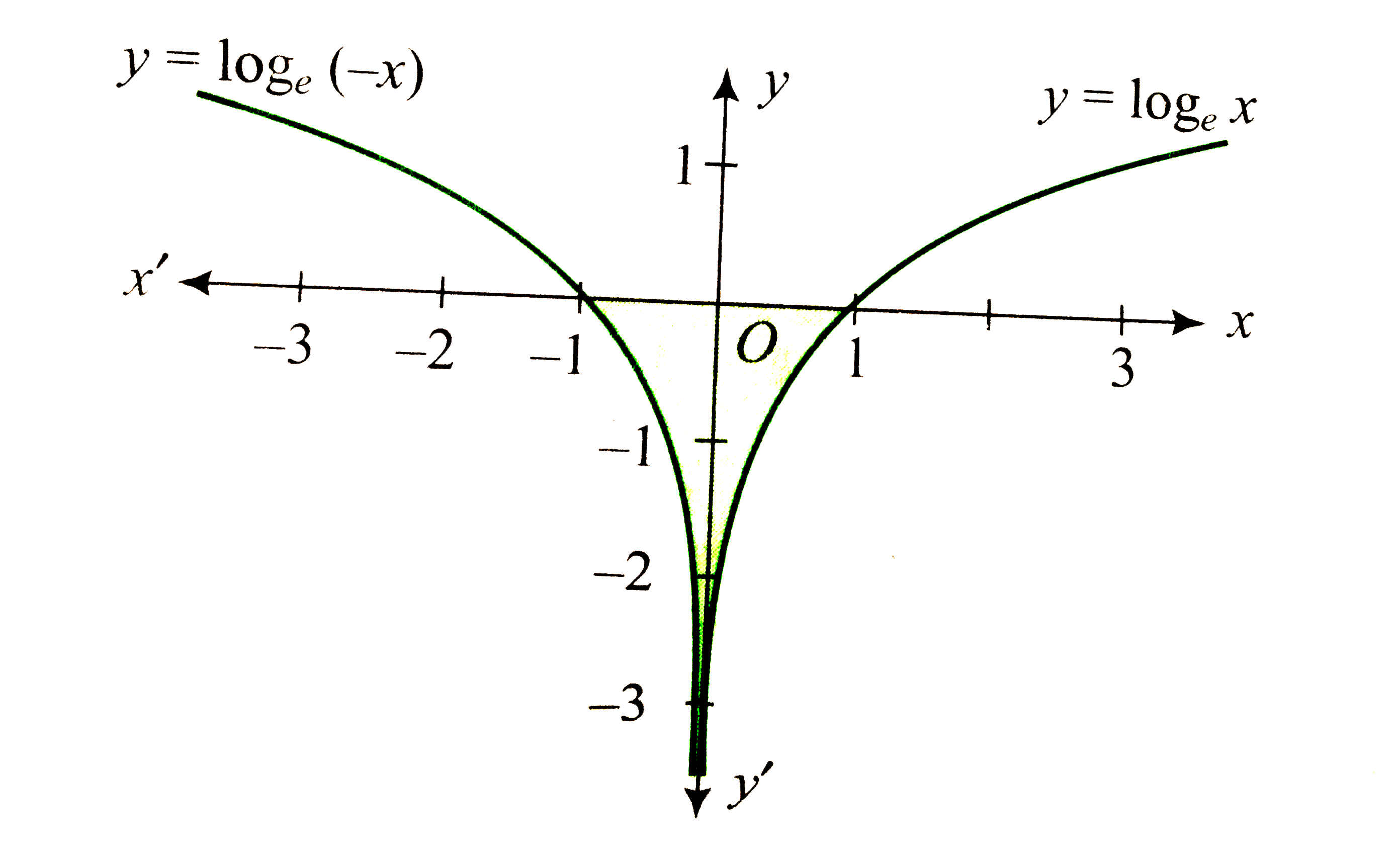
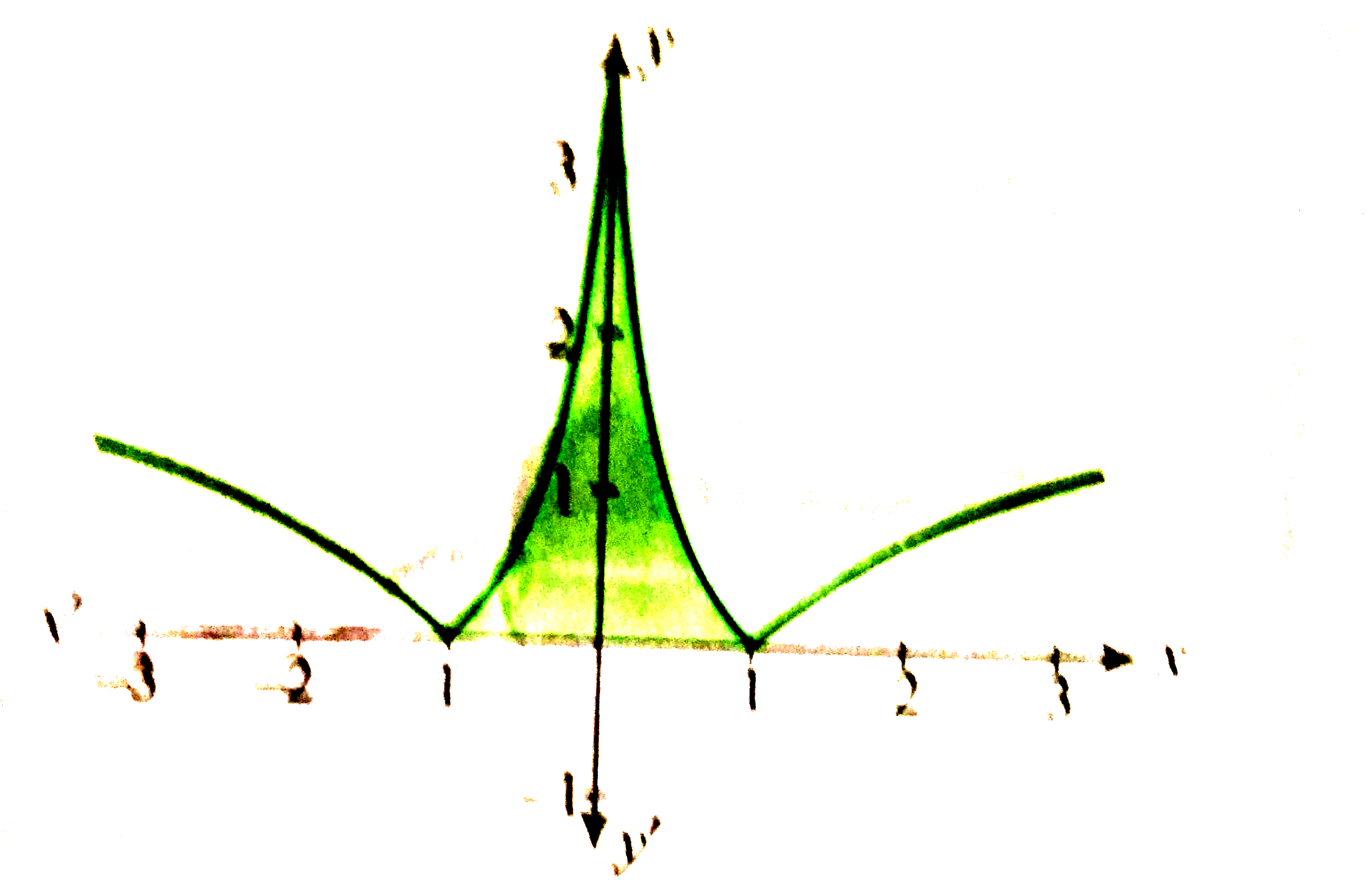
(i) y`=log""_(e)|x|andy=0` From the figure, required area = area of the shaded region = 1 + 1 =2 sq. units (as we know that area bounded by `y=log_(e)x, x= 0 and y= 0` is 1 sq. units) (ii) `y=|log""_(e)|x||andy=0` From the figure, Required area = Area of the shaded region = 1 + 1 =2 sq. units.
Topper's Solved these Questions
AREA
CENGAGE|Exercise Exercise 9.1|9 Videos
AREA
CENGAGE|Exercise Exercise 9.2|14 Videos
APPLICATIONS OF DERIVATIVES
CENGAGE|Exercise Subjective Type|2 Videos
AREA UNDER CURVES
CENGAGE|Exercise Question Bank|10 Videos
Similar Questions
Explore conceptually related problems
Find the area bounded by the curves x+2|y|=1 and x=0 .
The area bounded by the curve y=x(1-log_(e)x) and x-axis is
Compute the area of the region bounded by the curves y=e x(log_e x) and y=(log_e x)/(e x)
Find the area enclosed by the graph of y=log_(e)(x+1), y-axis, and the line y=1
Draw the graph of y = log_(e) (sin x).
The area bounded by the curves xsqrt3+y=2log_(e)(x-ysqrt3)-2log_(e)2, y=sqrt3x, y=-(1)/(sqrt3)x+2, is
Find the derivative of y = x ln^3 x .
Draw the graph of y=1/(log_(e)x)
Find the area enclosed between the curves: y = log_e (x + e) , x = log_e (1/y) & the x-axis.
The area of the region bounded by the curve y=e^(x) and lines x=0 and y=e is