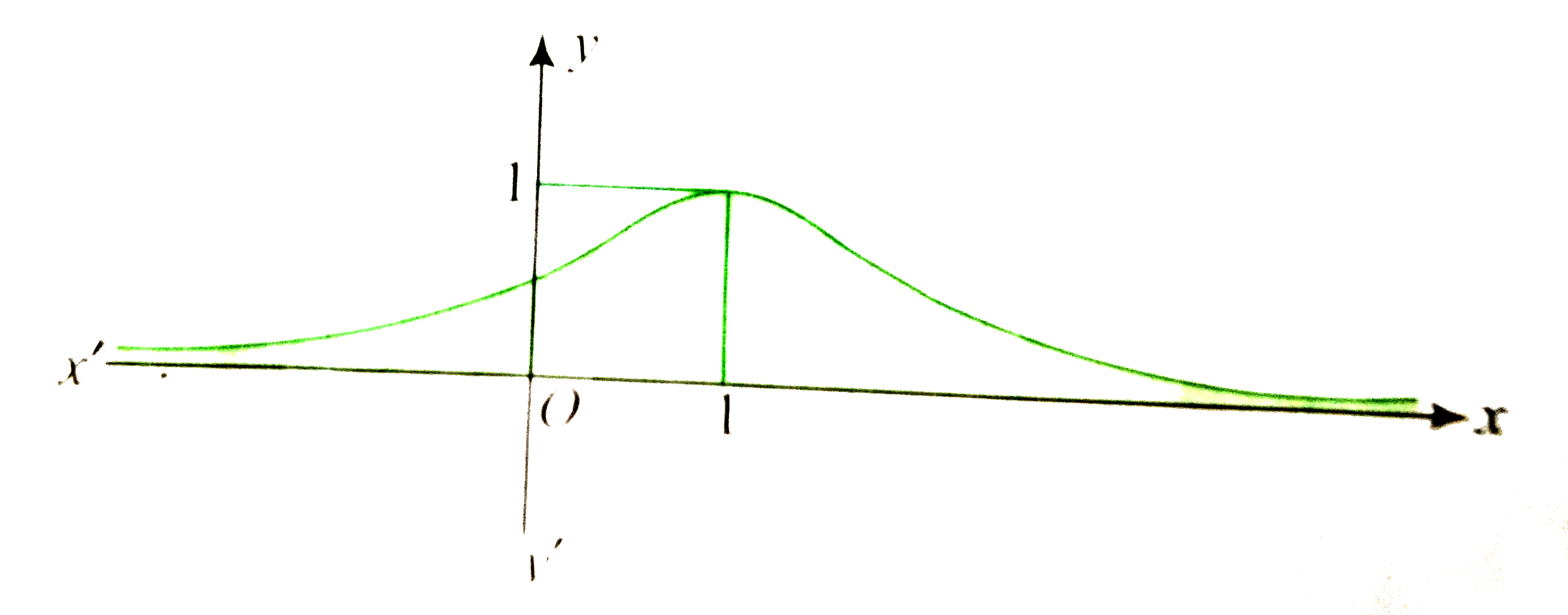
Find the area bounded by `y=1/(x^2-2x+2)`
and x-axis.
Text Solution
Verified by Experts
`y=(1)/((x-1)^(2)+1)` When `x=1, ""^(y)"max ."1` When `xrarrpmoo,yrarr0` Therefore, x-axis is the asymptote. Also `f(1+x)=f(1-x)` Hence, the graph is symmetrical about line x = 1 From these information the graph of function is as shown in the figure. `"Area "=2overset(oo)underset(1)int(1)/((x-1)^(2)+1)dx=[2tan^(-1)(x-1)]_(1)^(oo)=pi" sq. units."`
Topper's Solved these Questions
AREA
CENGAGE|Exercise Exercise 9.1|9 Videos
AREA
CENGAGE|Exercise Exercise 9.2|14 Videos
APPLICATIONS OF DERIVATIVES
CENGAGE|Exercise Subjective Type|2 Videos
AREA UNDER CURVES
CENGAGE|Exercise Question Bank|10 Videos
Similar Questions
Explore conceptually related problems
Find the area bounded by x=2y-y^2
Find the area bounded by y sin^(-1) (sin x) and x-axis for x in [0, 100pi]
Find the area bounded by y=-x^(3)+x^(2)+16x and y=4x
Find the area bounded by x=1 and x=2 , x axis and the line 4x-3y =12 .
Find the area bounded by the curves y=x^(3)-x and y=x^(2)+x.
Find the area bounded by y=x^(2) and y=x^(1//3)" for "x in [-1,1].
Find the area bounded by the curve xy^(2)=4(2-x) and y-axis.
Find the area bounded by y=| sin x -(1)/(2)| and y= 1" for "x in [0,pi]
"If "f: [-1,1]rarr[-(1)/(2),(1)/(2)],f(x)=(x)/(1+x^(2)), then find the area bounded by y=f^(-1)(x), x axis and lines x=(1)/(2), x=-(1)/(2).
Find the area bounded by 2y-3x-6=0 , x axis and the ordinates x=-1 and x=2 .