Home
Class 12
MATHS
If A1 is the area area bounded by |x-ai...

If `A_1` is the area area bounded by `|x-a_i| + |y|=b_i, i in N` ,where `a_(i+1) =a_i+3/2 b_i and b_(i+1)=b_i/2,a_i=0 and b_i=32`, then

A

`A_(3)=128`

B

`A_(3)=256`

C

`underset(nrarroo)limoverset(n)underset(i=1)SigmaA_(i)=(8)/(3)(32)^(2)`

D

`underset(nrarroo)limoverset(n)underset(i=1)SigmaA_(i)=(4)/(3)(16)^(2)`

Text Solution

Verified by Experts

The correct Answer is:
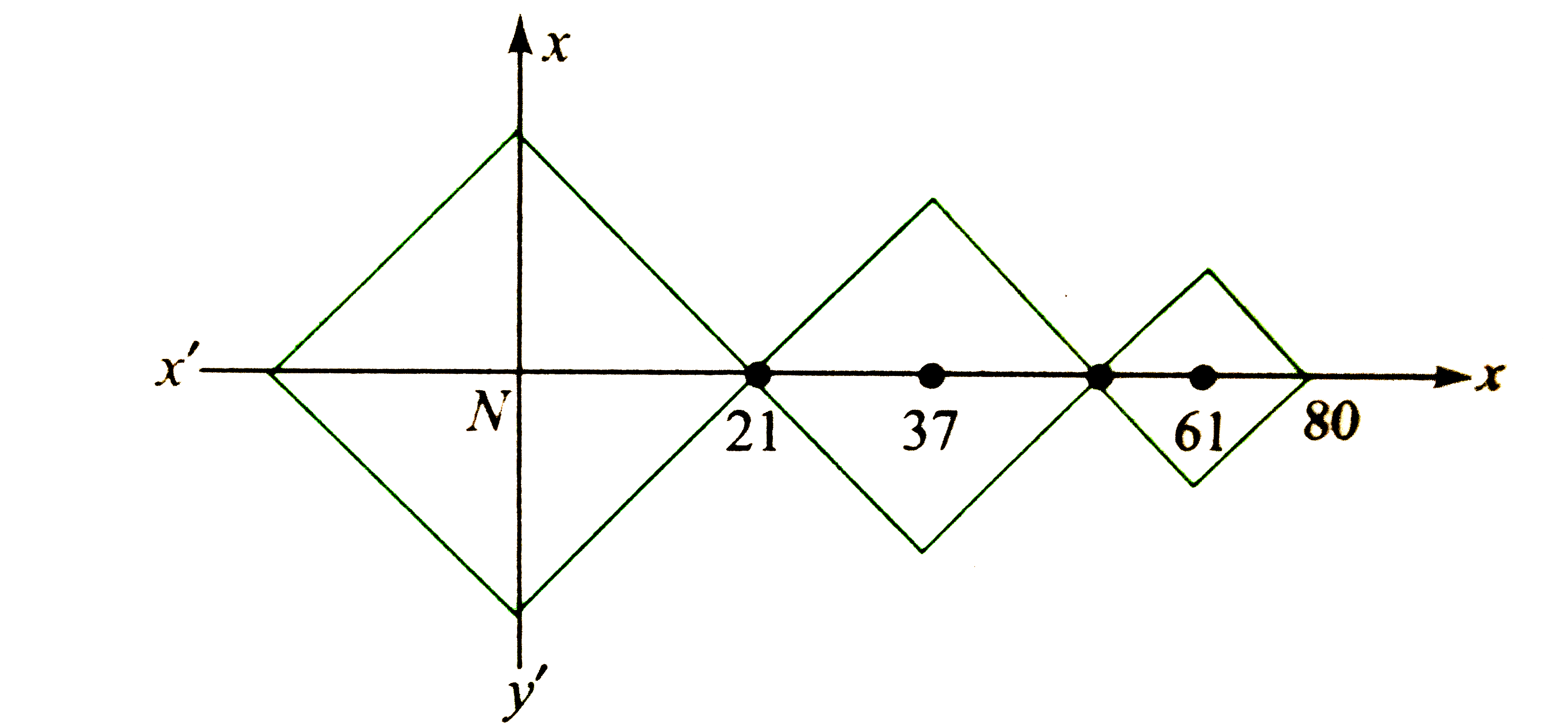
A, C

`a_(1)=0,b_(1)=32,a_(2)=a_(1)+(3)/(2)b_(1)=48,b_(2)=(b_(1))/(2)=16`
`a_(3)=48+(3)/(2)xx16=72,b_(3)=(16)/(2)=8`

So the three loops from i=1 to i=3 are alike.
Now area of ith loop (square) `=(1)/(2) ("diagonal")^(2)`
`A_(i)=(1)/(2)(2b_(i))^(2)=2(b_(i))^(2)`
`So, (A_(i)+1)/(A_(i))=(2(b_(i+1))^(2))/(2(b_(i))^(2))=(1)/(4).`
So the areas from a G.P. series.
So, the sum of the G.P. up to infinite terms is
`A_(1)(1)/(1-r)=2(32)^(2)xx(1)/(1-(1)/(4))`
`=2xx(32)^(2)xx(4)/(3)=(78)/(3)(32)^(2)` sq. units.
Promotional Banner

Topper's Solved these Questions

  • AREA

    CENGAGE|Exercise Exercise (Comprehension)|21 Videos
  • AREA

    CENGAGE|Exercise Exercise (Matrix)|4 Videos
  • AREA

    CENGAGE|Exercise Exercise (Single)|40 Videos
  • APPLICATIONS OF DERIVATIVES

    CENGAGE|Exercise Subjective Type|2 Videos
  • AREA UNDER CURVES

    CENGAGE|Exercise Question Bank|10 Videos

Similar Questions

Explore conceptually related problems

If b_i=1-a_i na = Sigma_(i=1)^(n) a_i, nb = Sigma_(i=1)^(n) b_i " then " Sigma_(i=1)^(n) a_b_i+Sigma_(i=1)^(n)(a_i-a)^2=

A path of length n is a sequence of points (x_(1),y_(1)) , (x_(2),y_(2)) ,…., (x_(n),y_(n)) with integer coordinates such that for all i between 1 and n-1 both inclusive, either x_(i+1)=x_(i)+1 and y_(i+1)=y_(i) (in which case we say the i^(th) step is rightward) or x_(i+1)=x_(i) and y_(i+1)=y_(i)+1 ( in which case we say that the i^(th) step is upward ). This path is said to start at (x_(1),y_(1)) and end at (x_(n),y_(n)) . Let P(a,b) , for a and b non-negative integers, denotes the number of paths that start at (0,0) and end at (a,b) . Number of ordered pairs (i,j) where i ne j for which P(i,100-i)=P(i,100-j) is

A path of length n is a sequence of points (x_(1),y_(1)) , (x_(2),y_(2)) ,…., (x_(n),y_(n)) with integer coordinates such that for all i between 1 and n-1 both inclusive, either x_(i+1)=x_(i)+1 and y_(i+1)=y_(i) (in which case we say the i^(th) step is rightward) or x_(i+1)=x_(i) and y_(i+1)=y_(i)+1 ( in which case we say that the i^(th) step is upward ). This path is said to start at (x_(1),y_(1)) and end at (x_(n),y_(n)) . Let P(a,b) , for a and b non-negative integers, denotes the number of paths that start at (0,0) and end at (a,b) . The value of sum_(i=0)^(10)P(i,10-i) is

If are the n Arithmetic means between a and b , then 2sum_(I - 1)^(n)a_(i) =

A path of length n is a sequence of points (x_(1),y_(1)) , (x_(2),y_(2)) ,…., (x_(n),y_(n)) with integer coordinates such that for all i between 1 and n-1 both inclusive, either x_(i+1)=x_(i)+1 and y_(i+1)=y_(i) (in which case we say the i^(th) step is rightward) or x_(i+1)=x_(i) and y_(i+1)=y_(i)+1 ( in which case we say that the i^(th) step is upward ). This path is said to start at (x_(1),y_(1)) and end at (x_(n),y_(n)) . Let P(a,b) , for a and b non-negative integers, denotes the number of paths that start at (0,0) and end at (a,b) . The sum P(43,4)+sum_(j=1)^(5)P(49-j,3) is equal to

Let Aa n dB be two 2xx2 matrices. Consider the statements (i) A B=O, A=O or B=O (ii) A B=I_2 implies A=B^(-1) (iii) (A+B)^2=A^2+2A B+B^2 a. (i) and (ii) are false, (iii) is true b. (ii) and (iii) are false, (i) is true c. (i) is false (ii) and, (iii) are true d. (i) and (iii) are false, (ii) is true

If a_1,a_2,a_3,... are in A.P. and a_i>0 for each i, then sum_(i=1)^n n/(a_(i+1)^(2/3)+a_(i+1)^(1/3)a_i^(1/3)+a_i^(2/3)) is equal to

The angle between Ai +j and B = i-j is

