Home
Class 12
MATHS
Let f:[0,oo)rarrR be a continuous functi...

Let `f:[0,oo)rarrR` be a continuous function such that `f(x)=1-2x+int_(0)^(x)e^(x-t)f(t)dt" for all "x in [0, oo).` Then, which of the following statements(s) is (are)) TRUE?

A

a)The curve y=f(x) passes through the point (1,2)

B

b)The curve y=f(x) passes through the point (2,-1)

C

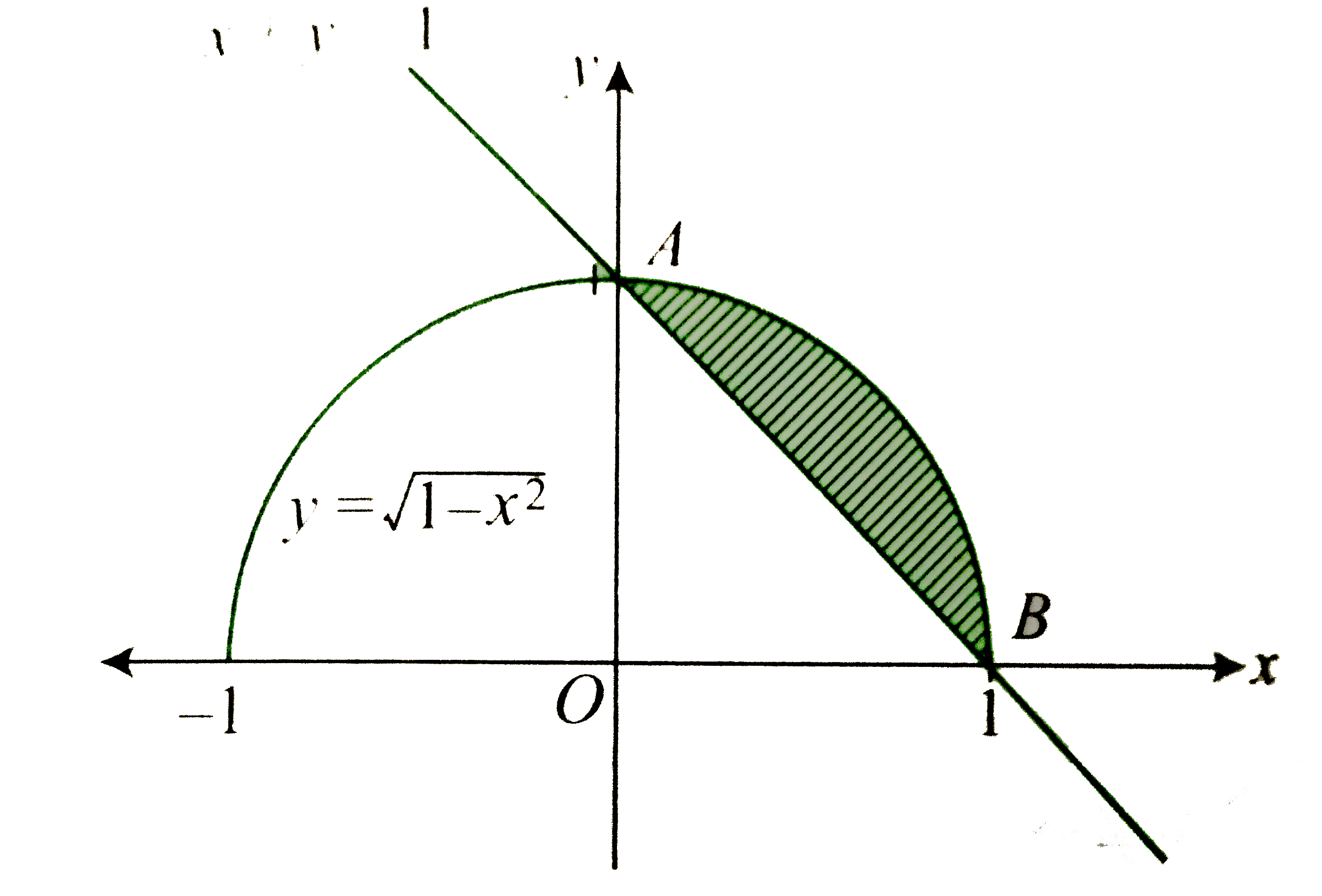
c)The area of the region `{(x,y) in [0,1]xxR:f(x)leylesqrt(1-x^(2))}" is "(pi-2)/(4)`

D

d)The area of the region `{(x,y)in [0,1]xxR:f(x)leylesqrt(1-x^(2))}" is "(pi-1)/(4)`

Text Solution

Verified by Experts

The correct Answer is:
B, C

`f(x)=1-2x+overset(x)underset(0)inte^(x-1)f(t)dt`
`rArr" "f(x)=1-2x+e^(x)overset(x)underset(0)inte^(-t)f(t)dt" ...(i)"`
Differentiating w.r.t. x, we get
`f'(x)=-2+e^(x)e^(-x)f(x)+e^(x)overset(x)underset(0)inte^(-t)f(t)dt" ...(ii)"`
Subtracting (i) from (ii), we get
`f'(x)-f(x)=-2+f(x)-1+2x`
`rArr" "f'(x)-2f(x)=2x-3`
This is linear differential equation.
`I.F. =e^(int-2dx)=e^(-2x)`
Therefore, solution is
`ycdote^(-2x)=int(2x-3)e^(-2x)dx+c`
`rArr" "ycdote^(-2x)=(2x-3)cdot(e^(-2x))/(-2)-int2xx(e^(-2x))/(-2)dx+c`
`rArr" "ycdote^(-2x)=-((2x-3)e^(-2x))/(2)-(e^(-2x))/(2)+c`
`rArr" "ycdote^(-2x)=(1-x)e^(-2x)+c`
`rArr" "y=(1-x)+c.e^(2x)" ...(iii)"`
Putting x=0 in (i), we get f(0)=1.
So, from above equation, we have
`1=1+c rArr c=0`
Now, (iii) reduces to y=1-x, which passes through point (2,-1).
`"Now,"f(x)leylesqrt(1-x^(2))`
`rArr" "1-xleylesqrt(1-x^(2))`
`1-xley` represents the region above the line `1-x=y and yle sqrt(1-x^(2))` represents the region inside the semicircle (lying above x-axis) `x^(2)+y^(2)=1.`
So, common region is as the shaded one in the following figure :

Area of the shaded region
=Area of quarter of the circle - Area of triangle OAB
`=(1)/(4)xxpi(1)^(2)-(1)/(2)xx1xx1=(pi-2)/(4)`
Promotional Banner

Topper's Solved these Questions

  • AREA

    CENGAGE|Exercise Single Correct Answer Type|27 Videos
  • AREA

    CENGAGE|Exercise Multiple Correct Answer Type|3 Videos
  • AREA

    CENGAGE|Exercise JEE Main Previous Year|10 Videos
  • APPLICATIONS OF DERIVATIVES

    CENGAGE|Exercise Subjective Type|2 Videos
  • AREA UNDER CURVES

    CENGAGE|Exercise Question Bank|10 Videos

Similar Questions

Explore conceptually related problems

Let f:RtoR be a differentiable function such that f(x)=x^(2)+int_(0)^(x)e^(-t)f(x-t)dt . y=f(x) is

Let f:RtoR be a differentiable function such that f(x)=x^(2)+int_(0)^(x)e^(-t)f(x-t)dt . f(x) increases for

Let f:[0,oo)vecR be a continuous strictly increasing function, such that f^3(x)=int_0^x tdotf^2(t)dt for every xgeq0. Then value of f(6) is_______

Let f(x) be a differentiable function such that f(x)=x^2 +int_0^x e^-t f(x-t) dt then int_0^1 f(x) dx=

Let f:(0,oo)->R be a differentiable function such that f'(x)=2-f(x)/x for all x in (0,oo) and f(1)=1 , then

A continuous function f(x) satisfies the relation f(x)=e^x+int_0^1 e^xf(t)dt then f(1)=

Let f: RvecR be a continuous function which satisfies f(x)= int_0^xf(t)dtdot Then the value of f(1n5) is______

Let f(x)=int_(2)^(x)f(t^(2)-3t+4)dt . Then

Let f:[1,oo] be a differentiable function such that f(1)=2. If 6int_1^xf(t)dt=3xf(x)-x^3 for all xgeq1, then the value of f(2) is

Let f be a real-valued function defined on interval (0,oo) ,by f(x)=lnx+int_0^xsqrt(1+sint).dt . Then which of the following statement(s) is (are) true? (A). f"(x) exists for all in (0,oo) . " " (B). f'(x) exists for all x in (0,oo) and f' is continuous on (0,oo) , but not differentiable on (0,oo) . " " (C). there exists alpha>1 such that |f'(x)|<|f(x)| for all x in (alpha,oo) . " " (D). there exists beta>1 such that |f(x)|+|f'(x)|<=beta for all x in (0,oo) .

