Home
Class 12
MATHS
For a point P in the plane, let d(1)(P) ...

For a point P in the plane, let `d_(1)(P) and d_(2)(P)` be the distances of point P from the lines `x-y=0 and x+y=0`, respectively. The area of the region R consisting of all points P lying in the first quadrant of the plane and satisfying `2 le d_(1)(P) + d_(2)(P) le 4`, is ________.

Text Solution

Verified by Experts

The correct Answer is:
6

For P(x,y), we have
`2led_(1)(P)+d_(2)(P)le4`
`rArr" "2le(|x-y|)/(sqrt(2))+(|x+y|)/(sqrt(2))le4`
`rArr" "2sqrt(2)le |x-y|+|x+y|le4sqrt(2)`
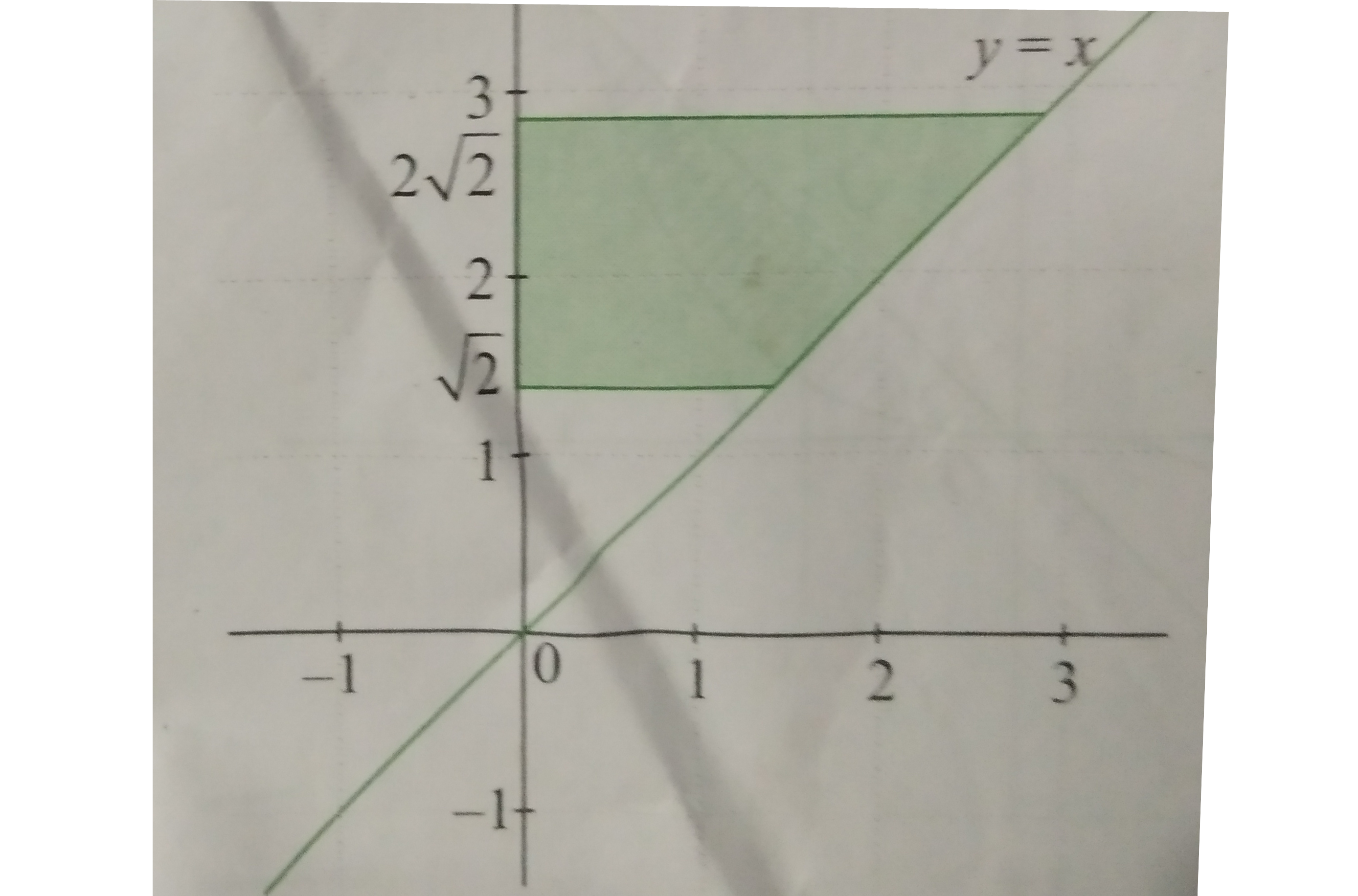
IN first quadrant if `xgty,` we have
`2sqrt(2)lex-y+x+yle4sqrt(2)`
`"or "sqrt(2)lexle2sqrt(2)`
The region of points satisfying these inequalities is

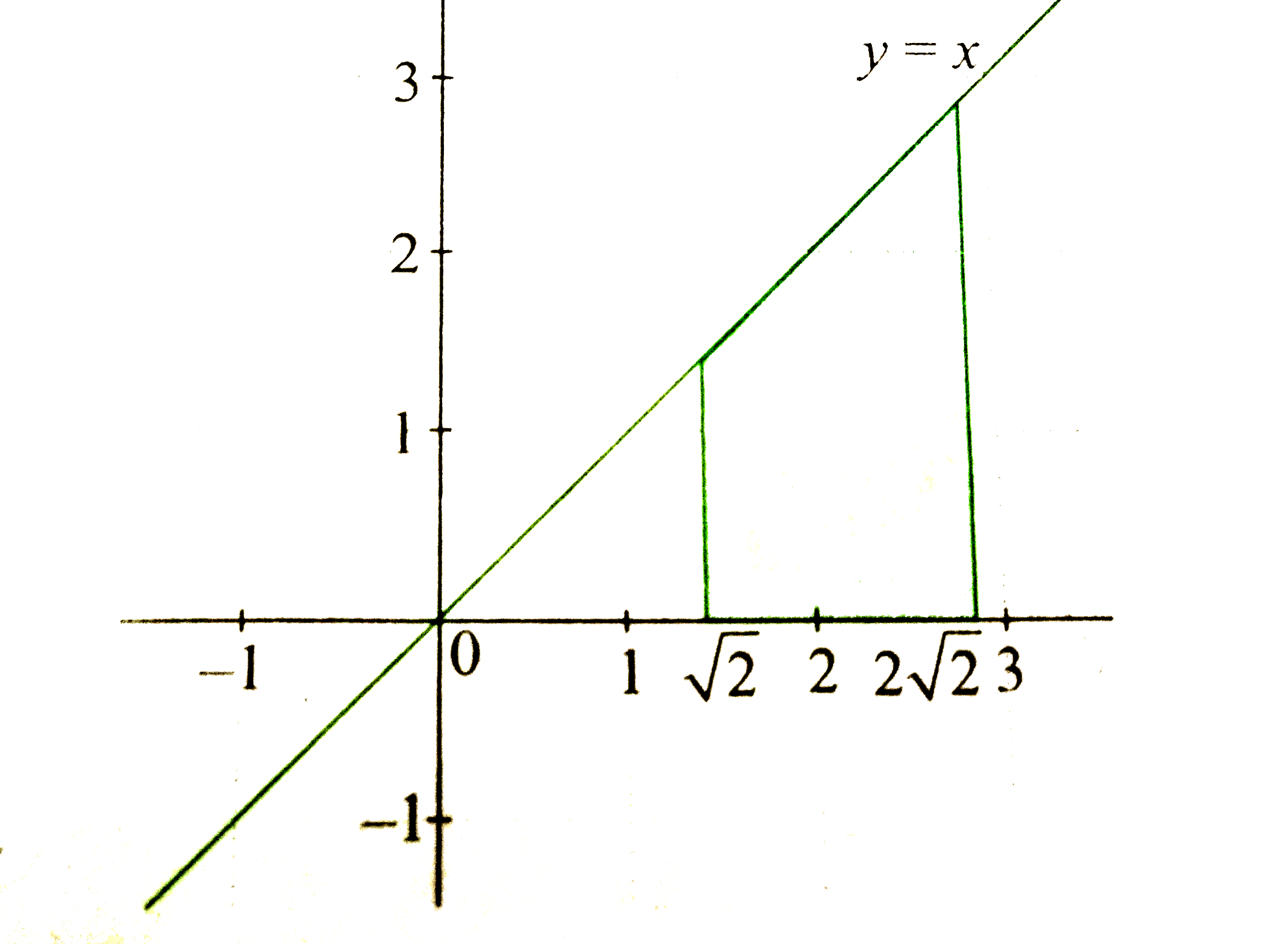
In first quadrant if `xlty`, we have
`2sqrt(2)ley-x+x+yle4sqrt(2)`
`"or "sqrt(2)leyle2sqrt(2)`
The region of points satisfying these inequalities is

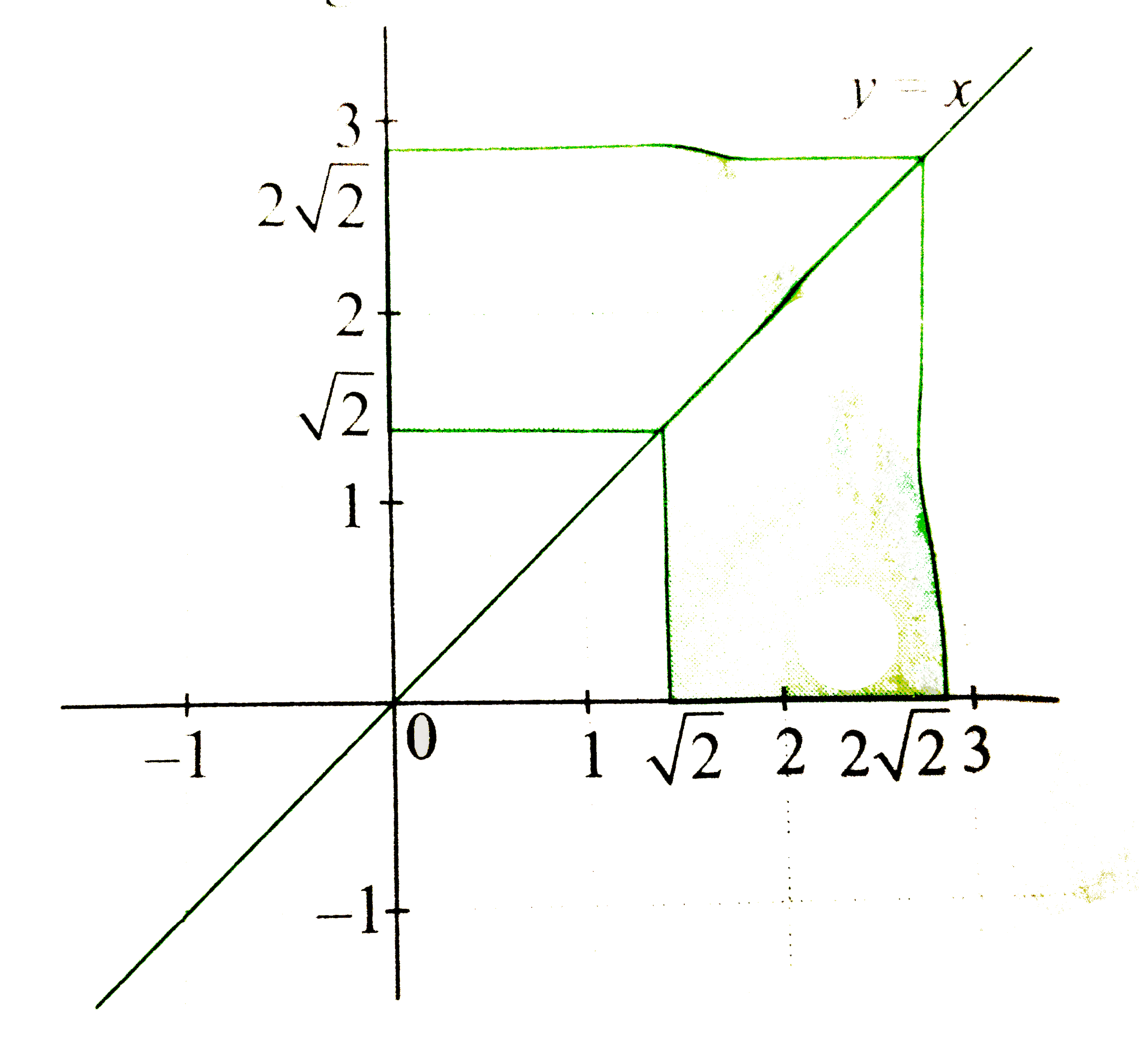
Combining above two regions we have

Area of the shaded region `=((2sqrt(2))^(2)-(sqrt(2))^(2))`
`=8-2=6` sq. units
Promotional Banner

Topper's Solved these Questions

  • AREA

    CENGAGE|Exercise Single Correct Answer Type|27 Videos
  • AREA

    CENGAGE|Exercise Multiple Correct Answer Type|3 Videos
  • AREA

    CENGAGE|Exercise JEE Main Previous Year|10 Videos
  • APPLICATIONS OF DERIVATIVES

    CENGAGE|Exercise Subjective Type|2 Videos
  • AREA UNDER CURVES

    CENGAGE|Exercise Question Bank|10 Videos

Similar Questions

Explore conceptually related problems

For a point P in the plane, let d_1(P)a n dd_2(P) be the distances of the point P from the lines x-y=0a n dx+y=0 respectively. The area of the region R consisting of all points P lying in the first quadrant of the plane and satisfying 2lt=d_1(P)+d_2(P)lt=4, is

For a point P in the plane, let d_1(P)a n dd_2(P) be the distances of the point P from the lines x-y=0a n dx+y=0 respectively. The area of the region R consisting of all points P lying in the first quadrant of the plane and satisfying 2lt=d_1(P)+d_2(P)lt=4, is

Distance of point P(vecP) from the plane vecr.vecn=0 is

Co-ordinates of points P and Q are -2 and 2 respectively. Find d(P,Q).

A point P(x,y) moves that the sum of its distance from the lines 2x-y-3=0 and x+3y+4=0 is 7 . The area bounded by locus P is (in sq. unit)

If sum of the perpendicular distances of a variable point P(x, y) from the lines x+y-5= 0 and 3x - 2y +7=0 is always 10. Show that P must move on a line.

Let R be the region containing the point (x, y) on the X-Y plane, satisfying 2le|x+3y|+|x-y|le4. Then the area of this region is

The line y=(3x)/4 meets the lines x-y=0 and 2x-y=0 at points Aa n dB , respectively. If P on the line y=(3x)/4 satisfies the condition P AdotP B=25 , then the number of possible coordinates of P is____

If sum of the perpendicular distances of a variable point P(x, y) from the lines x + y - 5 = 0 " and " 3x - 2y + 6 = 0 is always 10. Show that P must move on a line.

A line intersects the straight lines 5x-y-4=0 and 3x-4y-4=0 at A and B , respectively. If a point P(1,5) on the line A B is such that A P: P B=2:1 (internally), find point Adot