Home
Class 12
MATHS
Let T be the line passing through the...

Let `T` be the line passing through the points `P(-2,\ 7)` and `Q(2,\ -5)` . Let `F_1` be the set of all pairs of circles `(S_1,\ S_2)` such that `T` is tangent to `S_1` at `P` and tangent to `S_2` at `Q` , and also such that `S_1` and `S_2` touch each other at a point, say, `M` . Let `E_1` be the set representing the locus of `M` as the pair `(S_1,\ S_2)` varies in `F_1` . Let the set of all straight lines segments joining a pair of distinct points of `E_1` and passing through the point `R(1,\ 1)` be `F_2` . Let `E_2` be the set of the mid-points of the line segments in the set `F_2` . Then, which of the following statement(s) is (are) TRUE? The point `(-2,\ 7)` lies in `E_1` (b) The point `(4/5,7/5)` does NOT lie in `E_2` (c) The point `(1/2,\ 1)` lies in `E_2` (d) The point `(0,3/2)` does NOT lie in `E_1`

A

The point `(-2,7)` lies in `E_(1)`

B

The point `(4//5,7//5)` does NOT lie in `E_(2)`

C

The point `(1//2,1)` lie in `E_(2)`

D

The point `(0,3//2)` does NOT lie in `E_(1)`

Text Solution

Verified by Experts

The correct Answer is:
2,4

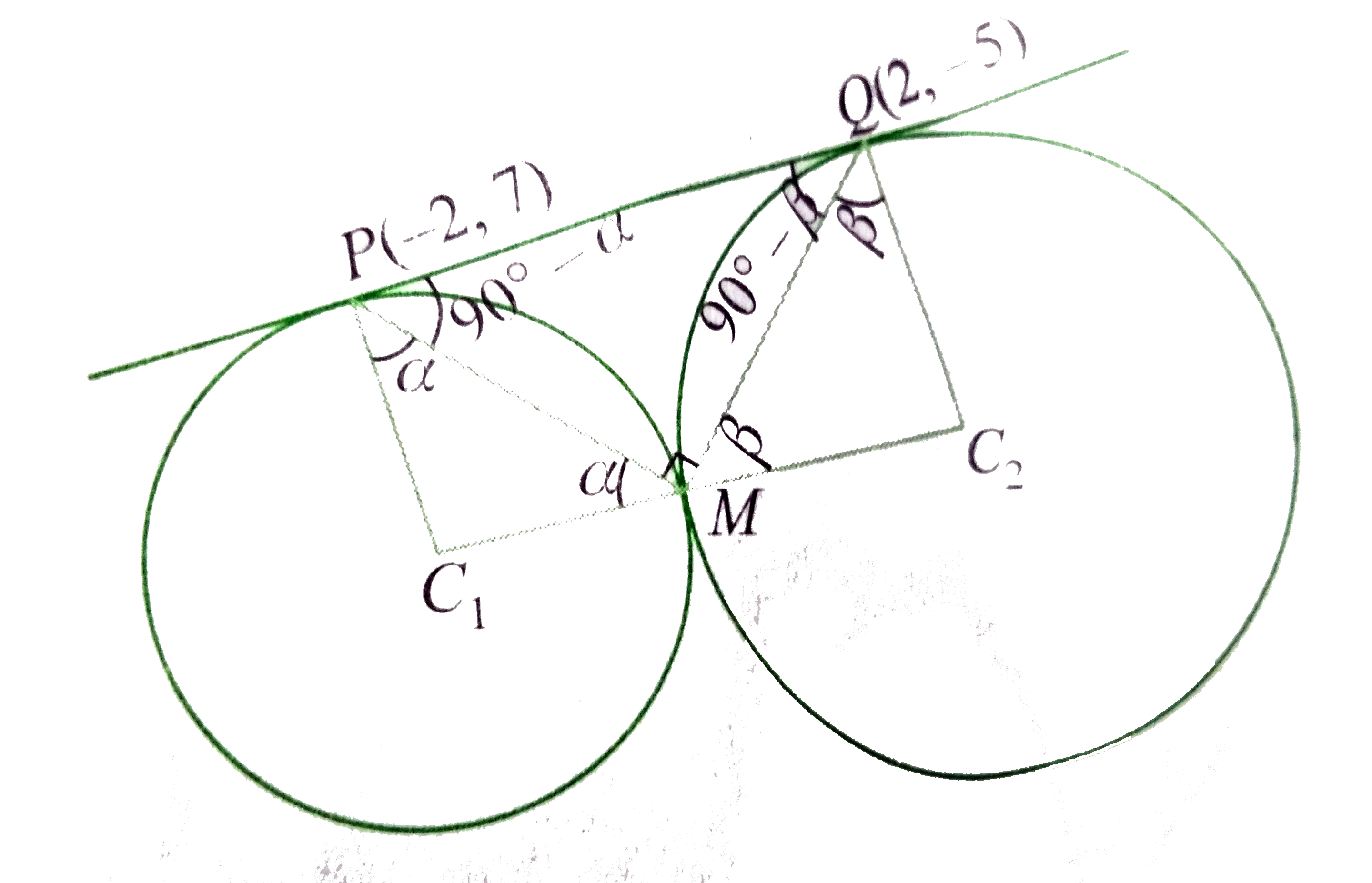
According to the question , we have the following figure `:`

Clearly, `/_ PMQ =(pi)/(2)`.
Hence, locus of M is
`(x+2)(x-2)+(y-7)(y+5)=0`
or `E _(1) -= x^(2)+y ^(2)-2y-39=0` (i)
Clearly, `E_(2)` is the locus of mid-points of chords of `E_(1)` passing through (1,1).
Let the mid-pioint of chord of `E_(1)` be (h,k) .
Its equation is
`h+k- (1+k) -39= h^(2)+k^(2)-2k-39`
or `h^(2)+k^(2)-2k-h+1=0`
Hence, `E_(2) -= x^(2)+y^(2)-x-2y+1=0` (ii) ltbrlt Operation (A) is incorrect, although, it satisfies eq. (i) otherwise the line T would touch the second circle at two points.
Als, `(4//5,7//5)` satisfies eq. (ii) but again in this case one end of the chord would be `(-2,7)` which is not included in `E_(1)`.Therefore, `(4//5, 7//5)` does not lie in `E_(2)`
`(1/2,1)` does not satisfy eq. (ii), therefore, it does not lie in `E_(2)`.
`(0,3//2)` does not satisfy eq. (i), so it does not lie in` E_(1)`.
Promotional Banner

Topper's Solved these Questions

  • CIRCLE

    CENGAGE|Exercise MATRIX MATCH TYPE|6 Videos
  • CIRCLE

    CENGAGE|Exercise JEE Main Previous Year|10 Videos
  • BINOMIAL THEOREM

    CENGAGE|Exercise Comprehension|11 Videos
  • CIRCLES

    CENGAGE|Exercise Question Bank|16 Videos

Similar Questions

Explore conceptually related problems

Let S(k)=1+3+5+...+(2k-1)=3+k^(2) . Then which of the following is true?

The center(s) of the circle(s) passing through the points (0, 0) and (1, 0) and touching the circle x^2+y^2=9 is (are)

Find the equation (s) of the circle passing through the points (1,1) and (2,2) and whose radius 1 .

Show that points P(1,-2), Q(5, 2), R(3, -1), S(-1, -5) are the vertices of a parallelogram.

let L be a straight line passing through the origin. Suppose that all the points on L are at a constant distance from the two planes P_1 : x + 2y-z +1 = 0 and P_2 : 2x-y + z-1 = 0 , Let M be the locus of the feet of the perpendiculars drawn from the points on L to the plane P_1 . Which of the following points lie(s) on M?

Let l_(1) and l_(2) be the two skew lines. If P, Q are two distinct points on l_(1) and R, S are two distinct points on l_(2) , then prove that PR cannot be parallel to QS.

Let S_1 be a circle passing through A(0,1) and B(-2,2) and S_2 be a circle of radius sqrt(10) units such that A B is the common chord of S_1a n dS_2dot Find the equation of S_2dot

Let S={1,2,3, …, 100} . The number of non-empty subsets A to S such that the product of elements in A is even is

Let S be the set of all values of x for which the tangent to the curve y = f(x)= x^(3) - x^(2)- 2x at (x, y) is parallel to the line segment joining the points (1, f(1)) and (-1, f(-1)) , then S is equal to

Let S_(1) be the set of all those solution of the equation (1+a) cos theta cos(2 theta-b)=(1+a cos 2 theta) cos (theta -b) which are independent of a and b and S_(2) be the set of all such solutions which are dependent on a and b. Then The set S_(1) and S_(2) are

