Home
Class 12
MATHS
PARAGRAPH "X" Let S be the circle in th...

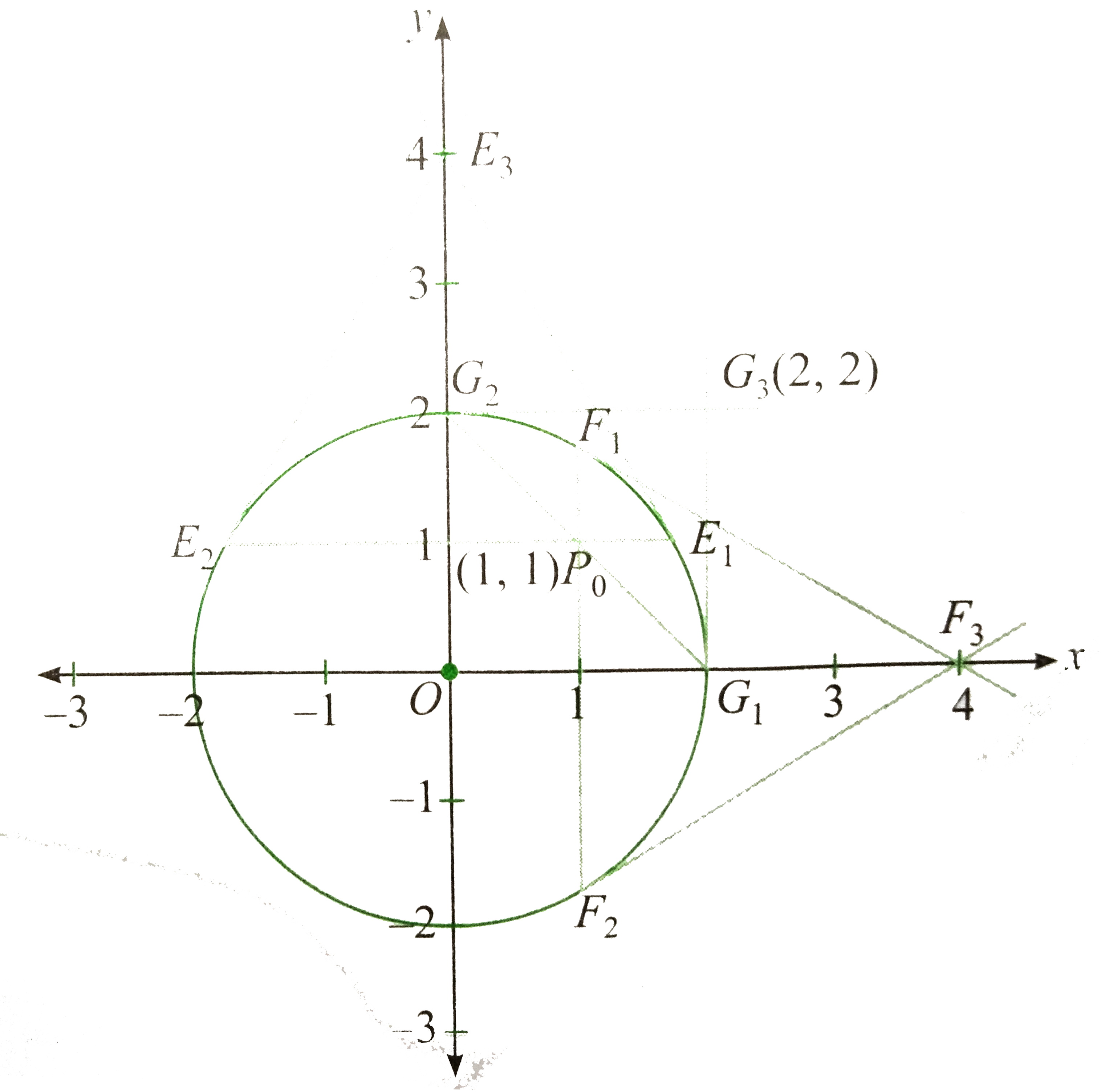
PARAGRAPH `"X"` Let `S` be the circle in the `x y` -plane defined by the equation `x^2+y^2=4.` (For Ques. No 15 and 16) Let `E_1E_2` and `F_1F_2` be the chords of `S` passing through the point `P_0(1,\ 1)` and parallel to the x-axis and the y-axis, respectively. Let `G_1G_2` be the chord of `S` passing through `P_0` and having slope `-1` . Let the tangents to `S` at `E_1` and `E_2` meet at `E_3` , the tangents to `S` at `F_1` and `F_2` meet at `F_3` , and the tangents to `S` at `G_1` and `G_2` meet at `G_3` . Then, the points `E_3,\ F_3` and `G_3` lie on the curve `x+y=4` (b) `(x-4)^2+(y-4)^2=16` (c) `(x-4)(y-4)=4` (d) `x y=4`

A

`x+y=4`

B

`(x-4)^(2)+(y-4)^(2)= 16`

C

`(x-4)(y-4)=4`

D

`xy=4`

Text Solution

Verified by Experts

The correct Answer is:
A


Circle is `x^(2)+y^(2) =4`.
Equation of chord through `P_(0) (1,1)` parallel to x-axis is `y=1`
Solving this with circle, we `E_(1)(sqrt(3),1)` and `E_(2)(- sqrt(3),1)`.
Equations of tangent to circle at `E_(1)` and `E_(2)` are `sqrt(3)x+y=4` and `- sqrt(3) x +y=4` , respectively.
These tangents meet at `E_(3)(0,4)`.
Chord through `p_(0)(1,1)`, parallel to y -axis is `x=1`, which meets circle at `F_(1)(1,sqrt(3))` and `F_(2) (1,-sqrt(3))`.
Tangents to circle at `F_(1)` and `F_(2)` meet at `F_(3)(0,4)`.
Chord through `P_(0)` having slope -1 is `x+y=2` which meets circle at `G_(1)(0,2)` and `G_(2)(2,0)`.
Tangest to circle at `G_(1)` and `G_(2)` meet at `G_(3)(2,2)`.
Clearly, `E_(3),F_(3)` and `G_(3)` lie on line `x+y=4`.
Promotional Banner

Topper's Solved these Questions

  • CIRCLE

    CENGAGE|Exercise MATRIX MATCH TYPE|6 Videos
  • CIRCLE

    CENGAGE|Exercise JEE Main Previous Year|10 Videos
  • BINOMIAL THEOREM

    CENGAGE|Exercise Comprehension|11 Videos
  • CIRCLES

    CENGAGE|Exercise Question Bank|16 Videos

Similar Questions

Explore conceptually related problems

The tangent to the curve y=xe^(x^2) passing through the point (1,e) also passes through the point

Let S be the circle in the x y -plane defined by the equation x^2+y^2=4. (For Ques. No 15 and 16) Let P be a point on the circle S with both coordinates being positive. Let the tangent to S at P intersect the coordinate axes at the points M and N . Then, the mid-point of the line segment M N must lie on the curve (a) (x+y)^2=3x y (b) x^(2//3)+y^(2//3)=2^(4//3) (c) x^2+y^2=2x y (d) x^2+y^2=x^2y^2

Let C be a curve defined by y=e^a+b x^2dot The curve C passes through the point P(1,1) and the slope of the tangent at P is (-2)dot Then the value of 2a-3b is_____.

Let E1 and E2, be two ellipses whose centers are at the origin.The major axes of E1 and E2, lie along the x-axis and the y-axis, respectively. Let S be the circle x^2 + (y-1)^2= 2 . The straight line x+ y =3 touches the curves S, E1 and E2 at P,Q and R, respectively. Suppose that PQ=PR=[2sqrt2]/3 .If e1 and e2 are the eccentricities of E1 and E2, respectively, then the correct expression(s) is(are):

If e_1 is the eccentricity of the ellipse x^2/16+y^2/25=1 and e_2 is the eccentricity of the hyperbola passing through the foci of the ellipse and e_1 e_2=1 , then equation of the hyperbola is

A curve y=f(x) passes through point P(1,1) . The normal to the curve at P is a (y-1)+(x-1)=0 . If the slope of the tangent at any point on the curve is proportional to the ordinate of the point, then the equation of the curve is

Suppose that the foci of the ellipse (x^2)/9+(y^2)/5=1 are (f_1,0)a n d(f_2,0) where f_1>0a n df_2<0. Let P_1a n dP_2 be two parabolas with a common vertex at (0, 0) and with foci at (f_1 .0)a n d (2f_2 , 0), respectively. Let T_1 be a tangent to P_1 which passes through (2f_2,0) and T_2 be a tangents to P_2 which passes through (f_1,0) . If m_1 is the slope of T_1 and m_2 is the slope of T_2, then the value of (1/(m1 2)+m2 2) is

The slope of the tangent to a curve y=f(x) at (x,f(x)) is 2x+1. If the curve passes through the point (1,2) then the area of the region bounded by the curve, the x-axis and the line x=1 is (A) 5/6 (B) 6/5 (C) 1/6 (D) 1

Let P be a point on the ellipse x^2/a^2+y^2/b^2=1 , 0 < b < a and let the line parallel to y-axis passing through P meet the circle x^2 +y^2=a^2 at the point Q such that P and Q are on the same side of x-axis. For two positive real numbers r and s, find the locus of the point R on PQ such that PR : RQ = r : s and P varies over the ellipse.

