Home
Class 12
MATHS
Let ABC be an equilateral triangle inscr...

Let ABC be an equilateral triangle inscribed in the circle `x^2+y^2=a^2` . Suppose pendiculars from A, B, C to the ellipse `x^2/a^2+y^2/b^2=1,(a > b)` meets the ellipse respectivelily at P, Q, R so that P, Q , R lies on same side of major axis as A, B, C respectively. Prove that the normals to the ellipse drawn at the points P Q nad R are concurrent.

Text Solution

Verified by Experts
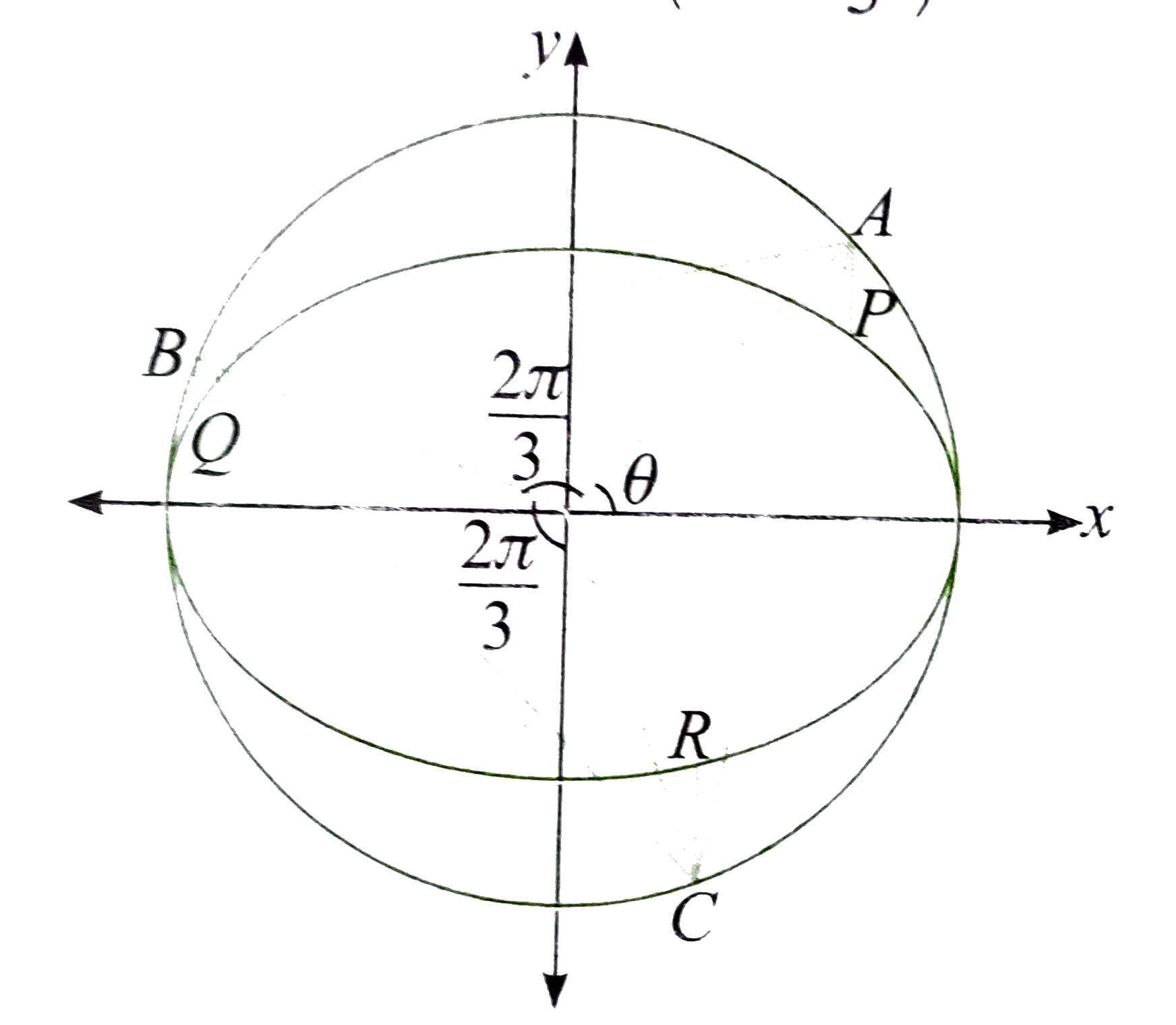
Let A , B and C, be the points on the cicle whose cooridnates are
`A(a cos theta, a sin theta)`
`B(a cos (theta+(2pi)/(3)),asin(theta+(2pi)/(3)))`
`C(a cos (theta+(4pi)/(3)),asin(theta+(4pi)/(3)))`
Hence, `P-=(a cos theta, b sin theta)`
`Q-=(a cos (theta+(2pi)/(3)),asin(theta+(2pi)/(3)))`
`R-=(a cos (theta+(4pi)/(3)),asin(theta+(4pi)/(3)))`
It is given that P,Q and R are on the same side of the x-axis as A,B, and C.
So, the required nomrmals ot the ellipse at P,Q and R are
`ax sec theta-"by cosec" theta=a^(2)-b^(2)" "(1)`
`ax sec(theta+(2pi)/(3)-"by cosec"(theta+(2pi)/(3))=a^(2)-n^(2)" "(2)`
`ax sec(theta+(4pi)/(3)-"by cosec"(theta+(4pi)/(3))=a^(2)-n^(2)" "(3)`

Now, `Delta`= `|{:(sec theta,"cosec"theta,1),(sec (theta+(2pi)/(3)),"cosec"(theta+(2pi)/(3)),1),(sec (theta+(2pi)/(3)),"cosec"(theta+(2pi)/(3)),1):}|`
Multiplying `R_(1),R_(2) and R_(3)`, by `sin theta cos, theta, sin (theta+(2pi)/(3))co (theta+(2pi)/(3))and sin (theta+(4pi)/(3))` respectively, we get
`Delta=(1)/(k)|{:(sin theta,cos theta,sin2theta),(sin (theta+(2pi)/(3)),cos(theta+(2pi)/(3)),sin (2 theta+(4pi)/(3))),(sin (theta-(2pi)/(3)),cos(theta-(2pi)/(3)),sin (2 theta-(4pi)/(3))):}|`
Where
`k=2sin theta cos theta sin(theta+(2pi)/(3))cos(theta-(2pi)/(3))sin(theta+(4pi)/(3))cos (theta+(4pi)/(3))`
Operating `R_(2)toR_(2)+R_(3)`
`Delta=(1)/(k)|{:(sin theta,cos theta,sin2theta),(2sin theta*cos.(2pi)/(3),2cos theta*cos.(2pi)/(3),2sin theta*cos.(4pi)/(3)),(sin(theta-(2pi)/(3)),cos(theta-(2pi)/(3)),sin (2theta-(4pi)/(3))):}|`
`=(1)/(k)|{:(sin theta,cos theta,sin2theta),(-sin theta ,-cos theta,-sin theta),(sin(theta-(2pi)/(3)),cos(theta-(2pi)/(3)),sin(2theta-(4pi)/(3))):}|`
Promotional Banner

Similar Questions

Explore conceptually related problems

Prove that the chords of contact of pairs of perpendicular tangents to the ellipse x^2/a^2+y^2/b^2=1 touch another fixed ellipse.

Area of the greatest rectangle inscribed in the ellipse x^(2)/a^(2) + y^(2)/b^(2) =1 is

Tangents are drawn from the point P(3, 4) to the ellipse x^2/9+y^2/4=1 touching the ellipse at points A and B.

Prove that the area bounded by the circle x^2+y^2=a^2 and the ellipse (x^2)/(a^2)+(y^2)/(b^2)=1 is equal to the area of another ellipse having semi-axis a-b and a ,a > b .

Find the equation of the normal to the ellipse (x^2)/(a^2)+(y^2)/(b^2)=1 at the positive end of the latus rectum.

If the ellipse x^2/a^2+y^2/b^2=1 (b > a) and the parabola y^2 = 4ax cut at right angles, then eccentricity of the ellipse is

If P Q R is an equilateral triangle inscribed in the auxiliary circle of the ellipse (x^2)/(a^2)+(y^2)/(b^2)=1,(a > b), and P^(prime)Q^(prime)R ' is the correspoinding triangle inscribed within the ellipse, then the centroid of triangle P^(prime)Q^(prime)R ' lies at center of ellipse focus of ellipse between focus and center on major axis none of these

A tangent to the ellipse x^2+4y^2=4 meets the ellipse x^2+2y^2=6 at P&Q.Prove that the tangents at P and Q of the ellipse x^2+2y^2=6 are right angle.

If the normal at any point P on the ellipse x^2/a^2+y^2/b^2=1 meets the axes at G and g respectively, then find the raio PG:Pg= (a) a : b (b) a^2 : b^2 (c) b : a (d) b^2 : a^2

Find the locus of point P such that the tangents drawn from it to the given ellipse (x^2)/(a^2)+(y^2)/(b^2)=1 meet the coordinate axes at concyclic points.

