Home
Class 12
MATHS
P is any point lying on the ellipse (x^(...

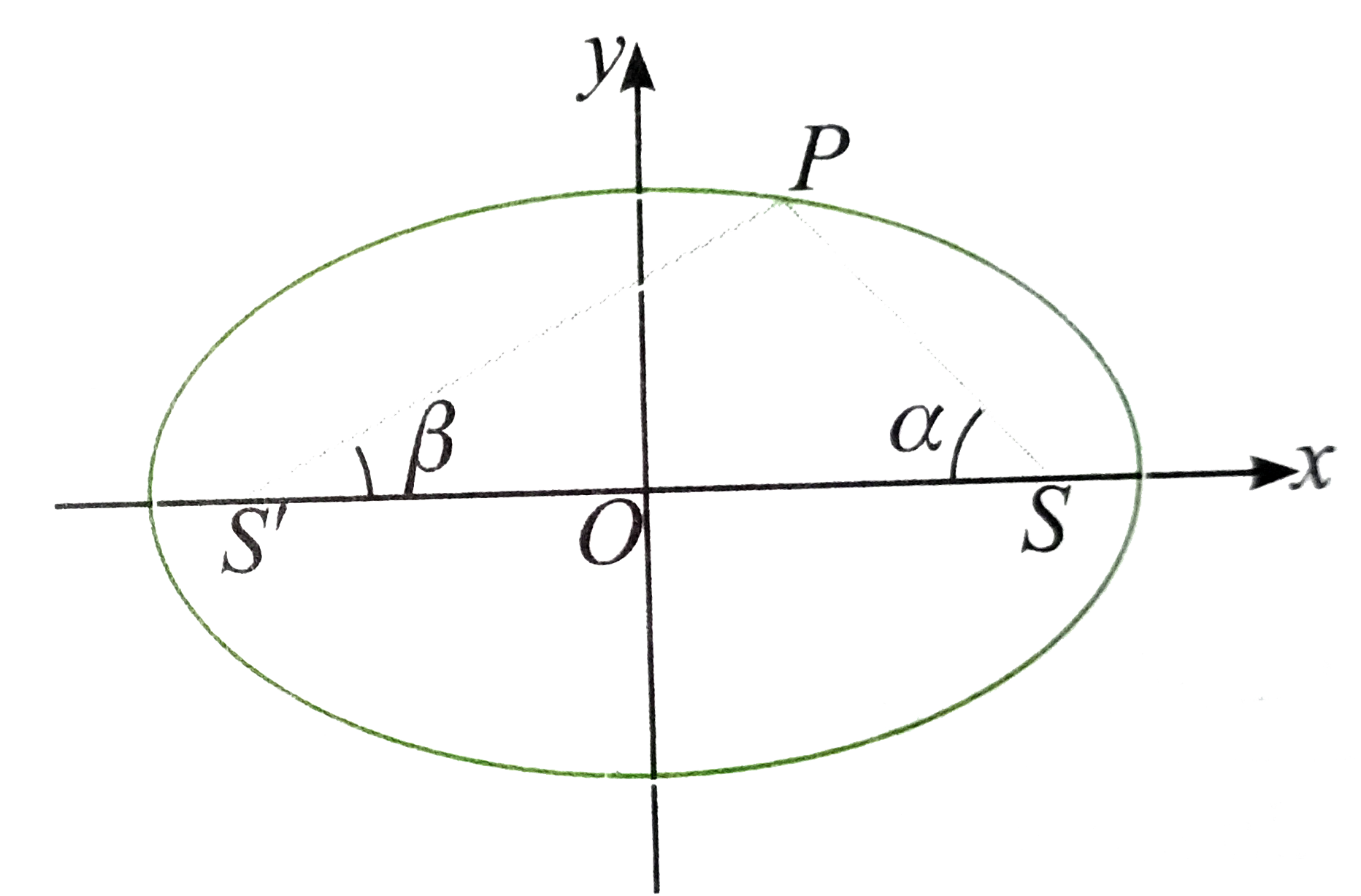
P is any point lying on the ellipse `(x^(2))/(a^(2))+(y^(2))/(b^(2))=1(agtb)` whose foci are `S` and `S'`. If `anglePSS'=alpha and anglePS'S=beta`, then the value of `tan.(alpha)/(2)tan.(beta)/(2)` is

A

`(1+e)/(1-e)`

B

`(1+e^(2))/(1-e^(2))`

C

`(1-e)/(1+e)`

D

1

Text Solution

Verified by Experts

The correct Answer is:
C


SP+S''P=2a
In `DeltaSPS''`
Perimeter, `2s=SP+S'P+SS'=2a+2ae=2a(1+e)`
Now, `tan.(alpha)/(2)tan.(beta)/(2)=sqrt(((s-b)(s-c))/(s(s-c)))sqrt(((s-a)(s-c))/(s(s-b)))`
`s(-c)/(s)=(2s-2c)/(2s)=(2a(1+e)-2c)/(2a(1+e))`
`(2a+2ae-4ae)/(2a(1+e))=(2a(1-e))/(2ae(1+e))`
`:.tan.(alpha)/(2)tan.(beta)/(2)=(1-e)/(1+e)`
Promotional Banner

Similar Questions

Explore conceptually related problems

Let P be a pooint on the ellipse (x^(2))/(a^(2))+(y^(2))/(b^(2))=1(agtb) in the first or second quadrants whowse foci are S_(1)and S_(2) . Then the least possible value of circumradius of DeltaPS_(1)S_(2) will be

Tangents drawn from the point (c, d) to the hyperbola (x^(2))/(a^(2))-(y^(2))/(b^(2))=1 make angles alpha and beta with the x-axis. If tan alpha tan beta=1 , then find the value of c^(2)-d^(2) .

If P(alpha,beta) is a point on the ellipse (x^2)/(a^2)+(y^2)/(b^2)=1 with foci Sa n dS ' and eccentricity e , then prove that the area of S P S ' is basqrt(a^2-alpha^2)

If the chord joining points P(alpha)a n dQ(beta) on the ellipse ((x^2)/(a^2))+((y^2)/(b^2))=1 subtends a right angle at the vertex A(a ,0), then prove that tan(alpha/2)tan(beta/2)=-(b^2)/(a^2)dot

The tangents drawn from a point P to ellipse (x^(2))/(a^(2))+(y^(2))/(b^(2))=1 make angles alpha and beta with the transverse axis of the hyperbola, then

If alpha and beta are the roots of x^(2)+6x-4=0 , find the value of (alpha-beta)^(2) .

If alpha and beta are the roots of x^(2)+6x-4=0 , find the values of (alpha-beta)^(2) .

If alpha and beta are the roots of 2x^(2) – 3x -4 = 0 find the value of 2 alpha^(2)+ beta^(2)

If 2 sin 2alpha=tan beta,alpha,beta, in((pi)/(2),pi) , then the value of alpha+beta is

If alpha and beta are roots of the equation x^(2) + 2x + 8 = 0 the the value of (alpha)/(beta) + (beta)/(alpha) is ………….. .

