Home
Class 12
MATHS
Consider the ellipse whose major and min...

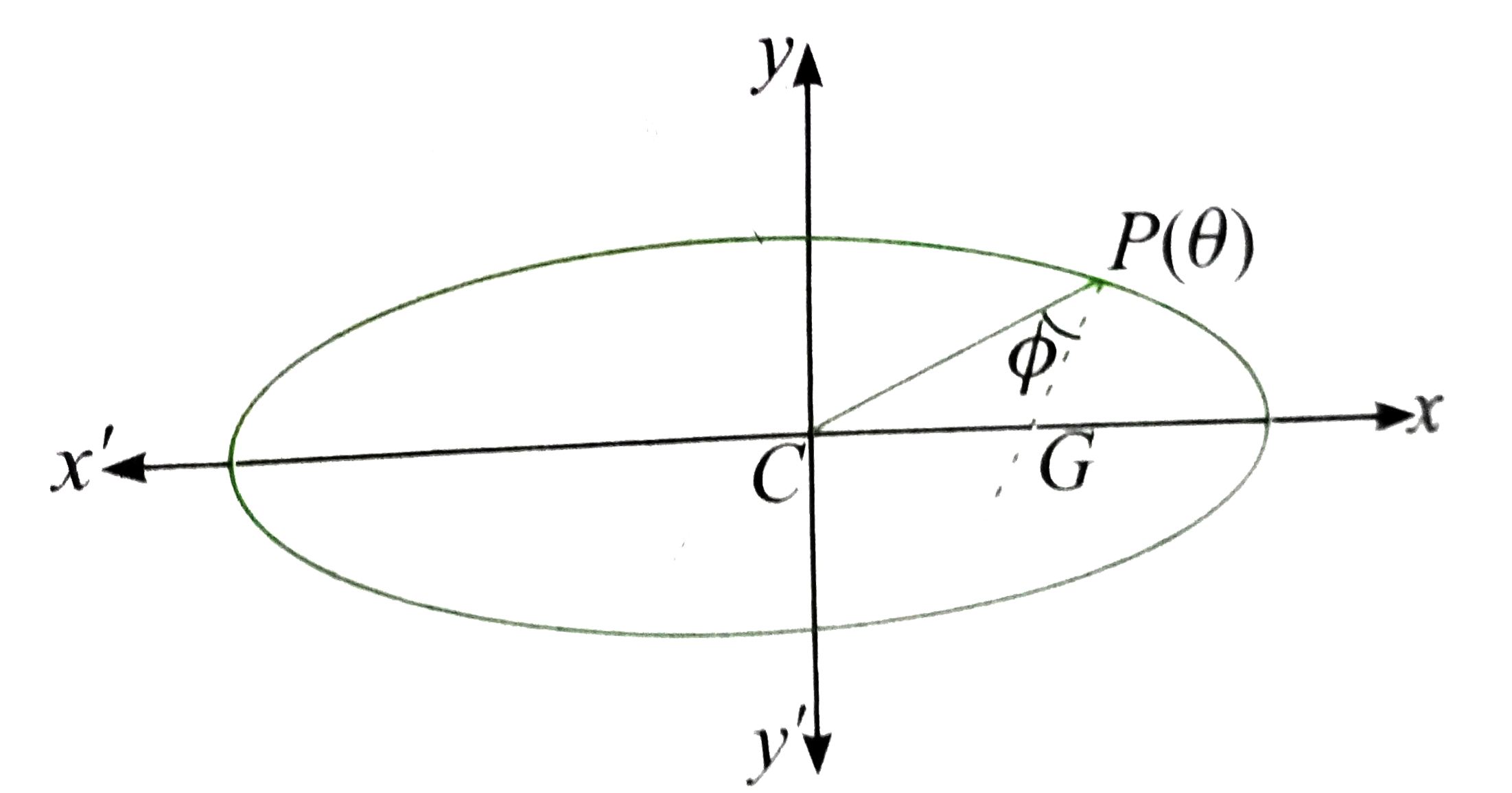
Consider the ellipse whose major and minor axes are x-axis and y-axis, respectively. If `phi` is the angle between the CP and the normal at point P on the ellipse, and the greatest value `tan phi` is `3/4` (where C is the centre of the ellipse). Also semi-major axis is 10 units . The eccentricity of the ellipse is

A

`1//2`

B

`1//3`

C

`sqrt(3)//2`

D

none of these

Text Solution

Verified by Experts


Let P be any point on the ellipse t `(a cos theta, b sin theta)`
Therefore, the equation of CP is
`y=((b)/(a) tan theta)x`
The normal to the ellipse at P is
`(ax)/(cos theta)-(bx)/(sin theta)=a^(2)-b^(2)`
Slopes of the lines CPand the normal GP are (b/a) `tan theta` and (a/b) `tan, theta` respectively. Therefore,
`tan phi=((a)/(b) tan theta-(b)/(a)tan theta)/(1+(a)/(b)tan theta(b)/(a)tan theta)`
`(a^(2)-b^(2))/(ab)=(tan theta)/(sec^(2)theta)`
`=(a^(2)-b^(2))/(ab) sin theta cos theta=(a^(2)-b^(2))/(2ab) sin 2 theta`
Therefore , the greatest value of `tan phi` is
`(x^(2)-b^(2))/(2ab)xx1=(a^(2)-b^(2))/(2ab)`
Given that
`(a^(2)-b^(2))/(2ab)=(3)/(2)`
Let `(a)/(b)=t`
`:. t-(1)/(t)=(3)/(2)`
or `2t^(2)-3t-2=0`
` or 2t^(2)-4t+t-2=0`
`or (2t+1)(t-2)`
`(a)/(b)=2`
or `e^(2)=1-(1)/(4)`
or `e=(sqrt(3))/(2`
The rectangle inscribed in the ellipse, whose one vertexis `a(cos theta,b sin theta), "is" (2a cos theta b sin theta)=2ab sin (2theta)` which has maximum, value 2ab. Given that a=10. Then b=5. Therefore, the maximum area is 100
Promotional Banner

Similar Questions

Explore conceptually related problems

Consider the ellipse whose major and minor axes are x-axis and y-axis, respectively. If phi is the angle between the CP and the normal at point P on the ellipse, and the greatest value tan phi is 3/4 (where C is the centre of the ellipse). Also semi-major axis is 10 units . A rectangle is inscribed in a ellipse whose sides are parallel to the coordinate axes, then the maximum area of rectangle is

Consider the ellipse whose major and minor axes are x-axis and y-axis, respectively. If phi is the angle between the CP and the normal at point P on the ellipse, and the greatest value tan phi is 3/4 (where C is the centre of the ellipse). Also semi-major axis is 10 units . Locus of the point of intersection of perpendicular tangents to the ellipse is:

If the normal at any point P on the ellipse cuts the major and minor axes in G and g respectively and C be the centre of the ellipse, then

The length of the latus rectum of an ellipse in 1/3 of its major axis. Its eccentricity is :

If the length of the major axis intercepted between the tangent and normal at a point P (a cos theta, b sin theta) on the ellipse (x^(2))/(a^(2)) +(y^(2))/(b^(2)) =1 is equal to the length of semi-major axis, then eccentricity of the ellipse is

The angle between the lines joining the foci of an ellipse to an extremity of its minor axis is 90^@ . The eccentricity is

S_1, S_2 , are foci of an ellipse of major axis of length 10 units and P is any point on the ellipse such that perimeter of triangle PS_1 S_2 , is 15 . Then eccentricity of the ellipse is:

An ellipse has OB, as semi minor axis, F and F' its foci and the angle FBF' is a right angle. Then the eccentricity of the ellipse is :

Find the coordinates of the foci, the vertices, the lengths of major and minor axes and the eccentricity of the ellipse 9x^(2)+4y^(2)=36

Normal to the ellipse (x^2)/(64)+(y^2)/(49)=1 intersects the major and minor axes at Pa n dQ , respectively. Find the locus of the point dividing segment P Q in the ratio 2:1.