Home
Class 12
MATHS
Let S and S' be the foci of the ellipse ...

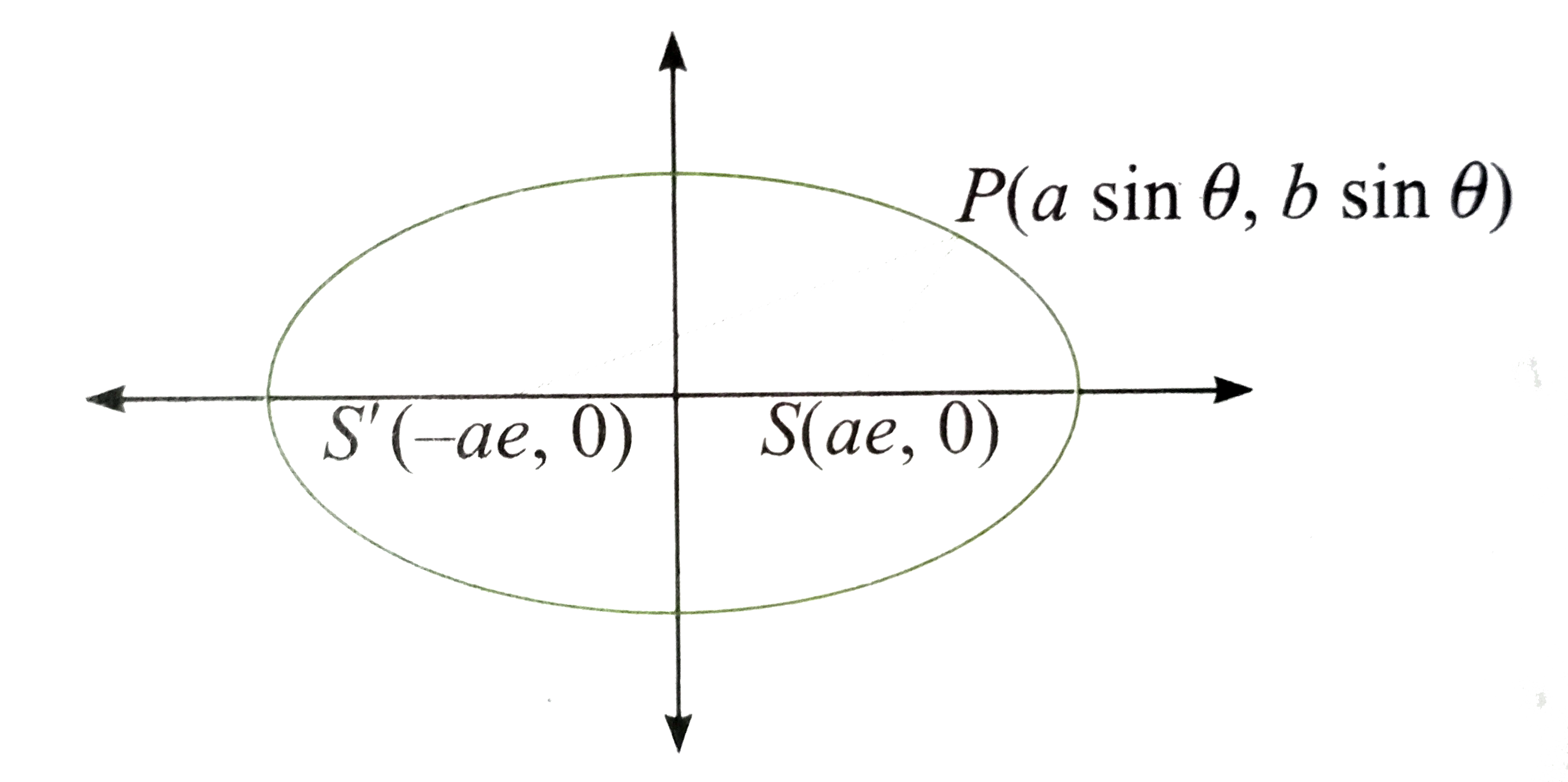
Let S and S' be the foci of the ellipse `(x^(2))/(a^(2))+(y^(2))/(b^(2))=1` whose eccentricity is e. P is a variable point on the ellipse. Consider the locus the incentre of `DeltaPSS'`
. The locus of the incenter is a\an

A

a) ellipse

B

b) hyperbola

C

c) parabola

D

d) circle

Text Solution

Verified by Experts


Let the coordinates of P be `(a cos theta, b sin theta)`
Here, SP= Focal distance of point `P=a-ae cos theta`
`S''P=a+ae cos theta`
SS''=2ae
If (h,k) are the coordinates of the incenter of `DeltaPSS''`, then
`h=(2ae(a cos theta)+a(1-ecos theta)(-ae)+a(1+e cos theta)ae)/(2ae+a(1-e cos theta)+a(1+e cos theta)`
`as cos theta" "(1)`
`and k=(2ae(a sin theta)+a(1-ecos theta)xx0+a(1+e cos theta)xx0)/(2ae+a(1-e cos theta)+a(1+e cos theta))`
`=(eb sin theta)/((e+1))" "(2)`
Eliminating `theta` from (1) and (2), we get
`(x^(2))/(a^(2)e^(2))+(y^(2))/({be//(e+1)}^(2))=1`
Which clearly represents an ellipse. Let `e_(1)` be its eccentricity . Then
`(b^(2)e^(2))/((e+1)^(2))=a^(2)e^(2)(1-e_(1)^(2))`
or`e_(1)^(2)=1-(b^(2))/(a^(2)(e+1)^(2))`
`or e_(1)^(2)=1-(1-e^(2))/((e+1))=1-(1-e)/(1+e)`
`or e_(1)^(2)=(2e)/(e+1)`
`or e_(1)=sqrt((2e)/(e+1))`
Maximum area of reactangle is
`2(ae)(("be")/(e+1))=(2abe^(2))/(e+1)`
Promotional Banner

Similar Questions

Explore conceptually related problems

Let S and S' be the fociof the ellipse (x^(2))/(a^(2))+(y^(2))/(b^(2))=1 whose eccentricity is e. P is a variable point on the ellipse. Consider the locus the incenter of DeltaPSS' The eccentricity of the locus of the P is

Let S and S'' be the foci of the ellipse (x^(2))/(a^(2))+(y^(2))/(b^(2))=1 whose eccentricity is i.e. P is a variable point on the ellipse. Consider the locus of the incenter of DeltaPSS'' The maximum area of recatangle inscribed in the locus is

P and Q are two points on the ellipse (x^(2))/(a^(2)) +(y^(2))/(b^(2)) =1 whose eccentric angles are differ by 90^(@) , then

The eccentricity of ellipse (x^(2))/(25)+(y^(2))/(9)=1 is ……………. .

Find the eccentricity of an ellipse (x^2)/(a^2)+(y^2)/(b^2)=1 whose latus rectum is half of its major axis. (agtb)

S and T are the foci of the ellipse x^(2)/a^(2)+y^(2)/b^(2)=1 and B is an end of the minor axis. If STB is an equilateral triangle, the eccentricity of the ellipse is . . .

P and Q are the foci of the ellipse (x^2)/(a^2)+(y^2)/(b^2)=1 and B is an end of the minor axis. If P B Q is an equilateral triangle, then the eccentricity of the ellipse is

Let P be a point on the ellipse (x^2)/(a^2)+(y^2)/(b^2)=1 of eccentricity edot If A ,A ' are the vertices and S ,S are the foci of the ellipse, then find the ratio area P S S ' ' : area A P A^(prime)dot

The normal at a variable point P on the ellipse (x^2)/(a^2)+(y^2)/(b^2)=1 of eccentricity e meets the axes of the ellipse at Qa n dRdot Then the locus of the midpoint of Q R is a conic with eccentricity e ' such that e^(prime) is independent of e (b) e^(prime)=1 e^(prime)=e (d) e^(prime)=1/e

Let Sa n dS ' be two foci of the ellipse (x^2)/(a^2)+(y^2)/(b^2)=1 . If a circle described on S S^(prime) as diameter intersects the ellipse at real and distinct points, then the eccentricity e of the ellipse satisfies (a) c=1/(sqrt(2)) (b) e in (1/(sqrt(2)),1) (c) e in (0,1/(sqrt(2))) (d) none of these