Home
Class 12
MATHS
The tangents drawn from a point P to ell...

The tangents drawn from a point P to ellipse `(x^(2))/(a^(2))+(y^(2))/(b^(2))=1` make angles `alpha and beta` with the transverse axis of the hyperbola, then

Text Solution

Verified by Experts
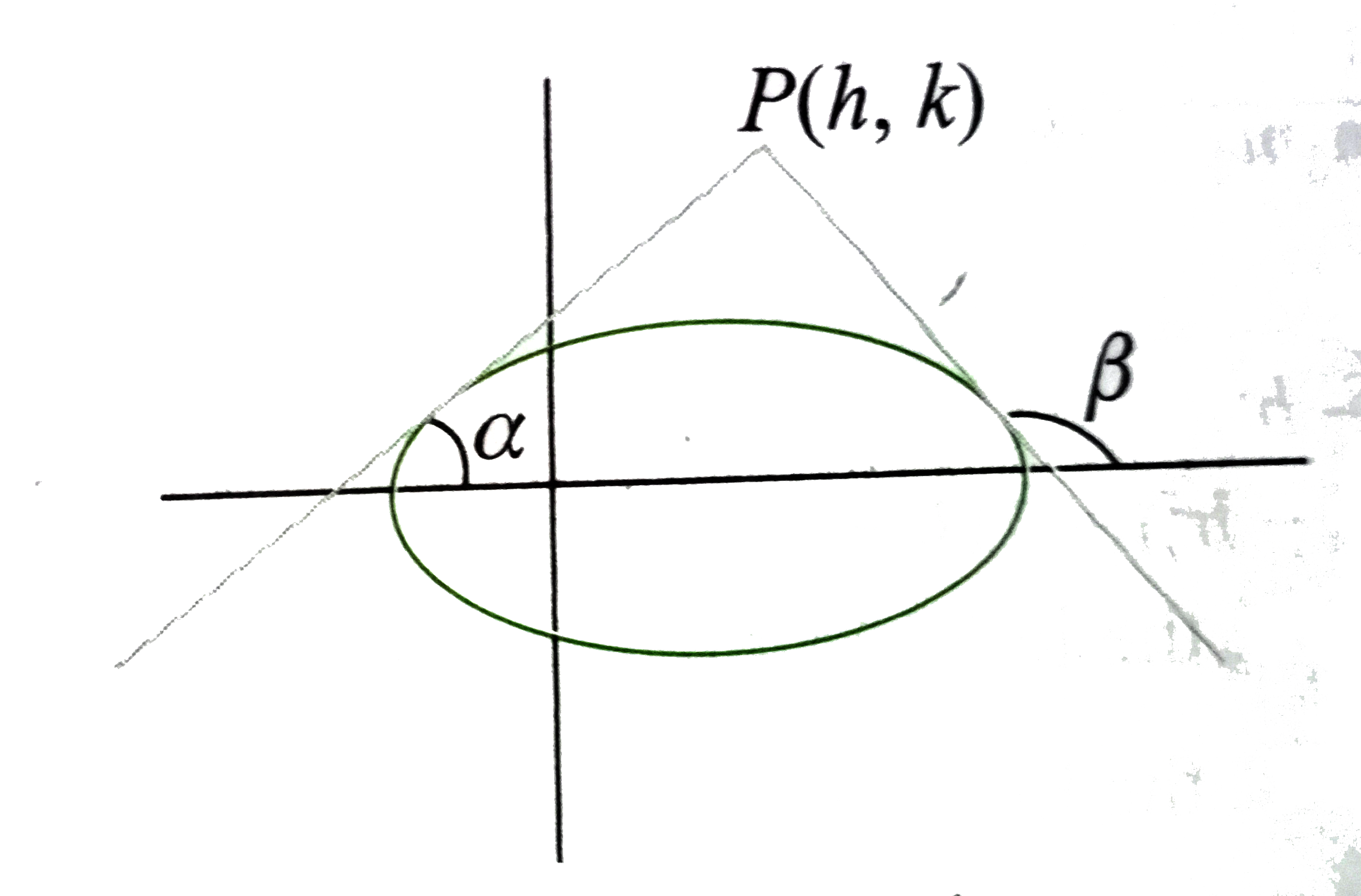
The equation of any tangent to
`(x^(2))/(a^(2))+(y^(2))/(b^(2))=1" "(1)`
is given by
`y=mx+sqrt(a^(2)m^(2)+b^(2))`

Sinc the passes through P(h,k) we have
`k=mh+sqrt(a^(2)m^(2)+b^(2))`
or `m^(2)(h^()-a^(12))-2kmnh++(k^(2)+b^(2))=0" "(2)`
As (2) is quadratic in m, having two roots `m_(1) andm_(2)` (ay), we age
`m_(1)+m_(2)=(2hk)/(h^(2)-a^(2)),m_(1)m_(2)=(k^(2)-b^(2))/(h^(2)-a^(2)) " "(3)`
or `tan(alpha+beta)=(tan alpha+tanbeta)/(1-tan alpha tan beta)`
`=(m_(1)+m_(2))/(1-m_(1)m_(2))=(2hk//(h^(2)-a^(2)))/(1-{(kl^(2)-b^(2))//(h^(2)-a^(2))})=(2hk)/(h^(2)-k^(2)-a^(2)+b^(2))`
(a) `alpha+beta=(cpi)/(2)` ltbrtgt When c even,
`m_(1)+m_(2)=0`
`(2kh)/(h^(2)-a^(2))=0`
or `2kh=0`
`xy=0`
Which is the equation of a pair of straight lines.
Whnen c is odd,
`1-m_(1)m_(2)=0`
`or (k^(2)-b^(2))/(h^(2)-a^(2))=1`
Therefore, the locus of (h,k) is `y^(2)-b^(2)=x^(2)-a^(2)`
which is a hyperbola.
(b) `m_(1)m_(2)=c`
or `(k^(2)-b^(2))/(h^(2)-a^(2))=c`
when `c=0,k=+-b`, the locus is a pair of straigth lines.
When `c=1,h^(2)-k^(2)=a^(2)-b^(2)`, the locusb is a hyperbola.
When `c-1,h^(2)+k^(2)=a^(2)+b^(2),` the locus is a circle
When `c=-2,2h^(2)+k^(2)=2a^(2)+b^(2)`, the locus is an ellipse
(c) `tan alpha+beta=c`
or `m_(1)+m_(2)=c`
When `c=0,kh,2-kh=0`, the locus ia pair of straight lines,
When `c ne 0`
`c(h^(2)-a^(2))-2kh=0`
the locus of (h,k) is `cx^(2)-2kh=0`
`Deta=-ca^(2)ne0`
Also,` h^(2)-ab=gt0`
Therefore, the locus is a hyperboal or `cne=0`
(d) `cot alpha+cos beta=c`
or `(1)/(m_(1))+(1)/(m_(2))=c`
or `(m_(1)+m_(2))/(m_(1)m_(2))=c`
or `(2kh)/(k^(2)-b^(2))=c`
When c=0, the locus is pair of straigth lines
Wehn `cne0`, the locus is hyperbola (as in previous case c)
Promotional Banner

Similar Questions

Explore conceptually related problems

Tangents drawn from the point (c, d) to the hyperbola (x^(2))/(a^(2))-(y^(2))/(b^(2))=1 make angles alpha and beta with the x-axis. If tan alpha tan beta=1 , then find the value of c^(2)-d^(2) .

The tangents drawn from a point P to the ellipse (x^2)/(a^2)+(y^2)/(b^2)=1 make angles alphaa n dbeta with the major axis. Column I, Column II If alpha+beta=(cpi)/2,(c in N), then locus of p can be, p. Circle If tanalphatanbeta=c ,(c in R), then the locus of P can be, q. Ellipse If tanalpha+tanbeta=c , (where c in R), then the locus of P can be, r. Hyperbola If cotalpha+cotbeta=c , (where c in R), then the locus of P can be, s. Pair of straight lines

The locus of the point which is such that the chord of contact of tangents drawn from it to the ellipse (x^2)/(a^2)+(y^2)/(b^2)=1 forms a triangle of constant area with the coordinate axes is a straight line (b) a hyperbola an ellipse (d) a circle

Two tangents are drawn from a point on hyperbola x^(2)-y^(2)=5 to the ellipse (x^(2))/(9)+(y^(2))/(4)=1 . If they make angle alpha and beta with x-axis, then

If the tangent at any point of the ellipse (x^2)/(a^2)+(y^2)/(b^2)=1 makes an angle alpha with the major axis and an angle beta with the focal radius of the point of contact, then show that the eccentricity of the ellipse is given by e=cosbeta/(cosalpha)

A tangent is drawn at any point on the hyperbola (x^(2))/(a^(2))-(y^(2))/(b^(2)) =1 . If this tangent is intersected by the tangents at the vertices at points P and Q, then which of the following is/are true

If the chords of contact of tangents from two points (-4,2) and (2,1) to the hyperbola (x^(2))/(a^(2))-(y^(2))/(b^(2))=1 are at right angle, then find then find the eccentricity of the hyperbola.

Find the points on the ellipse (x^2)/(a^2)+(y^2)/(b^2)=1 such that the tangent at each point makes equal angles with the axes.

Find the points on the ellipse (x^2)/(a^2)+(y^2)/(b^2)=1 such that the tangent at each point makes equal angles with the axes.

Tangents are drawn from any point on the circle x^(2)+y^(2) = 41 to the ellipse (x^(2))/(25)+(y^(2))/(16) =1 then the angle between the two tangents is

