Home
Class 12
MATHS
The normal at a point P on the ellipse x...

The normal at a point `P` on the ellipse `x^2+4y^2=16` meets the x-axis at `Qdot` If `M` is the midpoint of the line segment `P Q ,` then the locus of `M` intersects the latus rectums of the given ellipse at points. `(+-((3sqrt(5)))/2+-2/7)` (b) `(+-((3sqrt(5)))/2+-(sqrt(19))/7)` `(+-2sqrt(3),+-1/7)` (d) `(+-2sqrt(3)+-(4sqrt(3))/7)`

A

`(+-3sqrt(5)//2,+-2//7)`

B

`(+-3sqrt(5)//2,+-sqrt(19)//7)`

C

`+-2sqrt(3),+-17)`

D

`(+-2sqrt(3),+-4sqrt(3)//7)`

Text Solution

Verified by Experts

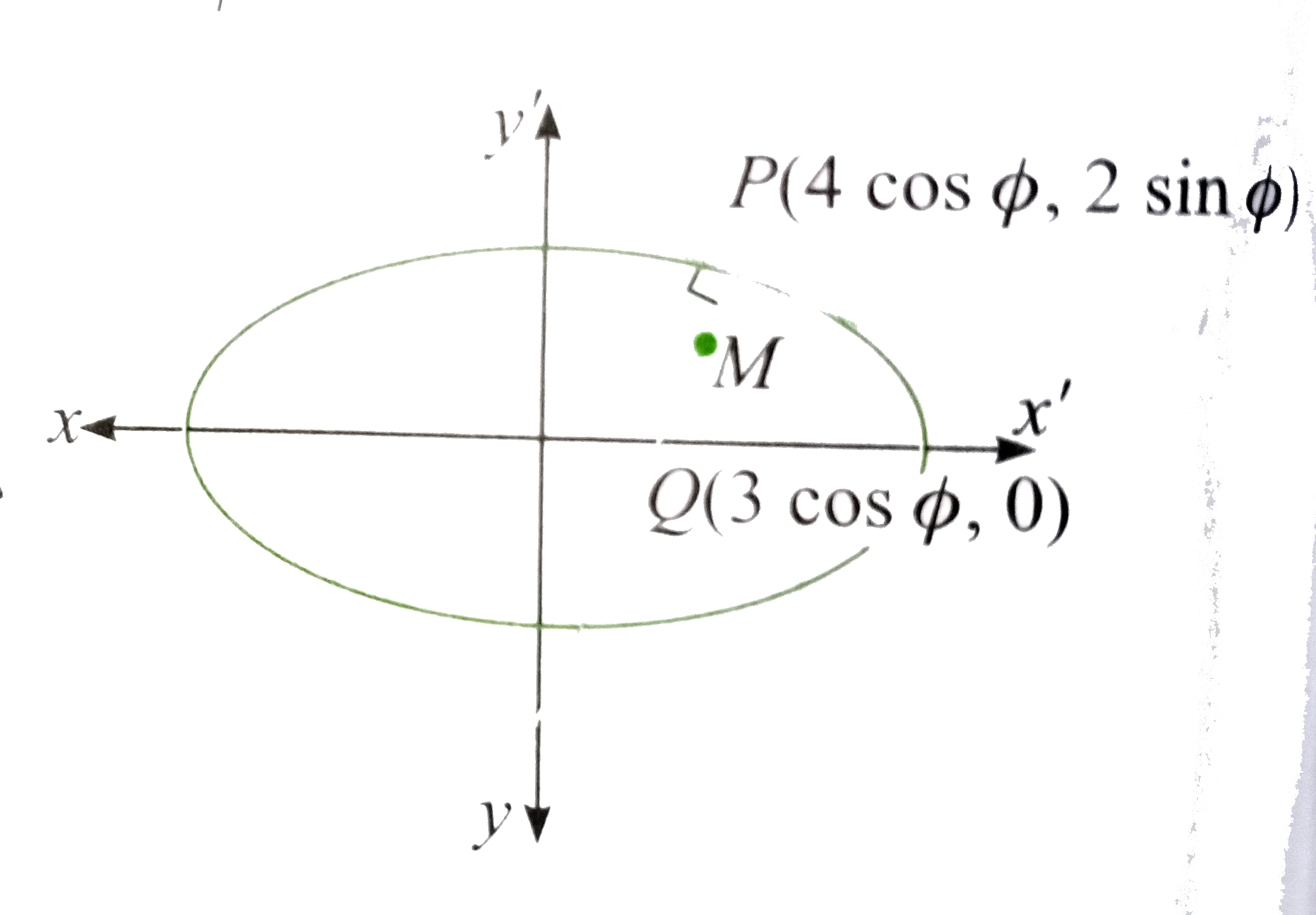
Given ellipse is `(x^(2))/(16)+(y^(2))/(4)=1`. Normal at `P(4 cos phi, 2 sin phi)`,
given by `4x sec phi-2y "cosec"phi=12`
It meets x-axist at
Let `M-=(alpha,beta)`
be the point of PQ.

`:. alpha=(3cos phi+4 cos phi)/(2)`
`=(7)/(2)cos phi`
or `cos phi=(2)/(7)alpha`
Using `cos^(2)phi+sin^(2)phi=1`, we have
`(4)/(49)alpha^(2)+beta^(2)=1`
or `(4)/(49)x^(2)+y^(2)=1`
Now, the rectum lines of given ellipse are `x=+-2sqrt(3)`
Solving (1) and (2), we have
`(48)/(49)+y^(2)=1`
`or y=+-(1)/(7)`
The points of intersection are `(+-2sqrt(3),+-1//7)`
Promotional Banner

Similar Questions

Explore conceptually related problems

The normal at a point P on the ellipse x^2+4y^2=16 meets the x-axis at Qdot If M is the midpoint of the line segment P Q , then the locus of M intersects the latus rectums of the given ellipse at points. (a) (+-((3sqrt(5)))/2+-2/7) (b) (+-((3sqrt(5)))/2+-(sqrt(19))/7) (c) (+-2sqrt(3),+-1/7) (d) (+-2sqrt(3)+-(4sqrt(3))/7)

Simplify (1)/(3 - sqrt(8)) - (1)/(sqrt(8) - sqrt(7)) + (1)/(sqrt(7) - sqrt(6)) - (1)/(sqrt(6) - sqrt(5)) + (1)/(sqrt(5) - 2)

Points on the curve f(x)=x/(1-x^2) where the tangent is inclined at an angle of pi/4 to the x-axis are (a)(0,0) (b) (sqrt(3),-(sqrt(3))/2) (-2,2/3) (d) (-sqrt(3),(sqrt(3))/2)

int_(-1)^(1/2)(e^x(2-x^2)dx)/((1-x)sqrt(1-x^2))i se q u a lto (sqrt(e))/2(sqrt(3)+1) (b) (sqrt(3e))/2 sqrt(3e) (d) sqrt(e/3)

Tangent of acute angle between the curves y=|x^2-1| and y=sqrt(7-x^2) at their points of intersection is (5sqrt(3))/2 (b) (3sqrt(5))/2 (5sqrt(3))/4 (d) (3sqrt(5))/4

If x=1+1/(3+1/(2+1/(3+1/(2oo)))) a sqrt(5/2) b. sqrt(3/2) c. sqrt(7/3) d. sqrt(5/3)

The points on the line x=2 from which the tangents drawn to the circle x^2+y^2=16 are at right angles is (are) (a) (2,2sqrt(7)) (b) (2,2sqrt(5)) (c) (2,-2sqrt(7)) (d) (2,-2sqrt(5))

If the eccentricity of the ellipse, x^2/(a^2+1)+y^2/(a^2+2)=1 is 1/sqrt6 then latus rectum of ellipse is

The abscissas of point Pa n dQ on the curve y=e^x+e^(-x) such that tangents at Pa n dQ make 60^0 with the x-axis are. 1n((sqrt(3)+sqrt(7))/7)a n d1n((sqrt(3)+sqrt(5))/2) 1n((sqrt(3)+sqrt(7))/2) (c) 1n((sqrt(7)-sqrt(3))/2) +-1n((sqrt(3)+sqrt(7))/2)