Home
Class 12
MATHS
Consider two straight lines, each of ...

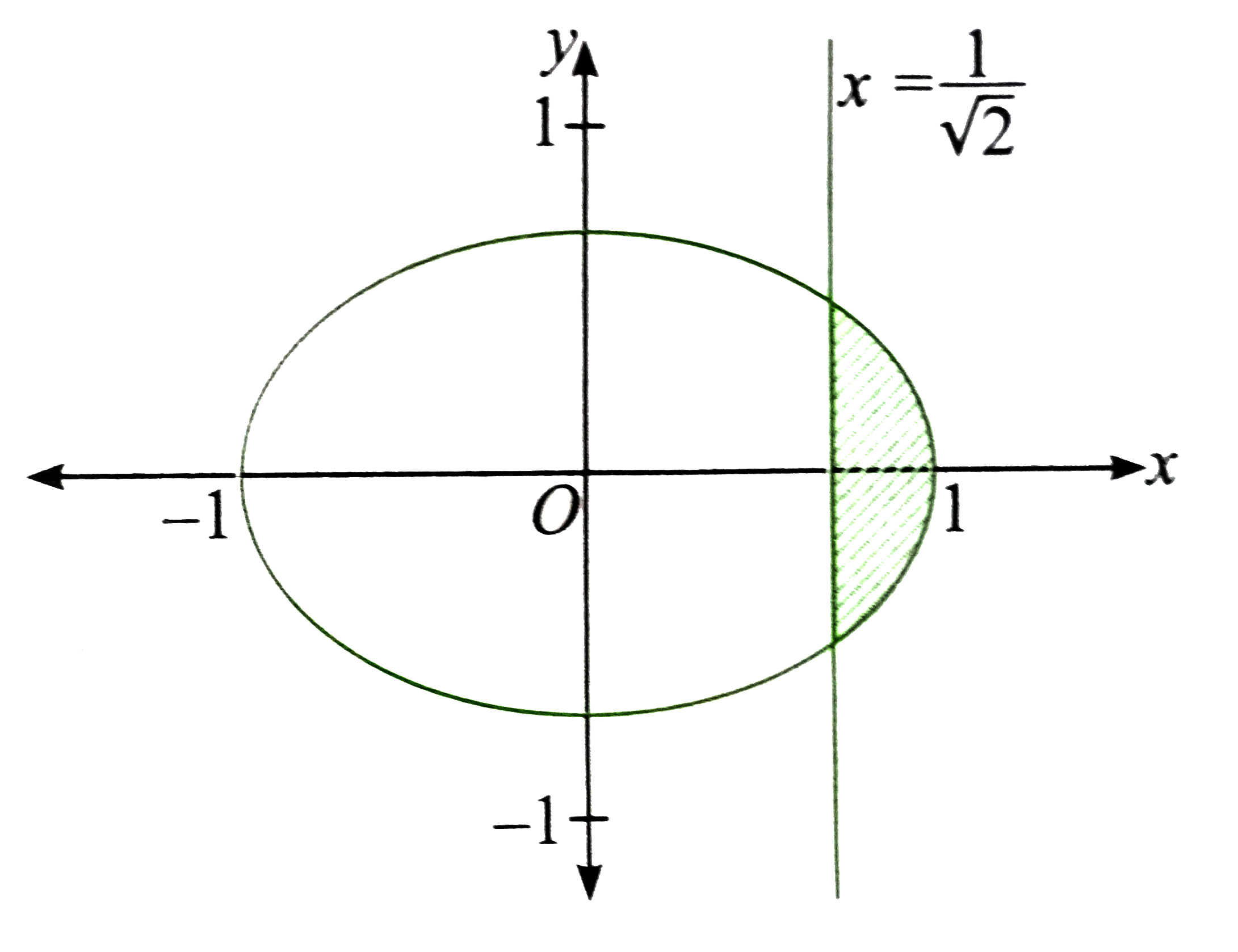
Consider two straight lines, each of which is tangent to both the circle `x^2+y^2=1/2` and the parabola `y^2=4x` . Let these lines intersect at the point `Q` . Consider the ellipse whose center is at the origin `O(0,\ 0)` and whose semi-major axis is `O Q` . If the length of the minor axis of this ellipse is `sqrt(2)` , then which of the following statement(s) is (are) TRUE? For the ellipse, the eccentricity is `1/(sqrt(2))` and the length of the latus rectum is 1 (b) For the ellipse, the eccentricity is `1/2` and the length of the latus rectum is `1/2` (c) The area of the region bounded by the ellipse between the lines `x=1/(sqrt(2))` and `x=1` is `1/(4sqrt(2))(pi-2)` (d) The area of the region bounded by the ellipse between the lines `x=1/(sqrt(2))` and `x=1` is `1/(16)(pi-2)`

A

For the ellipse, the eccentricity is `(1)/(sqrt(2))` and the length the latcus rectue is 1

B

For the ellipse, the eccentricity is `(1)/(2)` and the length the latcus rectue is `(1)/(2)`

C

The erea of the reagion bounded by the ellipse between the lines `x=(1)/(sqrt(2)) and x=1 "is" (1)/(4sqrt(4)) (pi-2)`

D

The erea of the region bounded by the ellipse between the lines `x=(1)/(sqrt(2)) and x=1 "is" (1)/(16)(pi-12)`

Text Solution

Verified by Experts

Equation of tangent of parabola `y^(2)=4x` having slop is `y=mx+(1)/(m)` ltbr If this is tangent to circle `x^(2)+y^(2)=1//2`.
If this is tangent of circle `x^(2)+y^(2)=1//2`, then distance form centre of the circle from the line is equal to radius.
`:.|(0+0+(1)/(m))/(sqrt(1+m^(2)))|=(1)/(sqrt(2))`
`:. m^(4)+m^(2)-2=0`
`:. m=+-`
Euqation of common tangens are `y=x+1 and y=-x-1`
These tangents intersects at point Q which is (-1,0) .
`:. OQ=1`
Let the equation of ellipese be `(x^(2))/(a^(2))+(y^(2))/(b^(2))=1`
`:. a=OQ=1`
Let the equation of ellipse be `(x^(2))/(a^(2))+(y^(2))/(b^(2))=1`
`:.a=OQ=1`
also, given that `2b=sqrt(2) or b=(1)/(sqrt(2))`
Thererfore, equation of ellipse is `(x^(2))/(1)+(y^(2))/(1//2)=1`
`e=sqrt(1-(b^(2))/(a^(2)))=sqrt(1-(1)/(2))=(1)/(sqrt(2))`
`L.R.=(2b^(2))/(a)=1`

Leh the area bounded by ellipse and lines `x=(1)/(sqrt(2)) and x=1` be A.
`A=2xxunderset(1//sqrt(2))overset(1)int(1)/(sqrt(2))sqrt(1-x^(2))dx`
`=sqrt(2)[(x)/(2)sqrt(1-x^(2))+(1)/(2)sin^(-1)x]_(1//sqrt(2))^(1)`
`=sqrt(2)[(pi)/(4)-((1)/(4)+(pi)/(8))]=sqrt(2)((pi)/(8)-(1)/(4))=(pi-2)/(4sqrt(2))`
Promotional Banner

Similar Questions

Explore conceptually related problems

An ellipse, with foci at (0, 2) and (0, –2) and minor axis of length 4, passes through which of the following points?

In each of the Find the coordinates of the foci, the vertices, the length of major axis, the minor axis, the eccentricity and the length of the latus rectum of the ellipse. 4x^(2)+9y^(2)=36

In each of the Find the coordinates of the foci, the vertices, the length of major axis, the minor axis, the eccentricity and the length of the latus rectum of the ellipse. (x^(2))/(4)+(y^(2))/(25)=1

In each of the Find the coordinates of the foci, the vertices, the length of major axis, the minor axis, the eccentricity and the length of the latus rectum of the ellipse. 36x^(2)+4y^(2)=144

In each of the Find the coordinates of the foci, the vertices, the length of major axis, the minor axis, the eccentricity and the length of the latus rectum of the ellipse. (x^(2))/(36)+(y^(2))/(16)=1

In each of the Find the coordinates of the foci, the vertices, the length of major axis, the minor axis, the eccentricity and the length of the latus rectum of the ellipse. (x^(2))/(16)+(y^(2))/(9)=1

In each of the Find the coordinates of the foci, the vertices, the length of major axis, the minor axis, the eccentricity and the length of the latus rectum of the ellipse. (x^(2))/(25)+(y^(2))/(100)=1

In each of the Find the coordinates of the foci, the vertices, the length of major axis, the minor axis, the eccentricity and the length of the latus rectum of the ellipse. (x^(2))/(49)+(y^(2))/(36)=1

In each of the Find the coordinates of the foci, the vertices, the length of major axis, the minor axis, the eccentricity and the length of the latus rectum of the ellipse. (x^(2))/(100)+(y^(2))/(400)=1

The tangents to the parabola y^2=4x at the points (1, 2) and (4,4) meet on which of the following lines?