Home
Class 12
MATHS
Consider equation (x - sin alpha) (x-cos...

Consider equation `(x - sin alpha) (x-cos alpha) - 2 = 0` . Which of the following is /are true?

A

If `0lt alpha lt (pi)/(4)`, then the equation has both roots in `(sin alpha, cos alpha)`

B

If `(pi)/(4) lt alpha (pi)/(2)`, then the equations has both roots in `(sin alpha, cos alpha oo)`

C

If `0lt alpha lt (pi)/(4)`, the one roots lies in `(-oo, sin alpha)` and the other in `(sin alpha, oo)`

D

If `(pi)/(4) lt alpha lt (pi)/(2)` then one root lies in `(-oo, cos alpha )` and the other is `(sin alpha, oo)`

Text Solution

Verified by Experts

The correct Answer is:
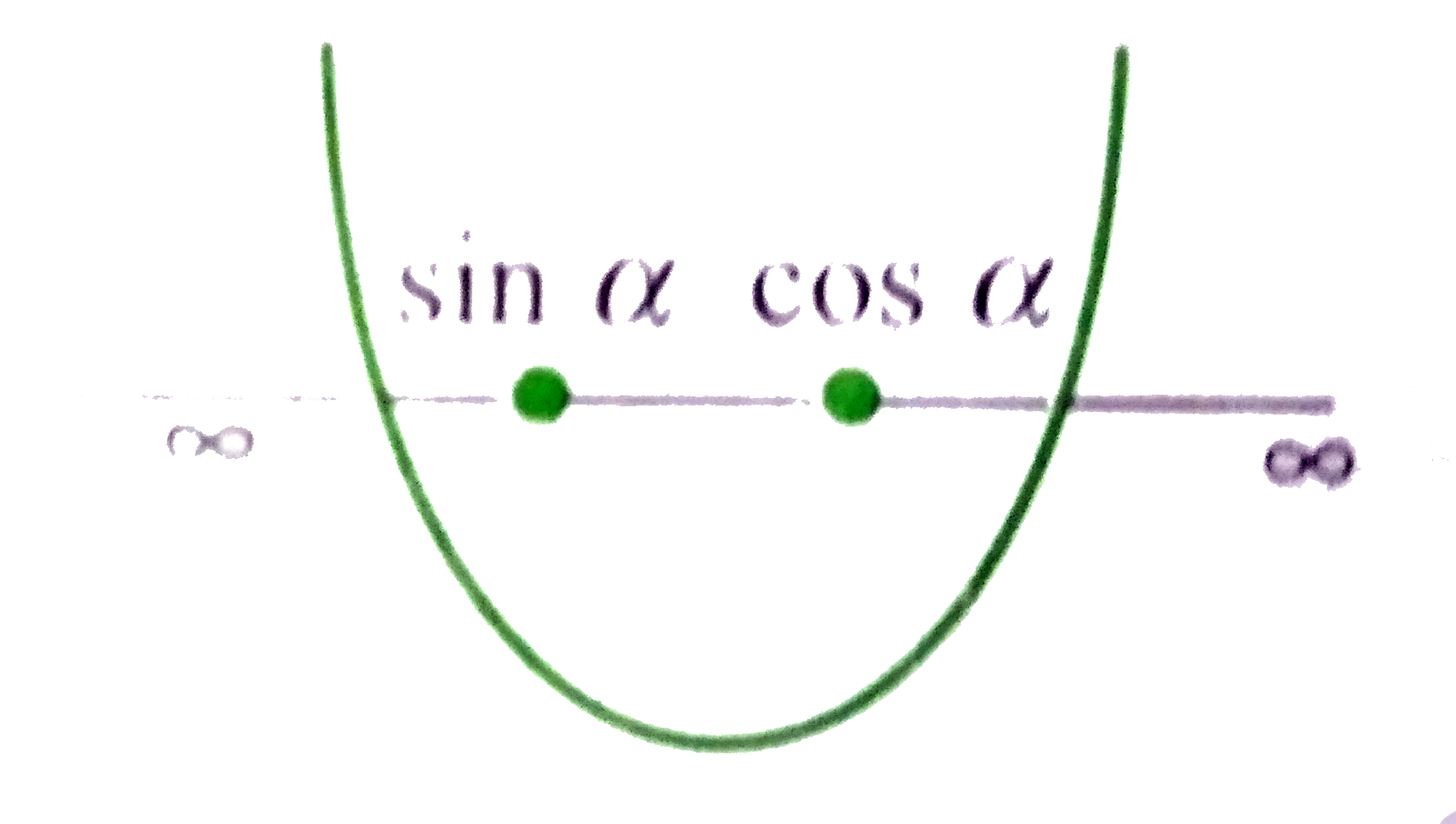
3,4

Let , `f(x) = (x - sin alpha ) (x - cos alpha) - 2 `
Then. ` f(sin alpha) = - 2 lt 0 ` and
` f(cos alpha) = - 2 lt 0 ` and
` f(cos alpha ) = - 2 lt 0 `
So, sin ` alpha and cos alpha ` lie between the
roots

Promotional Banner

Topper's Solved these Questions

  • THEORY OF EQUATIONS

    CENGAGE|Exercise Exercise (Comprehension)|37 Videos
  • THEORY OF EQUATIONS

    CENGAGE|Exercise Exercise (Matrix)|6 Videos
  • THEORY OF EQUATIONS

    CENGAGE|Exercise Exercise (Single)|89 Videos
  • STRAIGHT LINES

    CENGAGE|Exercise JEE Advanced Previous Year|4 Videos
  • THREE DIMENSIONAL GEOMETRY

    CENGAGE|Exercise Question Bank|12 Videos

Similar Questions

Explore conceptually related problems

(cos2 x - cos2 alpha)/(cos x - cos alpha)

Let f(x)=sin^(2)(x +alpha)+sin^(2)(x +beta)-2cos(alpha-beta)sin(x+alpha)sin(x +beta) . Which of the following is TRUE ?

If the sum of squares of roots of equation x^(2)-(sin alpha-2)x-(1+sin alpha)=0 is the least, then alpha is equal to

For the hyperbola x^2/ cos^2 alpha - y^2 /sin^2 alpha = 1 which of the following remains constant when alpha varies?

Repeated roots : If equation f(x) = 0, where f(x) is a polyno- mial function, has roots alpha,alpha,beta,… or alpha root is repreated root, then f(x) = 0 is equivalent to (x-alpha)^(2)(x-beta)…=0, from which we can conclude that f(x)=0 or 2(x-alpha)[(x-beta)...]+(x-alpha)^(2)[(x-beta)...]'=0 or (x-alpha) [2 {(x-beta)...}+(x-alpha){(x-beta)...}']=0 has root alpha . Thus, if alpha root occurs twice in the, equation, then it is common in equations f(x) = 0 and f'(x) = 0. Similarly, if alpha root occurs thrice in equation, then it is common in the equations f(x)=0, f'(x)=0, and f'''(x)=0. If alpha root occurs p times and beta root occurs q times in polynomial equation f(x)=0 of degree n(1ltp,qltn) , then which of the following is not ture [where f^(r)(x) represents rth derivative of f(x) w.r.t x] ?

If sin alpha + cos alpha = b, then sin 2 alpha is equal to

If sin(x +3alpha)=3 sin (alpha-x) , then

Let lambda and alpha be real. Then the numbers of intergral values lambda for which the system of linear equations lambdax +(sin alpha) y+ (cos alpha) z=0 x + (cos alpha) y+ (sin alpha) z=0 -x+(sin alpha) y -(cos alpha) z=0 has non-trivial solutions is

If sin alpha + cos alpha = b then sin 2 alpha is equal to . . . . .

alpha,beta,gammaa n ddelta are angle in I, II, III and iv quadrants, respectively and none of them is an integral multiple of pi/2dot They form an increasing arithmetic progression. Which of the following holds? cos(alpha+delta)>0 cos(alpha+delta)=0 cos(alpha+delta) 0orcos(alpha+delta)<0 Which of the following does not hold? sin(beta+gamma)=sin(alpha+delta) sin(beta-gamma)="sin"(alpha-delta) sin(alpha-beta)="tan"(beta-delta) sin(alpha+gamma)=cos2beta) If alpha+beta+gamma+delta=thetaa n dalpha=70^0, then 400^0

CENGAGE-THEORY OF EQUATIONS-Exercise (Multiple)
  1. If (x^(2) + 5)/(2) = x - 2 cos (m + nx) has at least one real root, ...

    Text Solution

    |

  2. Let three quadratic equations ax^(2) - 2bx + c = 0, bx^(2) - 2 cx + a...

    Text Solution

    |

  3. For the quadratic equation x^2+2(a+1)x+9a-5=0, which of the following ...

    Text Solution

    |

  4. If a ,b ,c in Ra n da b c<0 , then equation b c x^2+2(b+c-a)x+a=0h a ...

    Text Solution

    |

  5. The graph of the quadratic trinomial u=a x^2+b x+c has its vertex at (...

    Text Solution

    |

  6. Let a ,b ,c in Q^+ satisfying a > b > cdot Which of the following sta...

    Text Solution

    |

  7. Let f(X) = ax^(2) + bx + c . Consider the following diagram .

    Text Solution

    |

  8. Graph of y = ax^(2) + bx + c is as shown in the figure . If PQ= 9, ...

    Text Solution

    |

  9. ax^2 + bx + c = 0(a > 0), has two roots alpha and beta such alpha < -2...

    Text Solution

    |

  10. If the equation ax^(2) + bx + c = 0, a,b, c, in R have non -real ro...

    Text Solution

    |

  11. If cos x - y^(2) - sqrt(y - x ^(2) - 1 )ge 0 , then

    Text Solution

    |

  12. If a x^2+(b-c)x+a-b-c=0 has unequal real roots for all c in R ,t h e ...

    Text Solution

    |

  13. If (x^2+a x+3)//(x^2+x+a) takes all real values for possible real valu...

    Text Solution

    |

  14. If the range of function f(x) = (x + 1)/(k+x^(2)) contains the inter...

    Text Solution

    |

  15. Consider equation (x - sin alpha) (x-cos alpha) - 2 = 0 . Which of the...

    Text Solution

    |

  16. If the roots of the equation, x^3 + px^2+qx-1 = 0 form an increasing G...

    Text Solution

    |

  17. Consider a quadratic equation ax^2 + bx + c = 0 having roots alpha, b...

    Text Solution

    |

  18. The equaiton ((x)/(x+1))^(2) + ((x)/(x-1))^(2) = a(a-1) has

    Text Solution

    |

  19. lf the quadratic equations x^2+bx+c=0 and bx^2+cx+1=0 have a common r...

    Text Solution

    |

  20. If the inequality cot^(2)x + (k +1) cot x - (k-3) < 0 is true for at ...

    Text Solution

    |