Home
Class 12
MATHS
Let a ,b ,c be real. If a x^2+b x+c=0 ha...

Let `a ,b ,c` be real. If `a x^2+b x+c=0` has two real roots `alphaa n dbeta,w h e r ealpha<<-1a n dbeta>>1` , then show that `1+c/a+|b/a|<0`

Text Solution

Verified by Experts
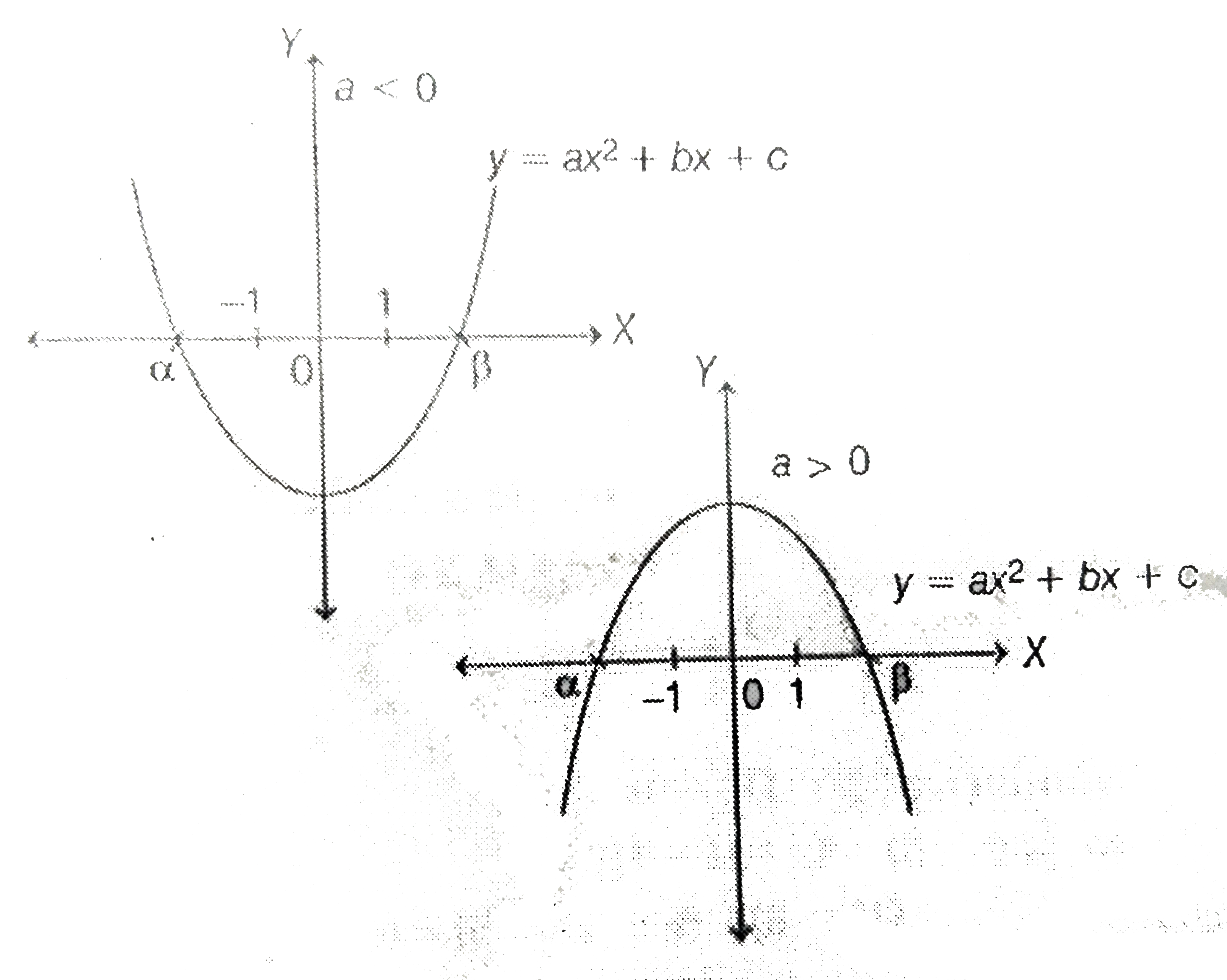

From figure it is clear that, if `a gt0,` then `f(-1)lt0and f(1)lt0 and if a gt0,f(-1)gt0 and f(1)gt0.` In both cases, `af(-1)lt0and af(1)lt0.`
`impliesa(a-b+c)lt0and a (a+b+c)lt0`
on dividing by `a^(2),` we get
`1-b/a+c/alt0 and 1+b/a+c/alt0`
On combining both, we get
`1pmb/a+c/alt0`
`impliesa+|(b)/(a)|+c/alt0`
Promotional Banner

Similar Questions

Explore conceptually related problems

If a x^2+(b-c)x+a-b-c=0 has unequal real roots for all c in R ,t h e n

If ax^2 + bx + c = 0, a, b, c in R has no real zeros, and if a + b + c + lt 0, then

If b^2<2a c , then prove that a x^3+b x^2+c x+d=0 has exactly one real root.

If alpha is a real root of the quadratic equation a x^2+b x+c=0a n dbeta ils a real root of -a x^2+b x+c=0, then show that there is a root gamma of equation (a//2)x^2+b x+c=0 whilch lies between alpha & beta

Let a ,b ,c be real numbers with a!=0a n dl e talpha,beta be the roots of the equation a x^2+b x+c=0. Express the roots of a^3x^2+a b c x+c^3=0 in terms of alpha,betadot

If alpha,beta are real and distinct roots of a x^2+b x-c=0a n dp ,q are real and distinct roots of a x^2+b x-|c|=0,w h e r e(a >0), then alpha,beta in (p ,q) b. alpha,beta in [p ,q] c. p ,q in (alpha,beta) d. none of these

If alpha,beta are the roots of a x^2+b x+c=0a n dalpha+h ,beta+h are the roots of p x^2+q x+r=0then h= a. -1/2(a/b-p/q) b. (b/a-q/p) c. 1/2(b/a-q/p) d. none of these

Let a in R and f : R rarr R be given by f(x)=x^(5)-5x+a , then (a) f(x)=0 has three real roots if a gt 4 (b) f(x)=0 has only one real root if a gt 4 (c) f(x)=0 has three real roots if a lt -4 (d) f(x)=0 has three real roots if -4 lt a lt 4

If roots of the equation a x^2+b x+c=0 are alphaa n dbeta , find the equation whose roots are 1/alpha,1/beta (ii) -alpha,-beta (iii) (1-alpha)/(1+alpha),(1-beta)/(1+beta)

If 2a+3b+6c = 0, then show that the equation a x^2 + bx + c = 0 has atleast one real root between 0 to 1.

