Home
Class 12
MATHS
Let F(1)(x(1),0) and F(2)(x(2),0) for x...

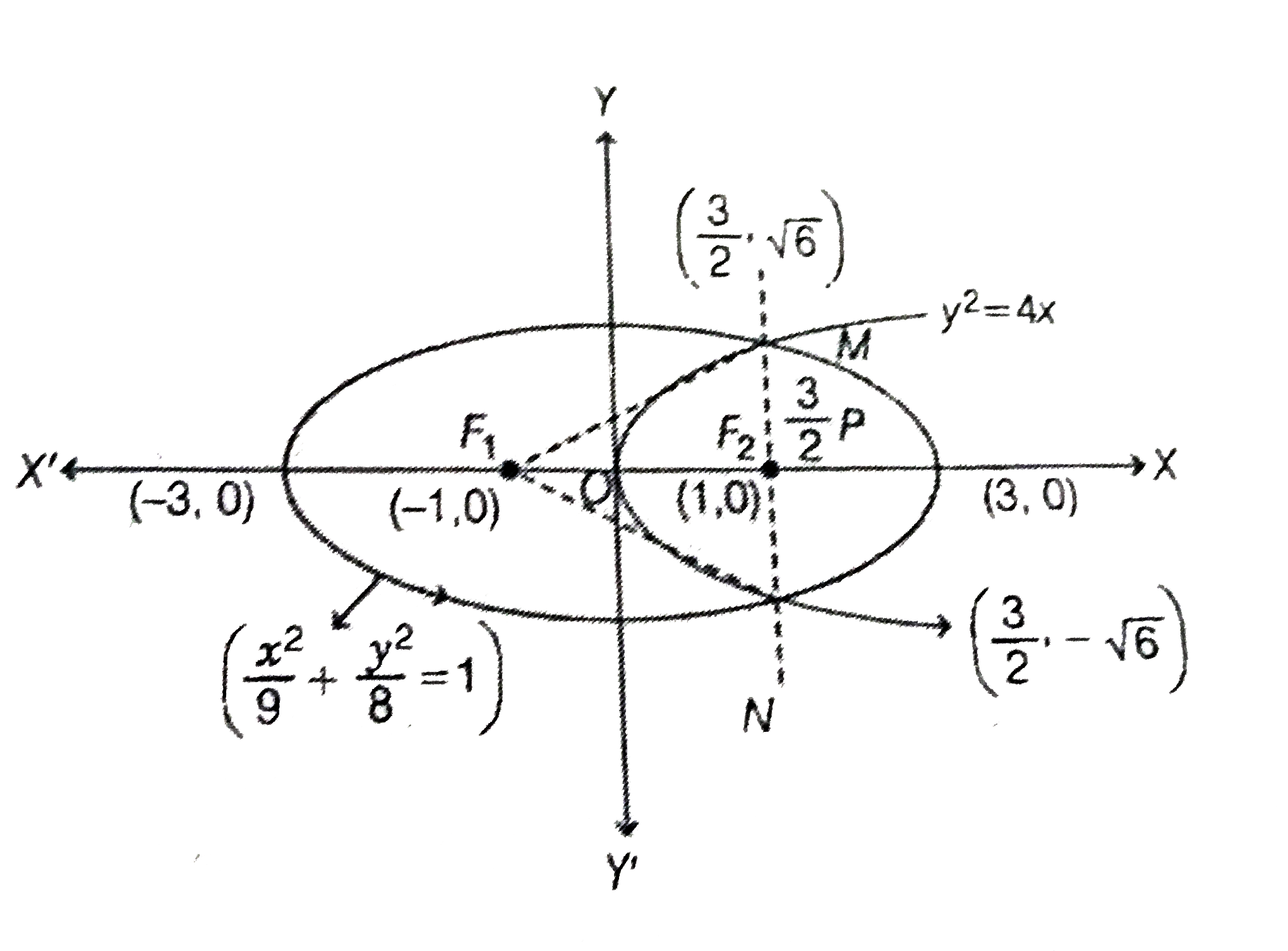
Let `F_(1)(x_(1),0) and F_(2)(x_(2),0)` for `x_(1)lt0 and x_(2)gt0`, be the foci of the ellipse `(x^(2))/(9)+(y^(2))/(8)=1` . Suppose a parbola having vertex at the origin and focus at `R_(2)` intersects the ellipse at point lt in the first quadrant and point N in the fourth quadrant
The orthocentre of the triangle `F_(1)` MN is

A

`(-(9)/(10),0)`

B

`((2)/(3),0)`

C

`((9)/(10),0)`

D

`((2)/(3),sqrt(6))`

Text Solution

Verified by Experts

The correct Answer is:
A

Here , `(x^(2))/(9)+(y^(2))/(8)=1`
has foci `(+_ ae, 0)`
where , `a^(2) e^(2)= a^(2)-b^(2)`
`implies a^(2)e^(2)=9-8`
`implies ae=+-1`
`i.e., F_(1),F_(2)=(+-1,0)`

Equation of parabola having vertex O(0,0) and `F_(2)(1,0) ( as ,x_(2) gt 0) `
`y_(2)=4x`
on solving `(x^(2))/(9)+(y^(2))/(8)=1 and y^(2)= 4x,` we get
`x=3//2 and y=+- sqrt(6)`
equation of altitude through M oin `NF_(1) ` is
`(y-sqrt(6))/(x-3//2)=(5)/(2sqrt(6))`
`implies (y-sqrt(6))=(5)/(2sqrt(6))(x-3//2)`. . .(iii)
and equilibrium of altitude through `F_(1) ` is Y=0 . . .(iv)
on solving Eqs. (iii) and (iv) , we get `(-(9)/(10),0)`as orthocentre.
Promotional Banner

Similar Questions

Explore conceptually related problems

let A(x_1,0) and B(x_2,0) be the foci of the hyperbola x^2/9-y^2/16=1 suppose parabola having vertex at origin and focus at B intersect the hyperbola at P in first quadrant and at point Q in fourth quadrant.

If F_1 and F_2 are the feet of the perpendiculars from the foci S_1a n dS_2 of the ellipse (x^2)/(25)+(y^2)/(16)=1 on the tangent at any point P on the ellipse, then prove that S_1F_1+S_2F_2geq8.

Find the area bounded by the ellipse (x^(2))/(a^(2)) + (y^(2))/(b^(2)) = 1 and the lines x = 0 and x = ae where b^(2) = a^(2)(1 - e^(2)) and e lt 1 .

A circle whose diameter is major aixs of ellipe (x^(2))/(a^(2))+(y^(2))/(b^(2))=1 (agtbgt0) meets axis at point P. Ifthe orthocentre of DeltaPF_(1)F_(2) lies on ellipse where F_(1)and F_(2) are foci of ellipse , then find the eccenricity of the ellipse

Let f(x+(1)/(x) ) =x^2 +(1)/(x^2) , x ne 0, then f(x) =?

From the point (2, 2) tangent are drawn to the hyperbola (x^2)/(16)-(y^2)/9=1. Then the point of contact lies in the (a)first quadrant (b) second quadrant (c)third quadrant (d) fourth quadrant

A circle concentric with the ellipse (x^2)/(a^2)+(y^2)/(b^2)=1 and passes through the foci F_1a n dF_2 of the ellipse. Two curves intersect at four points. Let P be any point of intersection. If the major axis of the ellipse is 15 and the area of triangle P F_1F_2 is 26, then find the value of 4a^2-4b^2dot

Let f(x)={:{(x+1,x gt 0),(x-1,x lt 0):}

Assertion (A) : cos x = (-1)/(2) and 0 lt x lt 2pi, "then the solutions are x" = (2pi)/(3), (4pi)/(3) . Reason (R ) : cos is negative in the first and fourth quadrant only

Suppose that the foci of the ellipse (x^2)/9+(y^2)/5=1 are (f_1,0)a n d(f_2,0) where f_1>0a n df_2<0. Let P_1a n dP_2 be two parabolas with a common vertex at (0, 0) and with foci at (f_1 .0)a n d (2f_2 , 0), respectively. Let T_1 be a tangent to P_1 which passes through (2f_2,0) and T_2 be a tangents to P_2 which passes through (f_1,0) . If m_1 is the slope of T_1 and m_2 is the slope of T_2, then the value of (1/(m1 2)+m2 2) is

