Home
Class 12
MATHS
The line passing through the extremity A...

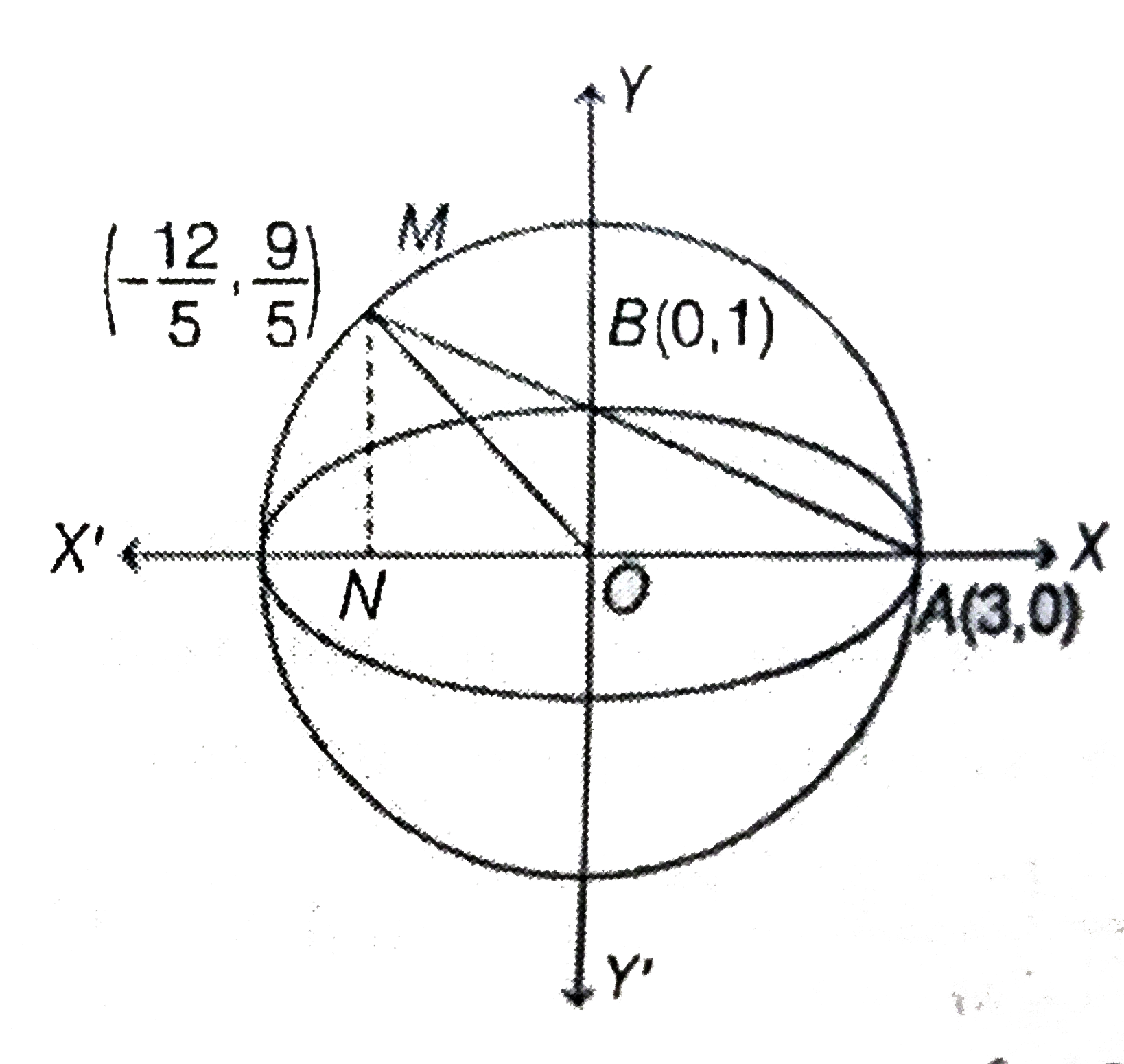
The line passing through the extremity `A` of the major exis and extremity `B` of the minor axis of the ellipse `x^2+9y^2=9` meets is auxiliary circle at the point `Mdot` Then the area of the triangle with vertices at `A ,M ,` and `O` (the origin) is (a)31/10 (b) 29/10 (c) 21/10 (d) 27/10

A

`(31)/(10)`

B

`(29)/(10)`

C

`(21)/(10)`

D

`(27)/(10)`

Text Solution

Verified by Experts

The correct Answer is:
D

Equations of auxilary circle is
`x^(2)+y^(2)=9`
Euations of AM is `(x)/(3)+(y)/(1)=1`

On solving Eqs.(i) and (ii) we get M`(-(12)/(5),(9),(5))`
Now , area of `Delta APOM =(1)/(2) OAxxMN=(27)/(10) `sq units.
Promotional Banner

Similar Questions

Explore conceptually related problems

Find area of the triangle with vertices at the point given in each of the following: ( 2,7),( 1,1) ,( 10,8 )

Find the foci, vertices, length of major axis and minor axis of the ellipse. 6x^(2)+9y^(2)+12x-36y-12=0

Normal is drawn at one of the extremities of the latus rectum of the hyperbola (x^2)/(a^2)-(y^2)/(b^2)=1 which meets the axes at points Aa n dB . Then find the area of triangle O A B(O being the origin).

Find the orthocentre of Delta A B C with vertices A(1,0),B(-2,1), and C(5,2)

The circle passing through the point (-1,0) and touching the y-axis at (0,2) also passes through the point:

The line x=t meets the ellipse x^2+(y^2)/9=1 at real and distinct points if and only if. |t| 1 (d) none of these

P is a variable on the ellipse (x^2)/(a^2)+(y^2)/(b^2)=1 with AA' as the major axis. Find the maximum area of triangle A P A '

A circle has the same center as an ellipse and passes through the foci F_1a n dF_2 of the ellipse, such that the two cuves intersect at four points. Let P be any one of their point of intersection. If the major axis of the ellipse is 17 and the area of triangle P F_1F_2 is 30, then the distance between the foci is (a) 13 (b) 10 (c) 11 (d) none of these

Find the area of the greatest isosceles triangle that can be inscribed in the ellipse ((x^2)/(a^2))+((y^2)/(b^2))=1 having its vertex coincident with one extremity of the major axis.

Extremities of the latera recta of the ellipses (x^2)/(a^2)+(y^2)/(b^2)=1(a > b) having a given major axis 2a lies on

