Here ,`E_(1):(x^(2))/(a^(2))+(y^(2))/(b^(2))=1,(agtb)`
`E_(2):(x^(2))/(c^(2))+(y^(2))/(d^(2))=1,(cltd) and S: x^(2) +(y-1)^(2)=2`
as tangent to `E_(1) ,E_(2)` and S is x+y=3
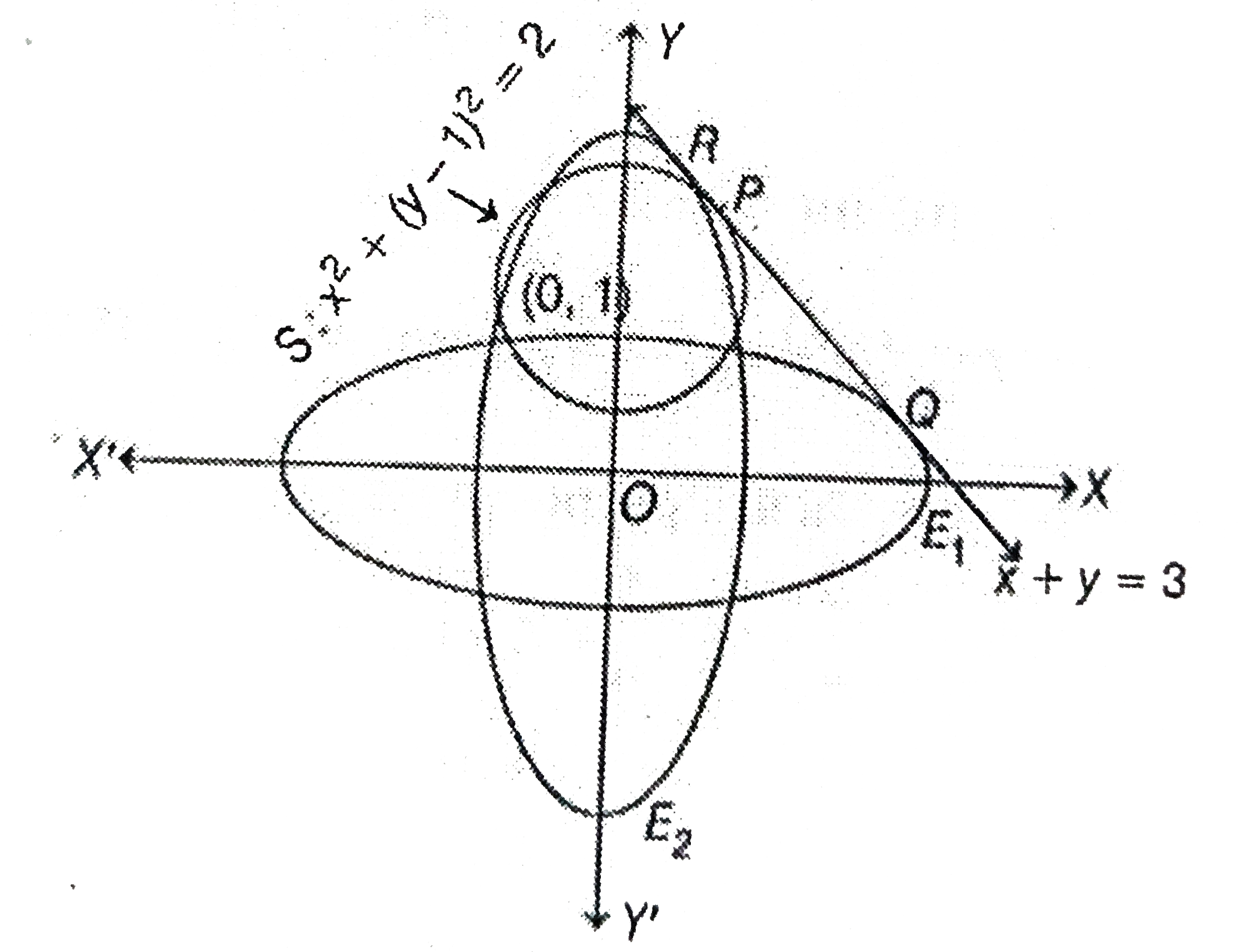
LEt the point of contact of tangent be `(X_(1),y_(1))` to S .
`therefore x.x_(1)+y.y_(1)-(y+y_(1))+1=2`
` or x x _(1) + y y_(1) -y=(1+y_(1)),` same as x+y =3.
`implies (x_(1))/(1)=(y_(1)-1)/(1)=(1+y_(1))/(3)`
`i.e., x_(1) =1 and y_(1)=2`
`therefore P=(1,2)`
since ,`PR=PQ =(2 sqrt(2))/(3).` thus , by parametric form,
` ( x-1)/(-1//sqrt(2))=(y-2)/(1//sqrt(2))=+- (2sqrt(2))/(3)`
`implies (x=(5)/(3),y=(4)/(3)) and (x=(1)/(3),y=(8)/(3))`
`therefore Q=((5)/(3),(4)/(3)) and R=((1)/(3),(8)/(3))`
Now , equation of tangent at Q on ellipse `E_(1)` is
`(x.5)/(a^(2).3)+(y.4)/(b^(2).3)=1`
On comparing with x+y=3, we get
`a^(2)= 5 and b^(2)=4`
`therefore e_(1)^(2)=1-(b^(2))/(a^(2))=1 -(4)/(5)=(1)/(5)`
also equation of tangent at R on ellipse `E_(2)` is
`(x.1)/(a^(2).3) +(y.8)/(b^(2).3)=1`
on comparing with `x+y=3` , we get
`a^(2)=a,b^(2)=8`
`therefore e_(2)^(2) - 1-(a^(2))/(b^(2))=1-(1)/(8)=(7)/(8)`
Now. `e_(1)^(2).e_(2)^(2)=(7)/(40)+. e_(1)e_(2)=(sqrt(7))/(2sqrt(10))`
`and e_(1)^(2)+e_(2)^(2)=(1)/(5)+(7)/(8)=(43)/(40)`
Also,`|e_(1)^(2)-e_(2)^(2)|=|(1)/(5)-(7)/(8)|=(27)/(40)`


