Home
Class 12
MATHS
Let ABC be can equililateral triangle in...

Let ABC be can equililateral triangle inscirbed in the circle `x^(2)+y^(2)=a^(2)`. Suppose perpendiculars from A, B and C to the major axis of the ellipse `(x^(2))/(a^(2))+(y^(2))/(b^(2))=1,(agtb)`, meet the ellipse, respectively, at P,Q and R so that P,Q and R lie on the same side of the major axis as A,B and C, respectively . Prove that the normals tot he ellipse drawn at the points P.Q, and R are concurrent .

Text Solution

Verified by Experts
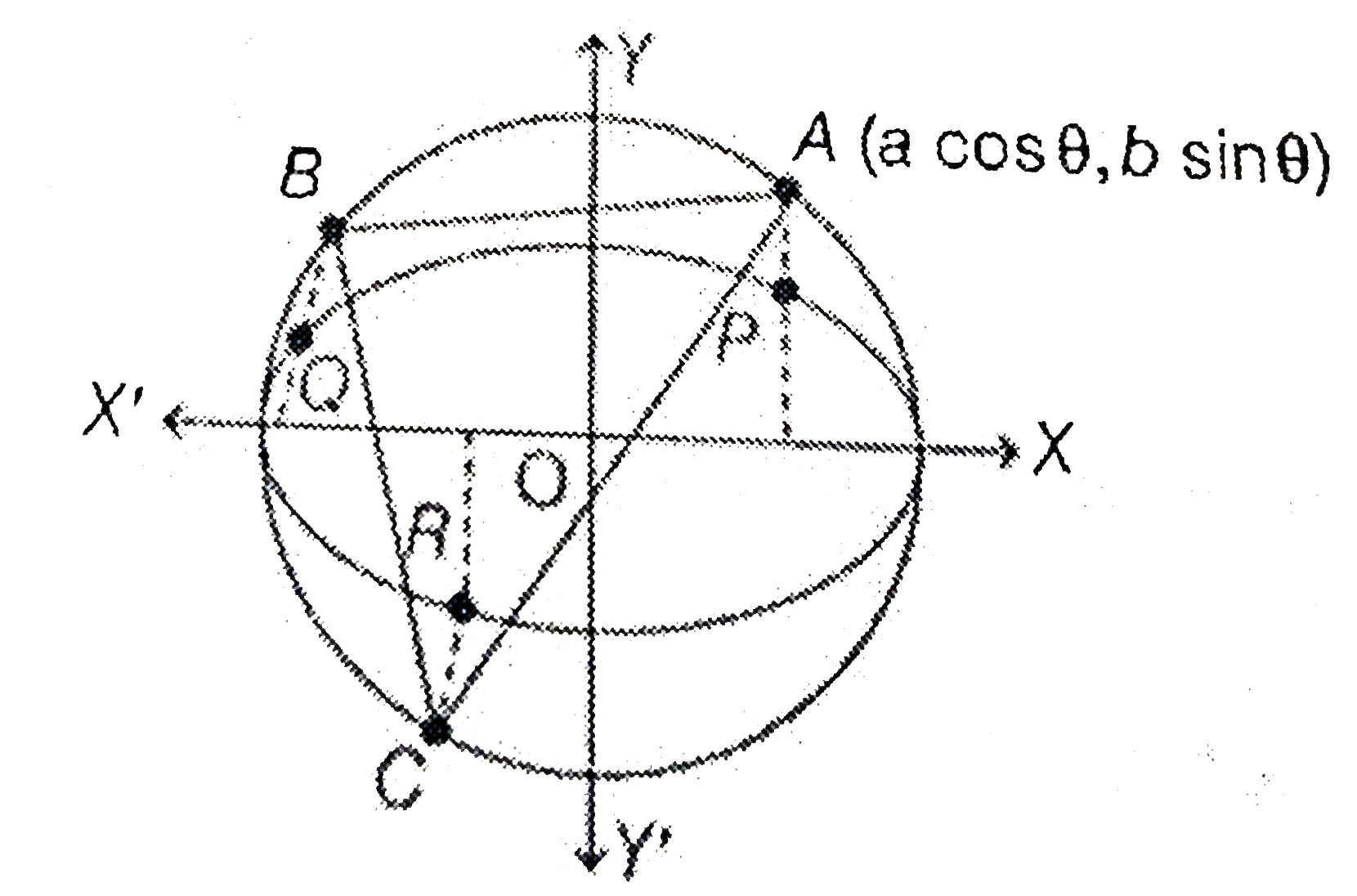
Let the coordinates of a A= ( a cos , sin theta ) , that the corrdinates of

`B= { alpha ( theta + 2 pi //3) , a sin theta + 2 pi /3 )}`
`and C= { alpha ( theta + 4 pi //3) , alpha sin ( theta + 4 pi //3 ) }`
according to the given condition , coordition coordinate of P are `( a cos theta b sin theta )` and that of Q are `( alpha cos ) theta+ 2pi //3).`
`b sin ( theta 2pi //3) and ` that of R are
`alpha cos ( theta + 4pi//3) , b sin ( theta + 4 pi //3)`

`[:' ` it is given normal that P,Q,R are on the same side of X-axis as A,B and C]
Equataion of the normal to the ellipse at Q is
`( ax)/( cos theta) -( by ) /( sin theta)= a^(2)-b^(2)`
`or ax sin theta - by cos ( theta +(2pi)/(3))`
`=(1)/(2) (a^(2) - b^(2)) sin ( 2 theta + ( 4pi )/(3))`
Equation of normal to the ellipse at R is
`a x sin ( theta + 4pi/3) - by cos( theta + 4pi//3) `
` =(1)/(2) (a^(2)- b^(2)) sin ( 2 theta + 8 pi //3) `
but ` sin ( theta + 4pi//3)= sin ( 2pi + theta - 2pi//3)`
`=sin ( theta - 2pi //3)`
`and cos ( theta + 4pi//3)= cos ( 2pi + theta //3)`
` = cos ( theta - 2pi +2 pi //3)`
`and sin ( 2 theta + 8 pi //3 )= sin ( 4 pi+ 2 theta -4pi //3)`
`= sin ( 2 theta - 4pi //3)`
Now ,Eq .(iii) can be written as ax sin `( theta - 2pi //3)- by cos ( theta - 2pi//3)`
`=(1)/(2)(a^(2)-b^(2))sin ( 2 theta - 4pi//3) `
for the lines (i) , (ii) and (iv) to be concurrent , we must have the determinant
`Delta_(1)=|{:(a sin theta, - b sin theta, (1)/(2)(a^(2)-b^(2))sin 2 theta),(a sin (theta+(2pi)/(3)), -b cos (0+(2pi)/(3)),(1)/(2)(a^(2)-b^(2)) sin ( 2theta + 4 pi//3)),(a sin ( theta-( 2pi)/(3)),- b cos(theta-(2pi)/(3)), (1)/(2)(a^(2)- b^(2))sin (2 theta- 4pi//3)):}|=0`
thus , lines (i) ,(ii) and (iv) are consurrent.
Promotional Banner

Similar Questions

Explore conceptually related problems

Let ABC be an equilateral triangle inscribed in the circle x^2+y^2=a^2 . Suppose pendiculars from A, B, C to the ellipse x^2/a^2+y^2/b^2=1,(a > b) meets the ellipse respectivelily at P, Q, R so that P, Q , R lies on same side of major axis as A, B, C respectively. Prove that the normals to the ellipse drawn at the points P Q nad R are concurrent.

AB and CD are two equal and parallel chords of the ellipse (x^(2))/(a^(2))+(y^(2))/(b^(2)) =1 . Tangents to the ellipse at A and B intersect at P and tangents at C and D at Q. The line PQ

If the normal at any point P on ellipse (x^(2))/(a^(2))+(y^(2))/(b^(2)) =1 meets the auxiliary circle at Q and R such that /_QOR = 90^(@) where O is centre of ellipse, then

If normal at any point P on the ellipse (x^(2))/(a^(2))+(y^(2))/(b^(2))=1 (agtbgt0) meets the major and minor axes at Q and R, respectively, so that 3PQ=2PR, then find the eccentricity of ellipse

P and Q are two points on the ellipse (x^(2))/(a^(2)) +(y^(2))/(b^(2)) =1 whose eccentric angles are differ by 90^(@) , then

If the normal at any point P on the ellipse cuts the major and minor axes in G and g respectively and C be the centre of the ellipse, then

Chords of the ellipse (x^2)/(a^2)+(y^2)/(b^2)=1 are drawn through the positive end of the minor axis. Then prove that their midpoints lie on the ellipse.

The maximum area of an isosceles triangle inscribed in the ellipse (x^2)/(a^2) + (y^2)/(b^2) = 1 with the vertex at one end of the major axis is

Extremities of the latera recta of the ellipses (x^2)/(a^2)+(y^2)/(b^2)=1(a > b) having a given major axis 2a lies on

A circle whose diameter is major aixs of ellipe (x^(2))/(a^(2))+(y^(2))/(b^(2))=1 (agtbgt0) meets axis at point P. Ifthe orthocentre of DeltaPF_(1)F_(2) lies on ellipse where F_(1)and F_(2) are foci of ellipse , then find the eccenricity of the ellipse

