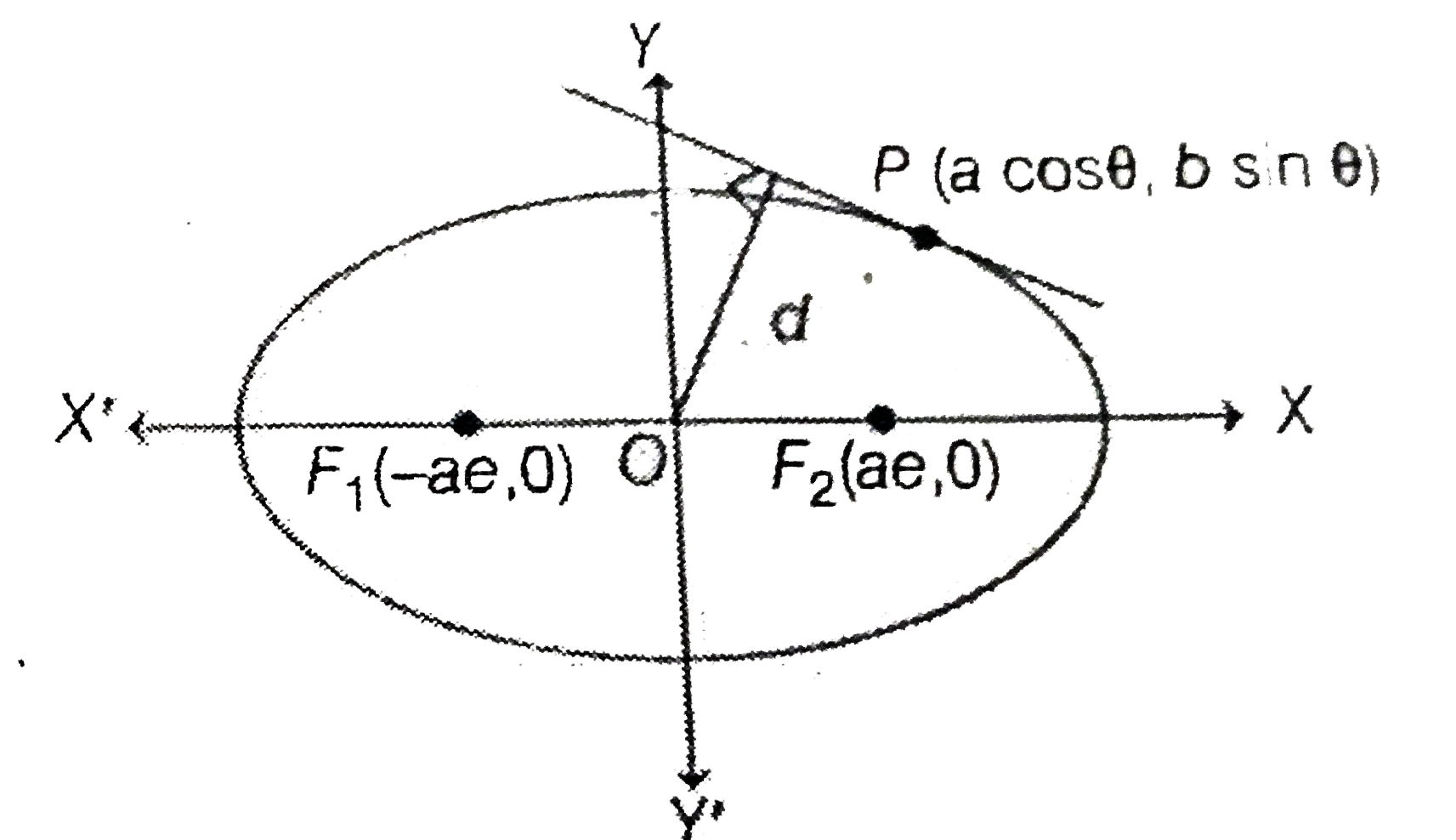
Let the coordinates of point P be `( a cos theta , b sin theta).`
then , equation of tangent at P is
`(x)/(a)cos theta +(y)/(b) sin theta=1`
we have ,d= length fo perpendicular from O to the tangent at P ,
`d=(|0+0-1|)/(sqrt((cos^(2)theta)/(a^(2))+(sin^(2)theta)/(b^(2))))`
`(1)/(d)=sqrt((cos^(2)theta)/(a^(2))+(sin^(2)theta)/(b^(2)))`
`implies (1)/(d^(2))=(cos^(2)theta)/(a^(2))+(sin^(2)theta)/(b^(2))`
we have to prove `(PF_(1)-PF_(2))^(2)=4a^(2)(1-(b^(2))/(d^(2)))`
Now , `RHS= 4a^(2)(1-(b^(2))/(d^(2)))=4a^(2)-(4a^(2)b^(2))/(d^(2))`
`=4a^(2)- 4a^(2) b^(2)((cos^(2)theta)/(a^(2))+ (sin ^(2)theta)/(b^(2)))`
`= 4a^(2)- 4b^(2)cos^(2) theta - 4a^(2) sin ^(2) theta`
`=4a^(2)(1-sin ^(2) theta )-4b^(2)cos theta`
`=4a^(2)cos^(2) theta - 4b^(2) cos ^(2) theta-4b^(2) cos ^(2) theta`
`= 4 cos^(2) theta ( a^(2)-b^(2))=4 cos^(2) theta .a^(2) e^(2)[ :' e= sqrt( 2-(b//a)^(2)]`
Again `PF_(1) = e |a cos theta +a//ee|=a | e cos theta theta+1|`
`= a ( e cos theta+1) `
`[:' -1 le cos theta 1 and 0 lt e lt 1]`
Similarly , `PF_(2)= a(1-e cos theta)`
` Therefore ,LHS=(PF_(1)-PF_(2))^(2)`
`=[a( e cos theta +1)-a(1-e cos theta)]^(2)`
`=(ae cos theta + alpha-a + ae cos theta)^(2)`
`= ( 2ae cos theta)^(2)= 4a^(2) e^(2)cos^(2)theta`
hence `LHS=RHS`


