Home
Class 12
MATHS
Let the functions defined in Column I (1...

Let the functions defined in Column I (1+2x) , tan xhave domain `(-pi/2, pi/2)` and range `(-oo, oo)`

Text Solution

Verified by Experts

The correct Answer is:
`A to q; B to r`

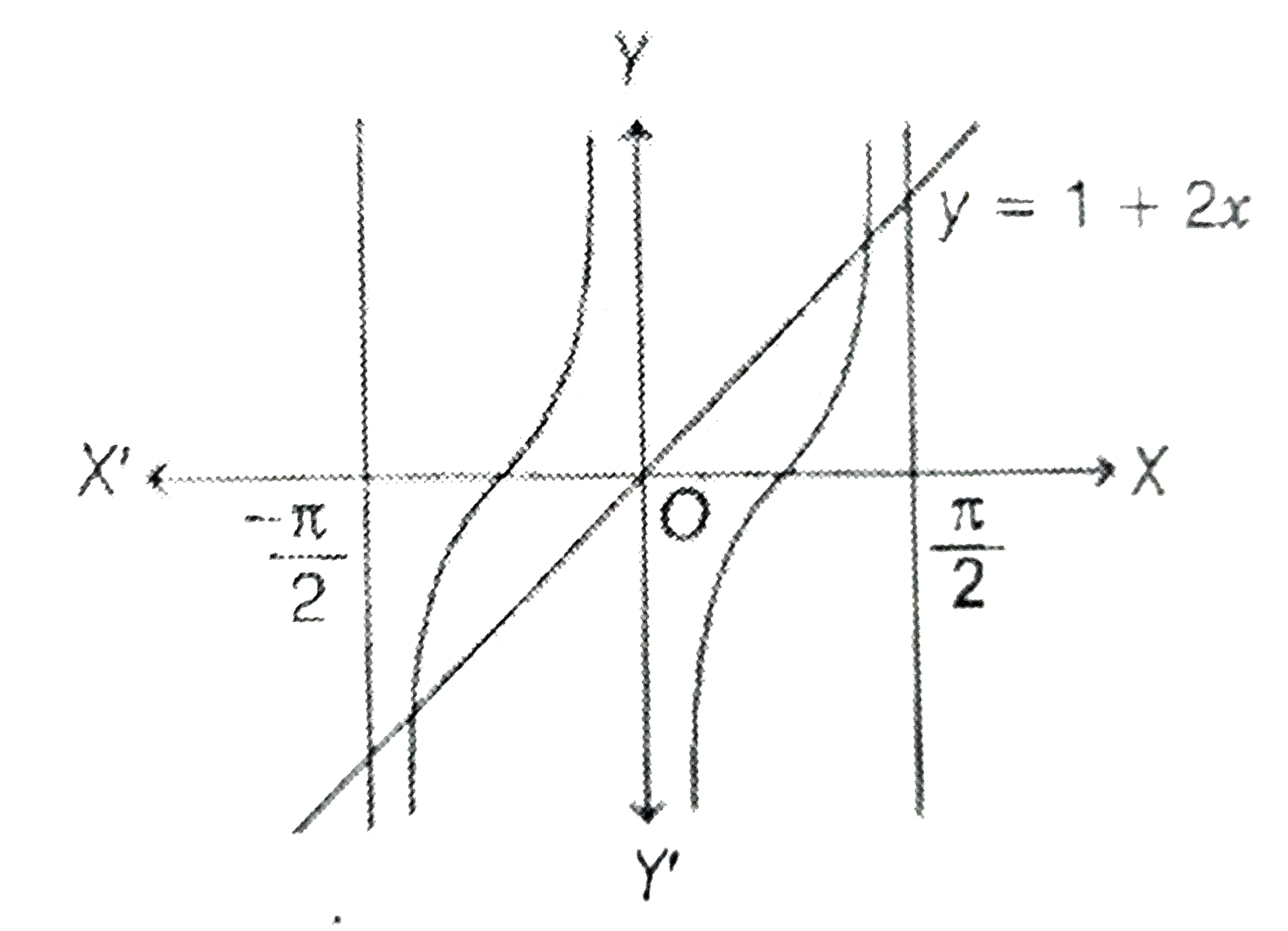
`y=1+2x` is linear function, therefore it is one-one and its range is `(-pi+1,pi+1).` Therefore (1 + 2x) is one-one but not onto so `(A) to (q)`. Again, see the figure.

It is clear from the graph that y = tan x is one-one and onto, therefore `(B) to (r).`
Promotional Banner

Similar Questions

Explore conceptually related problems

Let f be a function defined on [0,2]. Then find the domain of function g(x)=f(9x^2-1)

The number of real solution of the equation sin^(-1) (sum_(i=1)^(oo) x^(i +1) -x sum_(i=1)^(oo) ((x)/(2))^(i)) = (pi)/(2) - cos^(-1) (sum_(i=1)^(oo) (-(x)/(2))^(i) - sum_(i=1)^(oo) (-x)^(i)) lying in the interval (-(1)/(2), (1)/(2)) is ______. (Here, the inverse trigonometric function sin^(-1) x and cos^(-1) x assume values in [-(pi)/(2), (pi)/(2)] and [0, pi] respectively)

Let f(x)=sqrt(|x|-{x})(w h e r e{dot} denotes the fractional part of (x)a n dX , Y are its domain and range, respectively). Then (a) X in (-oo,1/2) and Y in (1/2,oo) (b) X in (-oo in ,1/2)uu[0,oo)a n dY in (1/2,oo) (c) X in (-oo,-1/2)uu[0,oo)a n dY in [0,oo) (d) none of these

Let f(x) be an increasing function defined on (0,oo) . If f(2a^2+a+1)>f(3a^2-4a+1), then the possible integers in the range of a is/are 1 (b) 2 (c) 3 (d) 4

Consider the function f:(-oo,oo)vec(-oo,oo) defined by f(x)=(x^2+a)/(x^2+a),a >0, which of the following is not true? maximum value of f is not attained even though f is bounded. f(x) is increasing on (0,oo) and has minimum at ,=0 f(x) is decreasing on (-oo,0) and has minimum at x=0. f(x) is increasing on (-oo,oo) and has neither a local maximum nor a local minimum at x=0.

Let f be the function f(x)=cosx-(1-(x^2)/2)dot Then f(x) is an increasing function in (0,oo) f(x) is a decreasing function in (-oo,oo) f(x) is an increasing function in (-oo,oo) f(x) is a decreasing function in (-oo,0)

The function defined by f(x)=(x+2)e^(-x) is (a)decreasing for all x (b)decreasing in (-oo,-1) and increasing in (-1,oo) (c)increasing for all x (d)decreasing in (-1,oo) and increasing in (-oo,-1)

If f(x)=x^2+x+3/4 and g(x)=x^2+a x+1 be two real functions, then the range of a for which g(f(x))=0 has no real solution is (A) (-oo,-2) (B) (-2,2) (C) (-2,oo) (D) (2,oo)

Consider the real-valued function satisfying 2f(sinx)+f(cosx)=xdot then the (a)domain of f(x)i sR (b)domain of f(x)i s[-1,1] (c)range of f(x) is [-(2pi)/3,pi/3] (d)range of f(x)i sR

Consider the function y=f(x) satisfying the condition f(x+1/x)=x^2+1//x^2(x!=0)dot Then the a)domain of f(x)i sR b)domain of f(x)i sR-(-2,2) c)range of f(x)i s[-2,oo] d)range of f(x)i s(2,oo)

