about to only mathematics
about to only mathematics
A
`((pm a^(2))/( sqrt ( a^(2) + b ^(2))) , ( pm b^(2))/( sqrt (a ^(2) + b ^(2)))) `
B
`((pma ^(2))/( sqrt (a ^(2) - b ^(2))), (pm b^(2))/( sqrt (a^(2) - b ^(2))))`
C
`(( pm a ^(2))/( sqrt (a^(2) + b ^(2))), ( pm b ^(2))/(sqrt (a ^(2) - b^(2)))) `
D
` (( pm a ^(2)) /(sqrt (a ^(2) - b ^(2))), ( pm b ^(2))/( sqrt (a ^(2) + b ^(2))))`
Text Solution
Verified by Experts
The correct Answer is:
A
Let the coordinates of P be `(a cos theta, b sin theta )`
Equations of tangent at P is
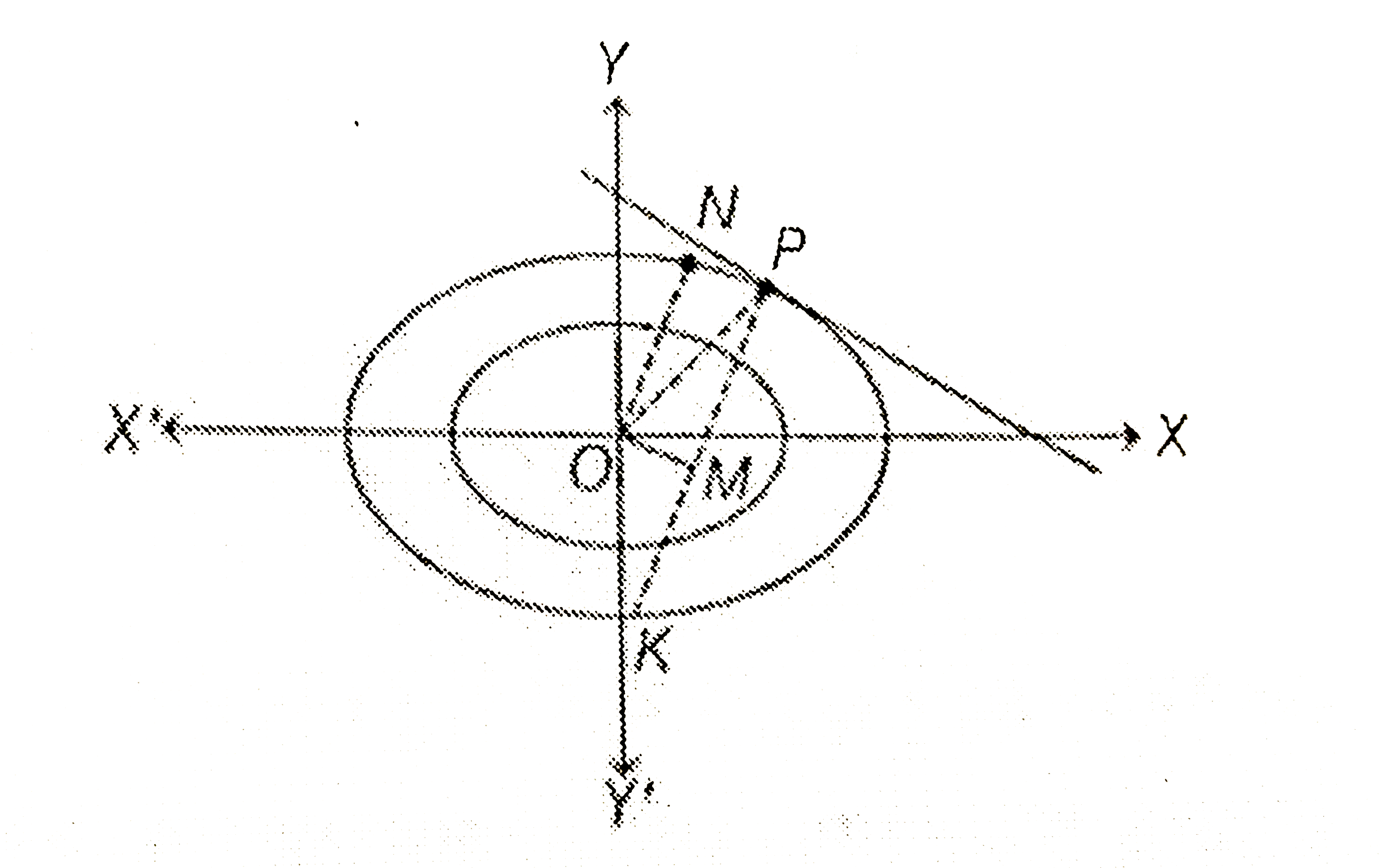
`" " (x)/(a) cos theta + (y)/(b)sin theta = 1 `
Again, equation of normal at point P is
` ax sec theta - b y cosec theta = a ^(2) - b ^(2)`
Let `M` be font of perpendicular from O to PK, the normal at P.
Area of `Delta OPN = (1)/(2) ` ( Area of rectangle OMPN)
`" " = (1)/(2) ON* OM`
Now, `ON = (1)/(sqrt ((cos ^(2) theta )/( a ^(2)) + ( sin ^(2) theta)/( b^(2)))) = ( ab) /( sqrt ( b ^(2) cos ^(2) theta + a ^(2) sin ^(2) theta))`
`" "` [ perpendicular from O, to line NP]
and OM ` = ( a ^(2) - b^(2))/( sqrt (a ^(2) sec ^(2) theta + b ^(2) cosec^(2) theta )) = (( a ^(2) - b ^(2)) * cos theta * sin theta)/( 2 ( a^(2) sin ^(2) theta + b ^(2) cos ^(2) theta))`
`" " = (ab( a ^(2) - b^(2)) tan theta )/( a (a ^(2) tan ^(2) theta + b^(2)))`
Let ` f(theta) = ( tan theta ) /( alpha ^(2) tan^(2) theta + b ^(2))" "[ 0 lt theta pi//2]`
`f ' ( theta ) = ( sec ^(2) theta (a ^(2)tan ^(2) theta + b ^(2)) square - tan theta ( 2 a^(2) tan theta sec ^(2) theta ))/( ( a ^(2) tan ^(2) theta + b ^(2)))`
`" " = ( sec ^(2) theta (a ^(2) tan ^(2) theta + b ^(2) - 2 a ^(2) tan ^(2) theta ))/( ( a ^(2) tan^(2) theta + b ^(2))^(2))`
` " " = ( sec ^(2) theta (a tan theta + b ) (b - a tan theta ))/( (a ^(2) tan ^( 2) theta + b ^(2))^(2))`
For maximum or minimum, we put
`f '( theta ) = 0 rArr b - alpha tan theta = 0`
`" " [ sec ^(2) theta ne 0, a tan theta + b ne 0, 0 lt theta lt pi//2]`
`rArr " " tan theta = b //a `
Also, ` f ' ( theta ){{:(gt 0",",if 0 lt theta lt tan ^(-1) (b//a)),(lt 0",", if tan ^(-1) (b //a) lt theta lt pi//2):}`
Therefore, `f ( theta )` has maximum, when
`" " theta = tan ^(-1) ((b)/(a)) rArr tan theta = (b)/(a)`
Again, ` sin theta = (b)/(sqrt (a^(2) + b ^(2))), cos theta = (a )/( sqrt (a ^(2) + b^(2)) )`
By using symmetry, we get the required points.
`" " (( pm a^(2))/(sqrt ( a^(2) + b ^(2))), ( pm b^(2))/( sqrt (a ^(2) + b ^(2))))`
Equations of tangent at P is
`" " (x)/(a) cos theta + (y)/(b)sin theta = 1 `
Again, equation of normal at point P is
` ax sec theta - b y cosec theta = a ^(2) - b ^(2)`
Let `M` be font of perpendicular from O to PK, the normal at P.
Area of `Delta OPN = (1)/(2) ` ( Area of rectangle OMPN)
`" " = (1)/(2) ON* OM`
Now, `ON = (1)/(sqrt ((cos ^(2) theta )/( a ^(2)) + ( sin ^(2) theta)/( b^(2)))) = ( ab) /( sqrt ( b ^(2) cos ^(2) theta + a ^(2) sin ^(2) theta))`
`" "` [ perpendicular from O, to line NP]
and OM ` = ( a ^(2) - b^(2))/( sqrt (a ^(2) sec ^(2) theta + b ^(2) cosec^(2) theta )) = (( a ^(2) - b ^(2)) * cos theta * sin theta)/( 2 ( a^(2) sin ^(2) theta + b ^(2) cos ^(2) theta))`
`" " = (ab( a ^(2) - b^(2)) tan theta )/( a (a ^(2) tan ^(2) theta + b^(2)))`
Let ` f(theta) = ( tan theta ) /( alpha ^(2) tan^(2) theta + b ^(2))" "[ 0 lt theta pi//2]`
`f ' ( theta ) = ( sec ^(2) theta (a ^(2)tan ^(2) theta + b ^(2)) square - tan theta ( 2 a^(2) tan theta sec ^(2) theta ))/( ( a ^(2) tan ^(2) theta + b ^(2)))`
`" " = ( sec ^(2) theta (a ^(2) tan ^(2) theta + b ^(2) - 2 a ^(2) tan ^(2) theta ))/( ( a ^(2) tan^(2) theta + b ^(2))^(2))`
` " " = ( sec ^(2) theta (a tan theta + b ) (b - a tan theta ))/( (a ^(2) tan ^( 2) theta + b ^(2))^(2))`
For maximum or minimum, we put
`f '( theta ) = 0 rArr b - alpha tan theta = 0`
`" " [ sec ^(2) theta ne 0, a tan theta + b ne 0, 0 lt theta lt pi//2]`
`rArr " " tan theta = b //a `
Also, ` f ' ( theta ){{:(gt 0",",if 0 lt theta lt tan ^(-1) (b//a)),(lt 0",", if tan ^(-1) (b //a) lt theta lt pi//2):}`
Therefore, `f ( theta )` has maximum, when
`" " theta = tan ^(-1) ((b)/(a)) rArr tan theta = (b)/(a)`
Again, ` sin theta = (b)/(sqrt (a^(2) + b ^(2))), cos theta = (a )/( sqrt (a ^(2) + b^(2)) )`
By using symmetry, we get the required points.
`" " (( pm a^(2))/(sqrt ( a^(2) + b ^(2))), ( pm b^(2))/( sqrt (a ^(2) + b ^(2))))`



Similar Questions
Explore conceptually related problems
A school library has 75 books on Mathematics, 35 books on physics. A student can choose only one book , In how many ways a student can choose a book on Mathematics or physics?
The first theorem in mathematics is ………… .
There are 15 candidates for an examination . 7 candidates are appearing for mathematics examination while the remaining 8 are appearing for different subjects. In how many ways can they be seated in a row so that no two mathematics candidates are together ?
There are 15 candidates for an examination. 7 candidates are appearing for mathematics examination while the remaning 8 are appearing for different subjects. In how many ways can they be seated in a row so that no two mathematics candidates are together?
There are 15 candidates for an examination. 7 candidates are appearing for mathematics examination while the remaining 8 are appearing for different subjects . In how many ways can they be seated in a row so that no two mathematics candidates are together ?
A bag contains a total of 20 books on physics and mathematics, Any possible combination of books is equally likely. Ten books are chosen from the bag and it is found that it contains 6 books of mathematics. Find out the probability that the remaining books in the bag contains 3 books on mathematics.
The probability that a student will score centum in mathematics is (4)/(5) . The probability that he will not score centum is ............
Recommended Questions
- about to only mathematics
Text Solution
|
- What did Schimba say about mathematics?
Text Solution
|
- Which of the following statements is not true about 'mapping in Mathem...
Text Solution
|
- about to only mathematics
Text Solution
|
- about to only mathematics
Text Solution
|
- about to only mathematics
Text Solution
|
- about to only mathematics
Text Solution
|
- about to only mathematics
Text Solution
|
- about to only mathematics
Text Solution
|