Let coordinates of P be ` ( t, t ^(2)+ 1)`
Reflection of P in `y = x` is `P_1 (t ^(2) +1, t)`
which clearly lies on `y^(2) = x - 1 `
Similarly, let coordinates of Qbe ` (s^(2) + 1, s)`
Its reflection in `y =x ` is
`Q_1( s, s ^(2) + 1 )`, which lies on `x ^(2) = y -1 `
We have, ` PQ_1^(2) = ( t - s )^(2) + ( t^(2) - s ^(2)) ^(2) = P _1 Q^(2)`
`rArr " " P Q_1 = P _1 Q`
Also `PP_1 || Q Q_1 " "[ because ` both perpendicular to `y = x ]`
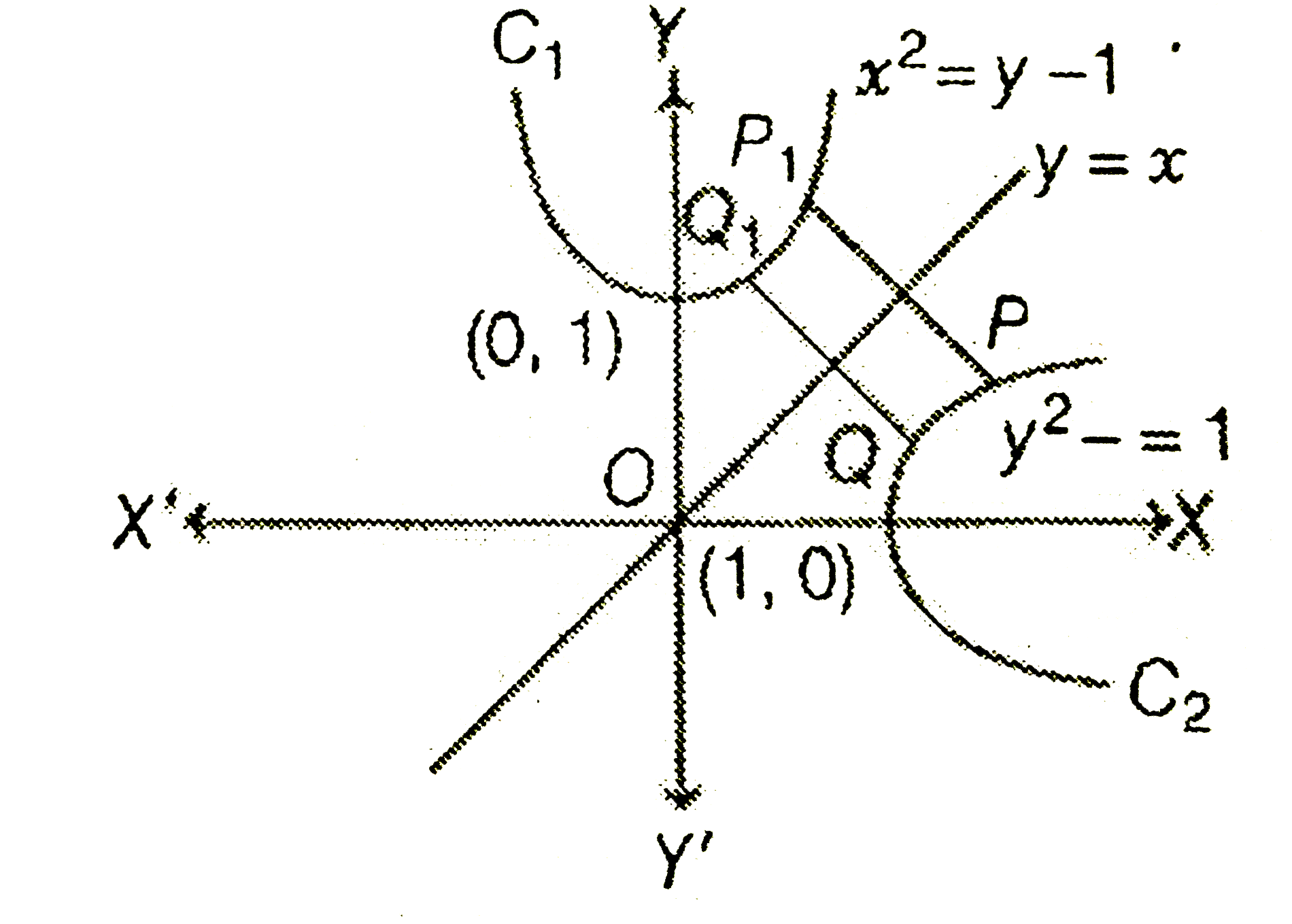
Thus, `PP_1 Q Q_1` is an isosceles trapezium.
Also, P lies on `P Q_1 ` and Q lies on `P_1 Q_1 ` then
`PQ ge min { P P _1 Q Q_1 }`
Let us take min `{ P P _1 Q Q_1 }`
` therefore PQ^(2) ge P P_1 ^(2) = ( t ^(2) + 1 - t) ^(2) + ( t ^(2) + 1 - t ^(2))`
`" " = 2 ( t^(2) + 1 - t ^(2)) = f (t)" " ` [ say ]
we have, ` f ' (t) = 4( t^(2) + 1 - t) ( 2t -1 )`
`" " = 4[ ( t - 1 //2 ) ^(2) + 3//4 ] [ 2t - 1]`
now, ` f ' (t) = 0 `
`rArr " " t = 1//2`
Also, `f ' (t) lt 0 "for " t lt 1//2`
and ` f '(t) gt 0 " for " t gt 1//2 `
Thus, ` f (t)` is least when ` t = 1//2 `
Corresponding to ` t = 1//2`, point `P_0` on ` C_1 ` is ` (1//2, 5//4)` and` P_1 ` ( which we take as ` Q_0`) on ` C_2` are ` ( 5//4, 1//2)`. Note that ` P _0 Q_0 le P Q` for all pairs of ` (P, Q)` with P on `C_2 `


