Home
Class 12
MATHS
Let A(p^2,-p),B(q^2, q),C(r^2,-r) be the...

Let `A(p^2,-p),B(q^2, q),C(r^2,-r)` be the vertices of triangle ABC. A parallelogram AFDE is drawn with D,E, and F on the line segments BC, CA and AB, respectively. Using calculus, show that the maximum area of such a parallelogram is `1/2(p+q)(q+r)(p-r)dot`

Text Solution

Verified by Experts
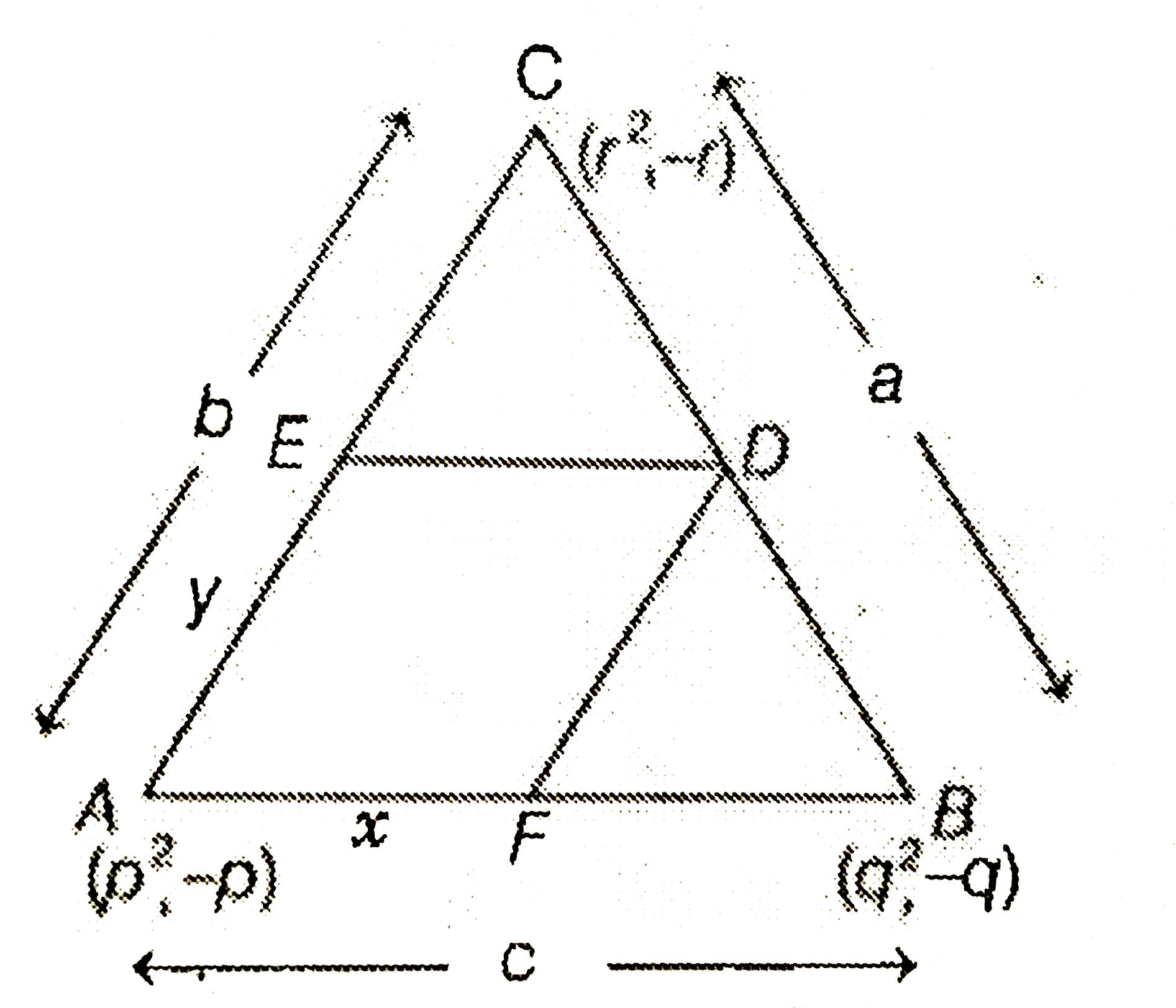
Let ` AF = x and AE = y, Delta ABC and Delta EDC ` are similar.
`therefore " " (AB)/( ED) = (AC)/( CE)`

`rArr " " (c )/(x) = ( b)/( b - y )`
`rArr " " bx = c ( b - y ) rArr x = ( c )/(b) (b - y)`
Let z denotes the area of par
allelogram AFDE.
Then, ` " "z= xy sin A`
`rArr " " z = (c )/(b) (b - y ) y * sin A " " ` ... (i)
On differentiating w.r.t. y we get
`(dz)/( dy ) = (c )/( b )(b - 2y ) sin A and (d ^(2)z)/( dy ^(2)) = ( - 2 c)/(b) sin A `
For maximum or minimum values of z, we must have
`" " (dz)/( dy ) = 0 `
`rArr " " (c ) /(b ) (b - 2y ) = 0 rArr y = (b)/(2)`
Clearly, ` (d ^(2) z)/( d y ^(2)) = - ( 2c)/( b ) lt 0 , AA y `
Hence, z is maximum, when `y = (b)/(2)`.
On putting `y = (b)/(2) ` in Eq. (i), we get
the maximum value of z is
` z = (c )/(b) ( b - (b)/(2)) * (b)/(2)* sin A = (1)/(4) b c sin A `
` " " = (1)/(2) ` area of ` Delta ABC`
` " " = (1)/(2) xx (1)/(2) |{:( p ^(2),, - p,, 1 ) , ( q ^(2),, q ,, 1 ), ( r ^(2) ,, - r ,, 1 ):}|`
Applying `R _ 3 to R_3 - R_1 and R_2 to R_2 - R_1 `
`" " = (1)/(4) |{:( p ^(2),, -p,, 1 ), ( q ^(2) - p ^(2),, q + p ,, 0), ( r ^(2) - p ^(2),, - r + p,, 0):}|`
` " " = (1)/(4) ( p + q) ( r - p) |{:( p^(2) ,, - p ,, 1), ( q- p,, 1,,0 ), ( r + p,, - 1 ,, 0 ):}|`
`" " = (1)/(4) ( p + q) ( r- p ) (-q - r )`
` " " = (1)/(4) ( p + q ) ( q + r ) ( p - r) `
Promotional Banner

Similar Questions

Explore conceptually related problems

ABC is a triangle and through A, B, C lines are drawn parallel to BC, CA and AB respectively intersecting at P, Q and R. Prove that the perimeter of DeltaPQR is double the perimeter of DeltaABC.

If the truth value of the statement p to (~q vee r) is false (F), then the truth values of the statements p,q and r are respectively

In acute angled triangle A B C ,A D is the altitude. Circle drawn with A D as its diameter cuts A Ba n dA Ca tPa n dQ , respectively. Length of P Q is equal to /(2R) (b) (a b c)/(4R^2) (c) 2RsinAsinBsinC (d) delta/R

If P={a,b,c} and Q={r}, form the sets P xx Q and Q xx P .

If a ,b ,c are the p t h ,q t h ,r t h terms, respectively, of an H P , show that the points (b c ,p),(c a ,q), and (a b ,r) are collinear.

Sum of the first p, q and r terms of an A.P. are a, b and c, respectively. Prove that a/p(q-r)+b/q (r-p) +c/r (p-q)=0

If the pth, qth, and rth terms of an A.P. are in G.P., then the common ratio of the G.P. is a. (p r)/(q^2) b. r/p c. (q+r)/(p+q) d. (q-r)/(p-q)

If the p^("th"), q^("th") and r^("th") terms of a G.P. are a, b and c, respectively. Prove that a^(q – r) b^(r-p) c^(P - q) = 1.

