Home
Class 12
MATHS
Consider the hyperbola H : x^2-y^2=1 and...

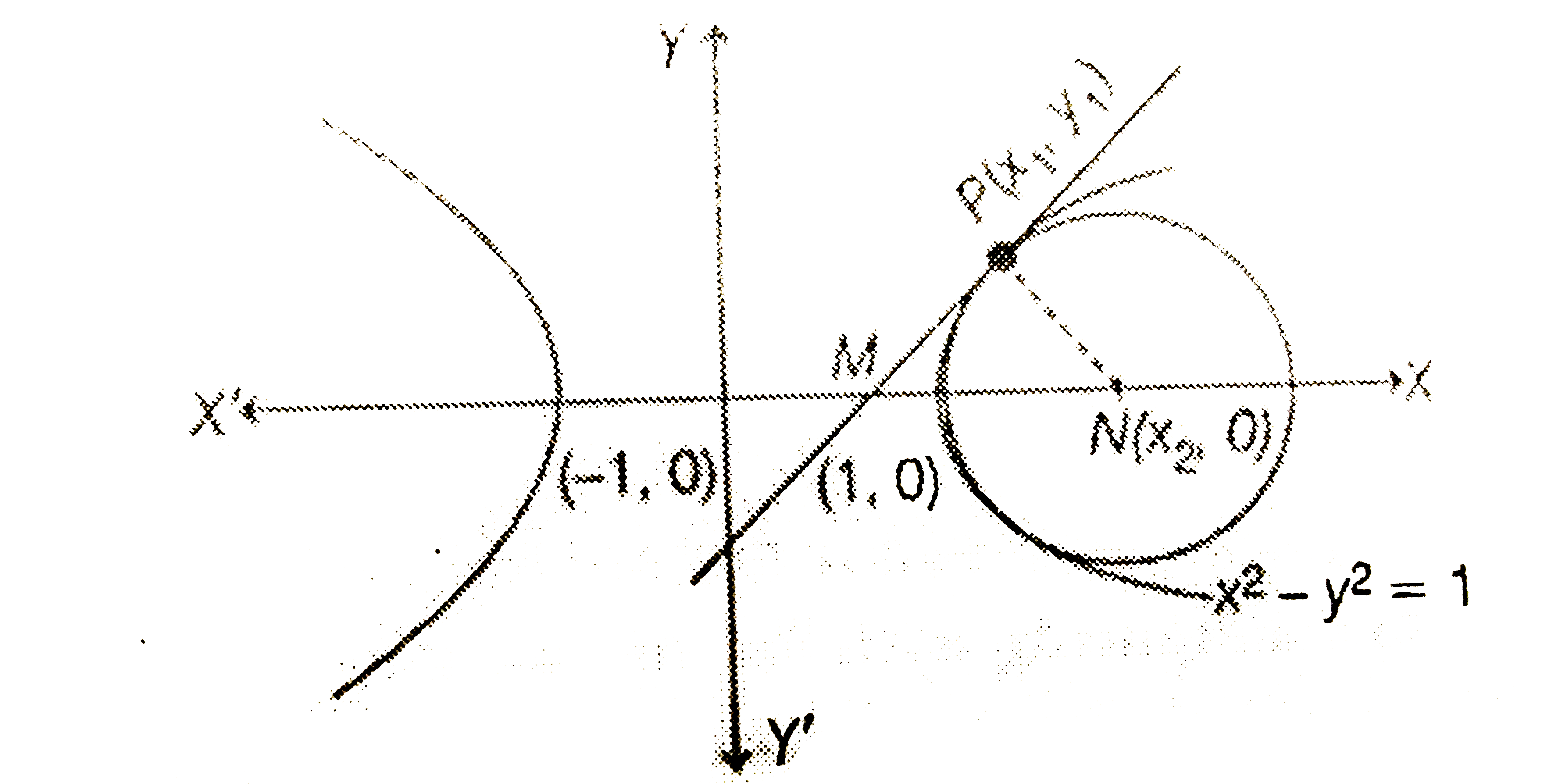
Consider the hyperbola `H : x^2-y^2=1` and a circle `S` with center `N(x_2,0)` . Suppose that `Ha n dS` touch each other at a point `P(x_1, y_1)` with `x_1>1` and `y_1> 0.` The common tangent to `Ha n dS` at `P` intersects the x-axis at point `Mdot` If `(l ,m)` is the centroid of the triangle `P M N ,` then the correct expression(s) is (are) `(d l)/(dx_1)=1-1/(3x1 2)forx_1>1` `(d m)/(dx_1)=(x_1)/(3sqrt(x1 2-1))` for`x_1>` `(d l)/(dx_1)=1+1/(3x1 2)` for `x_1>1` `(d m)/(dy_1)=1/3` for `x_1>0`

A

`(dl)/(dx_(1))=1-(1)/(3x_(1)^(2)) " for " x_(1) gt 1`

B

`(dm)/(dx_(1))=(x_(1))/(3(sqrt(x_(1)^(2)-1)))" for "x_(1) gt 1`

C

`(dl)/(dx_(1))=1+(1)/(3x_(1)^(2)) " for " x_(1) gt 1`

D

`(dm)/(dy_(1))=(1)/(3)" for " y_(1) gt 0`

Text Solution

Verified by Experts


Equation of family of circles touching hyperbola at
`(x_(1),y_(1)) " is " (x-x_(1))^(2)+lambda (x x_(1)-y y_(1)-1)=0`
Now, its centre is `(x_(2),0).`
` therefore [(-(lambda x_(1)-2x_(1)))/(2),(-(-2y_(1)-lambday_(1)))/(2)]=(x_(2),0)`
`rArr 2y_(1)+lambda y_(1)=0 rArr lambda = -2`
` and 2x_(1)-lambda x_(1)=2x_(2) rArr x_(2)=2x_(1)`
` therefore P(x_(1),sqrt(x_(1)^(2)-1)) and N(x_(2),0)=(2x_(1),0)`
As tangent intersect X-axis at `M((1)/(x_(1)),0)`.
Centroid of `triangle PMN=(l,m)`
`rArr ((3x_(1)+(1)/(x_(1)))/(3),(y_(1)+0+0)/(3))=(l,m)`
`rArr l=(3x_(1)+(1)/(x_(1)))/(3)`
On differentiating w.r.t. `x_(1)`, we get `(dl)/(dx_(1))=(3-(1)/(x_(1)^(2)))/(3)`
`rArr (dl)/(dx_(1))=1-(1)/(3x_(1)^(2)), " for " x_(1) gt 1 and m=(sqrt(x_(1)^(2)-1))/(3)`
On differentiating w.r.t. `x_(1)`, we get
`rArr (dm)/(dx_(1))=(2x_(1))/(2xx3sqrt(x_(1)^(2)-1))=(x_(1))/(3sqrt(x_(1)^(2)-1)) " for " x_(1) gt 1`
Also, `m=(y_(1))/(3)`
On differentiating w.r.t `y_(1), " we get " (dm)/(dy_(1))=(1)/(3) " for " y_(1) gt 0`
Promotional Banner

Similar Questions

Explore conceptually related problems

The mirror image of the parabola y^2=4x in the tangent to the parabola at the point (1, 2) is (a) (x-1)^2=4(y+1) (b) (x+1)^2=4(y+1) (c) (x+1)^2=4(y-1) (d) (x-1)^2=4(y-1)

"F i n d"(dy)/(dx)"if"y=tan^(-1)((sqrt(1+x^2)-1)/x), where x!=0

The locus of the center of the circle touching the line 2x-y=1 at (1,1) is (a) x+3y=2 (b) x+2y=3 (c) x+y=2 (d) none of these

The coordinates of two points Pa n dQ are (x_1,y_1)a n d(x_2,y_2)a n dO is the origin. If the circles are described on O Pa n dO Q as diameters, then the length of their common chord is (a) (|x_1y_2+x_2y_1|)/(P Q) (b) (|x_1y_2-x_2y_1|)/(P Q) (|x_1x_2+y_1y_2|)/(P Q) (d) (|x_1x_2-y_1y_2|)/(P Q)

If the tangent at (x_1,y_1) to the curve x^3+y^3=a^3 meets the curve again in (x_2,y_2), then prove that (x_2)/(x_1)+(y_2)/(y_1)=-1

If y= sin^(-1)x , show that (1-x^(2)) (d^(2)y)/(dx^(2))-x(dy)/(dx)0 .

The equation to the chord joining two points (x_1,y_1) and (x_2,y_2) on the rectangular hyperbola xy=c^2 is: (A) x/(x_1+x_2)+y/(y_1+y_2)=1 (B) x/(x_1-x_2)+y/(y_1-y_2)=1 (C) x/(y_1+y_2)+y/(x_1+x_2)=1 (D) x/(y_1-y_2)+y/(x_1-x_2)=1

If x_1,x_2,x_3 as well as y_1, y_2, y_3 are in G.P. with same common ratio, then prove that the points (x_1, y_1),(x_2,y_2),a n d(x_3, y_3) are collinear.

If x_1,x_2,x_3 as well as y_1, y_2, y_3 are in G.P. with same common ratio, then prove that the points (x_1, y_1),(x_2,y_2),a n d(x_3, y_3) are collinear.

The parabolas y^2=4ac and x^2=4by intersect orthogonally at point P(x_1,y_1) where x_1,y_1 != 0 provided (A) b=a^2 (B) b=a^3 (C) b^3=a^2 (D) none of these