Home
Class 12
MATHS
Let A,B,C, be three angles such that A=p...

Let A,B,C, be three angles such that `A=pi/4` and `tanB ,tanC=pdot` Find all possible values of `p` such that `A , B ,C` are the angles of a triangle.

Text Solution

Verified by Experts

The correct Answer is:
`p in (- oo, 0) cup [3+2sqrt(2), oo)`

Sinc `A+B+C=pi`
`rArr B+Cpi-pi//4=3pi//4" "...(i)`
` [ :. A=pi//4) "given"]`
`:. 0ltB,Clt3pi//4`
Alos, given `tanB*tanC=p`
`rArr (sin B*sin C)/(cos B*cos C)=(p)/(1)`
`rArr (sinB*sinC+cosB cos C)/(sinB*sinC-cosB*cisC)=(p-1)/(p-1)`
`rArr (cos(B-C))/(cos(B+C))=(1+p)/(1-q)`
` rArr cos (B-C)=-((1+p))/(sqrt(2)(1-p)) " "...(i)`
`[ :. B+C=3pi//4]` ltbr Since B or C can vary from 0 to `3pi//4`
`:. 0le B-Cle 3pi//4`
`rArr -(1)/(sqrt(2))lt cos (B-C)le1" "...(ii)`
From Eqs. (ii) and (iii),`-(1)/(sqrt(2))le(1+p)/(sqrt(2)(p-1))le1`
`rArr -(1)/(sqrt(2))le(1+p)/(sqrt(2)(p-1)) and (1+p)/(sqrt(2)(p-1))le1`
`rArr(1+p)/(p-1)+1ge0 and(1+p-sqrt(2)p+sqrt(2))/(sqrt(2)(p-1))le0`
`rArr(2p)/(p-1)+1ge0 and((1+p-sqrt(2))(p-(1+sqrt(2))/(1-sqrt(2))sqrt(2)))/(sqrt(2)(p-1))le0`
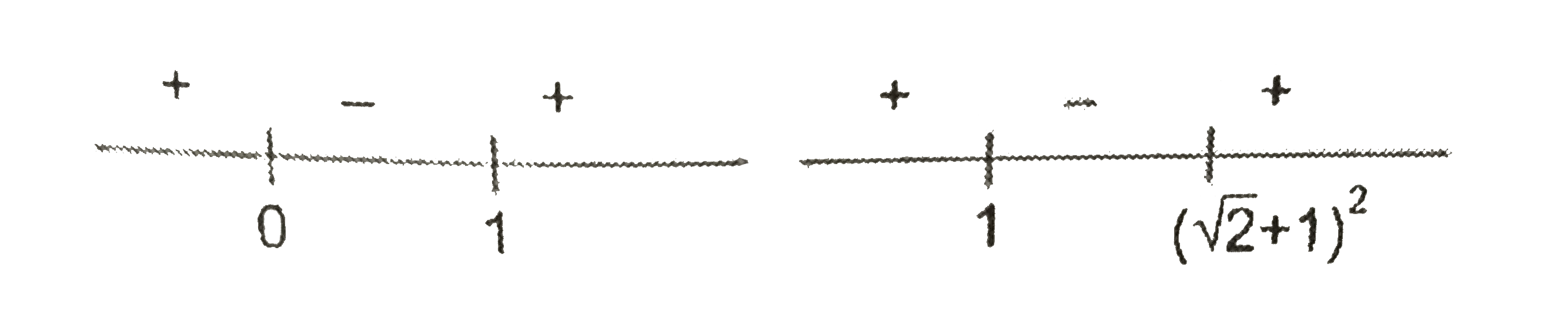
`rArr(2p)/(p-1)+1ge0 and((p-(sqrt(2)+1)^(2)))/((p-1))ge0`

`rArr (plt0 or p gt1)`
and `(plt 1 or p ge (sqrt(2)+1)^(2))`
ON combining above expression, we get
gt `plt0or p ge(sqrt(2)+1)^(2)`
`i.e., p in (-oo,0)uu[(sqrt(2)+1)^(2),oo)`
`or p in (-oo,0) uu [ 3+2sqrt(2),oo)`
Promotional Banner

Similar Questions

Explore conceptually related problems

Let A , B , C be the three angles such that A+B+C=pi . If T a nAtanB=2, then find the value of (cosA.cosB)/(cos c)

In A B C , if /_A=pi/4, then find all possible values of tanBtanCdot

Let a,b,c,d be real numbers such that |a-b|=2, |b-c|=3, |c-d|=4 Then the sum of all possible values of |a-d|=

In a triangle A B CifB C=1a n dA C=2, then what is the maximum possible value of angle A ?

If three positive real numbers a, b, c are in A.P and abc = 4 , then the minimum possible value of b is

Let a ,b and c be real numbers such that a+2b+c=4 . Find the maximum value of (a b+b c+c a)dot

If A, B, C are the angles of a triangle such that sin^(2)A+sin^(2)B=sin^(2)C , then

If A,B,C are the angles of a non right angled triangle ABC. Then find the value of: |[tanA,1,1],[1,tanB,1],[1,1,tanC]|

Let A(0,beta), B(-2,0) and C(1,1) be the vertices of a triangle. Then All the values of beta for which angle A of triangle ABC is largest lie in the interval

Let A B Ca n dA B C ' be two non-congruent triangles with sides A B=4,A C=A C^(prime)=2sqrt(2) and angle B=30^0 . The absolute value of the difference between the areas of these triangles is

