Home
Class 12
MATHS
Let A B C be a triangle having O and I a...

Let `A B C` be a triangle having `O and I` as its circumcenter and incentre, respectively. If `R and r` are the circumradius and the inradius, respectively, then prove that `(O I)^2=R^2-2R rdot` Further show that the triangle `B I O` is a right angled triangle if and only if `b` is arithmetic mean of `a and c.`

Text Solution

Verified by Experts
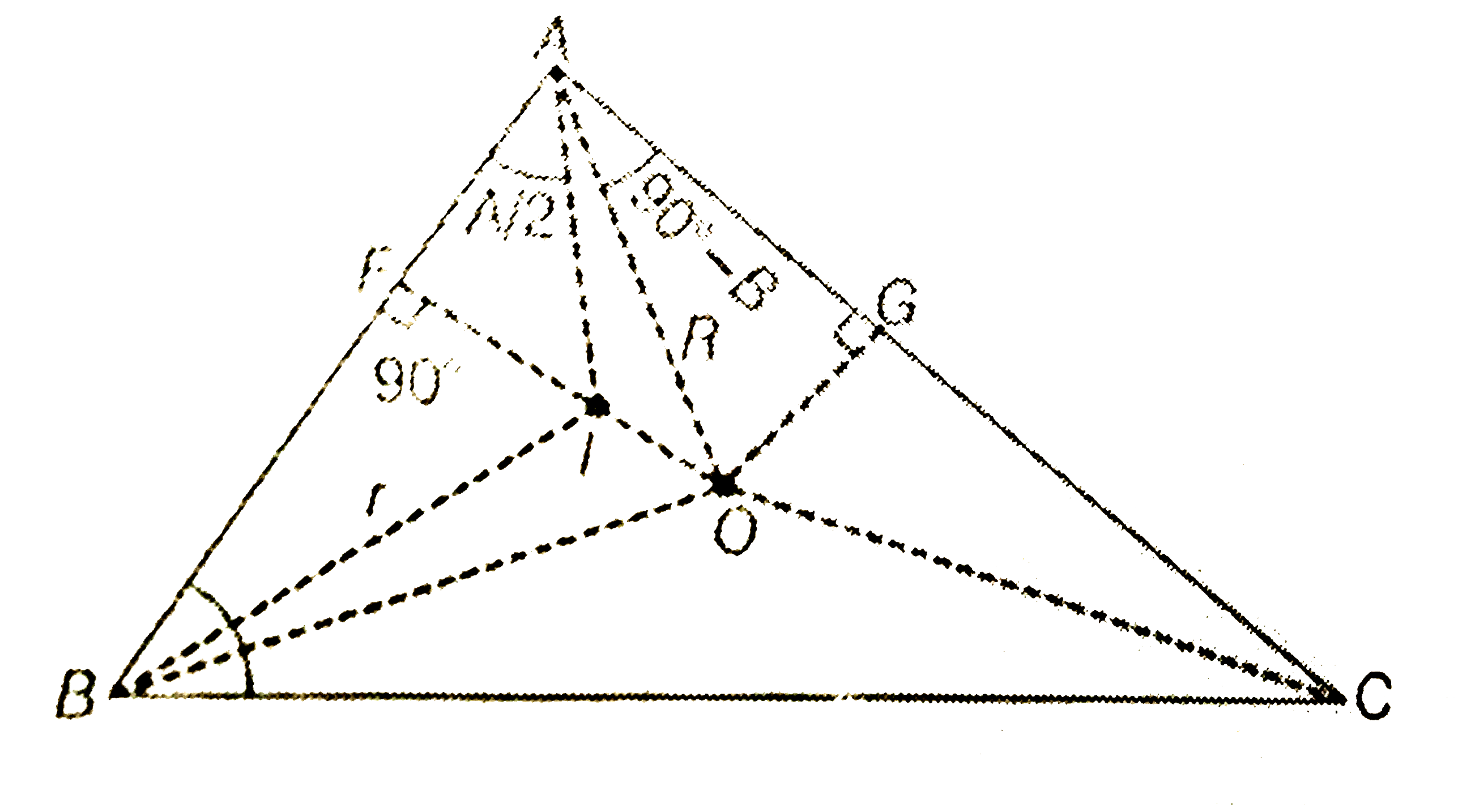
It is clear from the figure that, OA=R

`AI=(IF)/("sin(A/2)")`
`because DeltaAIF" is right angled triangle, so"=r/("sin(A/2)")`
`"But "r=4R sin (A//2)sin(B//2)sin(C//2)`
`:." AI=4Rsin(B/2)sin(C/2)"`
`"Again, "/_GOA=BrArrOAG=90^(@)-B`
`"Therefore, "/_IAO=/_IAC-/_OAC`
`= A//2-(90^(@)-B)=1/2(A+2B-180^(2@))`
`=1/2(A+2B-A-B-C)=1/2(B-C)`
`"In"DeltaOAI, OI^(2)=OA^(2)+AI^(2)-2(OA)(AI)cos(/_IAO)`
`=R^(2)+[4Rsin(B//2)sin(C//2)]^(2)-2R.[4Rsin(B//2)sin(C//2)]cos((B-C)/2)`m
`=[R^(2)+16R^(2)sin(B//2)sin^(2)(c//2)-8R^(2)sin(B//2)sin(C//2)cos((B-C)/2)]`
`=R^(2)[1+16sin(B//2)sin^(2)(C//2)-8sin(B//2)sin(C//2)cos((B-C)/2)]`
`R^(2)[1+8sin(B//2)sin(C//2){2sin(B//2)sin(C//2)-cos((B-C)/2)}]`
`=R^(2)[1+8sin(B//2)sin(C//2){cos)((B-C)/2)+cos((B+C)/(2))cos((B-C)/2)}]`
`=R^(2)[1-8sin(B//2)sin(C//2)cos((B+C)/2)]`
`=R^(2)[1-8sin(B//2)sin(C//2)cos(pi/2-A/2)`
`becauseA/2+B/2+C/2=pi/2]`
`=R^(2)[1-8sin(A//2)sin(B//2)sin(C//2)]`
`=R^(2)[1-8(r/(4R))]=R^(2)-2Rr`
Now, in right anglen `DeltaBIO`.
`OB^(2)=BI^(2)+IO^(2)`
`rArr" "R^(3)=BI^(2)+R^(2)-2Rr`
`rArr" "2Rr=BI^(2)`
`rArr" "2Rr=r^(2)//sin^(2)(B//2)`
`rArr" "2Rsin^(2)B//2=r`
`rArr" "R(1-cosB)=Delta/s`
`rArr" "(abc)/(4Delta)(1-cosB)=Delta/s`
`rArr" "abc(1-cos B)=(4Delta^(2))/s`
`rArr" "abc[1-(a^(2)+c^(2)-b^(2))/(2ac)](4Delta^(2))/s`
`rArr" "abc[(2ac-a^(2)-c^(2)+b^(2))/(2ac)]=(4Delta^(2))/s`
`rArr" "b[b^(2)-(a-c)^(2)]=(4Delta^(2))/s`
`rArr" "b[b^(2)-(a-c)^(2)]=8(s-a)(s-b)(s-c)`
`rArr" "b[{b-(a-c)}{b+(a-c)}]=8(s-a)(s-b)(s-c)`
`rArr" "b[(b+c-a)(b+a-c)]=8(s-a)(s-b)(s-c)`
`rArr" "b[(2s-2a)(2s-2c)]=8(s-a)(s-b)(s-c)`
`rArr" "b[2*2(s-a)(s-c)]=8(s-a)(s-b)(s-c)`
`rArr" "b=2s-2b`
`rArr" "2b=a+c`
Which shows that b is arithmetic mean between a and c.
Promotional Banner

Similar Questions

Explore conceptually related problems

If r_1=r_2+r_3+r prove that the triangle is right angled .

A B C is an equilateral triangle of side 4c mdot If R ,ra n dh are the circumradius, inradius, and altitude, respectively, then (R+h)/h is equal to 4 (b) 2 (c) 1 (d) 3

The perimeter of a triangle ABC right angled at C is 70 and the inradius is 6, then |a-b|=

In triangle ABC if 2sin^(2)C=2+cos2A+cos2B , then prove that triangle is right angled.

in a triangle ABC , let angle C = (pi)/(2) if r the in radius and R is the circumradius of the triangle ABC , then 2( r+R) equals

The distance of incentre of the right-angled triangle ABC (right angled at A) from B and C are sqrt10 and sqrt5 , respectively. The perimeter of the triangle is _____

In triangle A B C , the equation of side B C is x-y=0. The circumcenter and orthocentre of triangle are (2, 3) and (5, 8), respectively. The equation of the circumcirle of the triangle is

If I is the incenter of Delta ABC and R_(1), R_(2), and R_(3) are, respectively, the radii of the circumcircle of the triangle IBC, ICA, and IAB, then prove that R_(1) R_(2) R_(3) = 2r R^(2)

Let A B C be a triangle right-angled at Aa n dS be its circumcircle. Let S_1 be the circle touching the lines A B and A C and the circle S internally. Further, let S_2 be the circle touching the lines A B and A C produced and the circle S externally. If r_1 and r_2 are the radii of the circles S_1 and S_2 , respectively, show that r_1r_2=4 area ( A B C)dot

O P Q R is a square and M ,N are the midpoints of the sides P Q and Q R , respectively. If the ratio of the area of the square to that of triangle O M N is lambda:6, then lambda/4 is equal to (a)2 (b) 4 (c) 2 (d) 16

