Home
Class 12
MATHS
Let S be the area of the region enclosed...

Let `S` be the area of the region enclosed by `y=e^-x^2,y=0,x=0,a n dx=1.` Then `Sgeq1/e` (b) `Sgeq1=1/e` `Slt=1/4(1+1/(sqrt(e)))` (d) `Slt=1/(sqrt(2))+1/(sqrt(e))(1-1/(sqrt(2)))`

A

`S ge (1)/(e) `

B

`S ge 1-(1)/(e) `

C

`S le (1)/(4)(1+(1)/(sqrt(e))) `

D

`S le (1)/sqrt(2)+(1)/(sqrt(e))(1-(1)/(sqrt(2))) `

Text Solution

Verified by Experts

The correct Answer is:
B, D

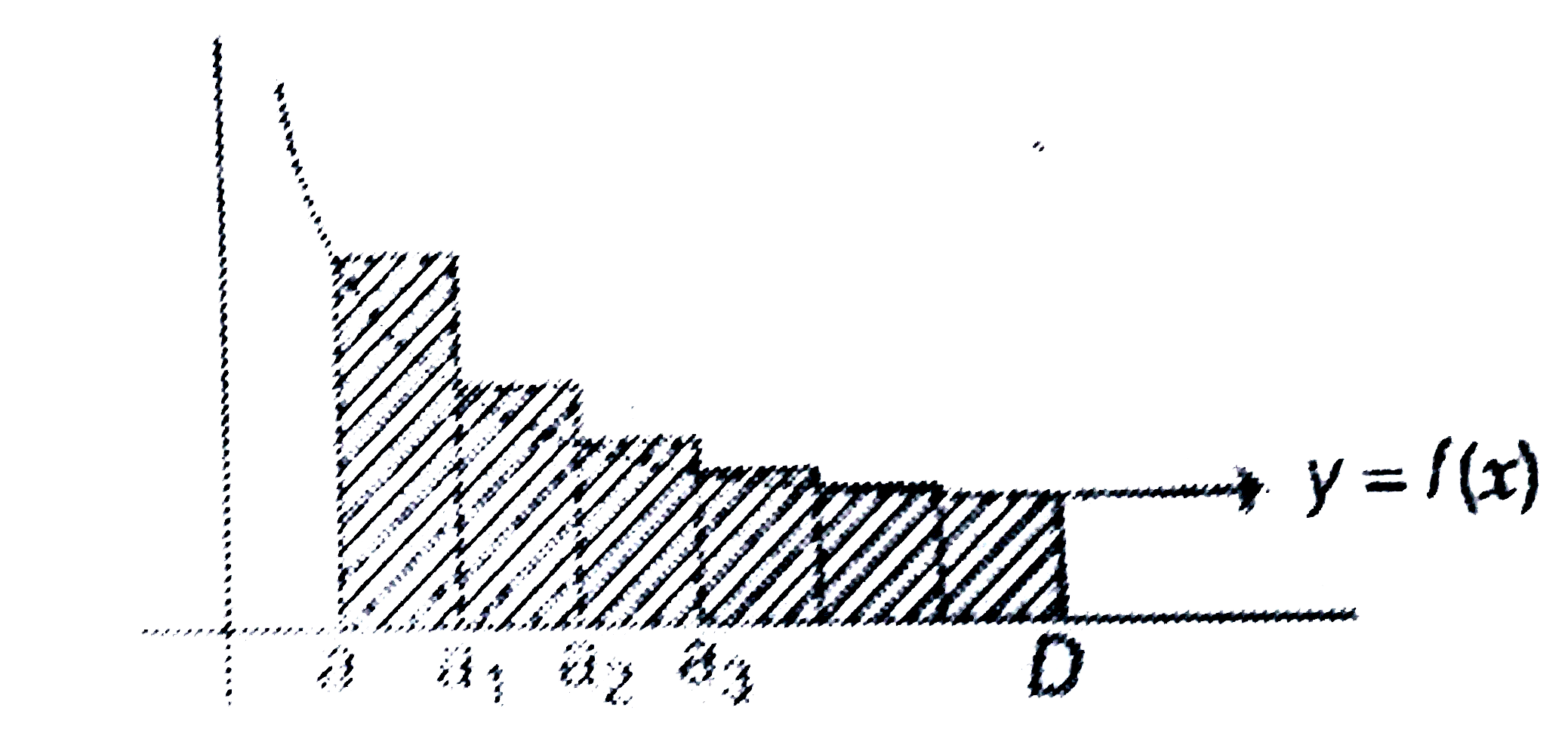
PLAN (i) Area of region f(x) bounded between ` x=a " to " x=b` is

`int_(a)^(b)f(x)dx = "Sum of areas of rectangle shown in shaded part."`
`(ii) " If " f(x) ge g(x) ` when defined in [a, b], then
` int_(a)^(b)f(x)dx ge int_(a)^(b)g(x)dx `
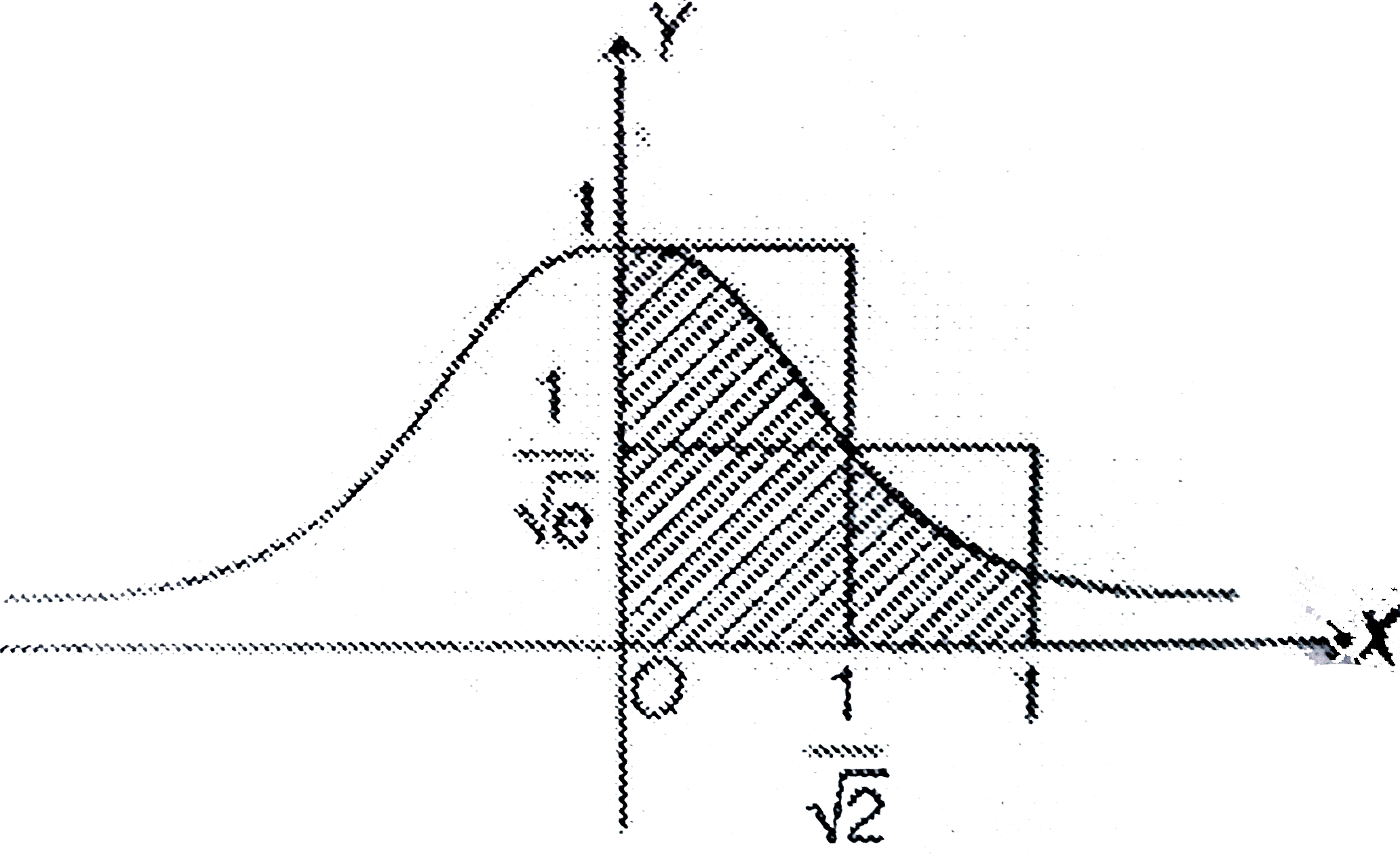
Description of situation As the given curve `y=e^(-x^(2))` cannot be integrated, thus we have to bound this function by using above mentioned concept.
Graph for `y=e^(-x^(2))`

Since, `x^(2) le x " when " x in [0,1]`
` rArr -x^(2) ge -x " or " e^(-x^(2)) ge e^(-x) `
` therefore int_(0)^(1)e^(-x^(2))dx ge int_(0)^(1)e^(-x)dx `
` rArr S ge-(e^(-x))_(0)^(1)=1-(1)/(e) " "...(i)`
Also, ` int_(0)^(1)e^(-x^(2))dx le ` Area of two rectangles
` le (1xx(1)/(sqrt(2)))+(1-(1)/(sqrt(2)))xx(1)/(sqrt(e)) `
` le (1)/(sqrt(2))+(1)/(sqrt(e))(1-(1)/(sqrt(2))) " "...(ii)`
` therefore (1)/(sqrt(2))+(1)/(sqrt(e))(1-(1)/(sqrt(2))) ge S ge 1 -(1)/(e) [" from Eqs. (i) and (ii) "]`
Promotional Banner

Similar Questions

Explore conceptually related problems

Let S be the area of the region enclosed by y=e^(-x^2),y=0,x=0,a n dx=1. Then (a) Sgeq1/e (b) Sgeq1=1/e (c) Slt=1/4(1+1/(sqrt(e))) (d) Slt=1/(sqrt(2))+1/(sqrt(e))(1-1/(sqrt(2)))

The area of the region bonded by y=e^(x),y=e^(-x),x=0 and x = 1 is

int(dx)/(sqrt(2e^(x)-1))=

Evaluate: 1/(sqrt(1-e^(2x)))dx

Evaluate: int1/(sqrt(e^(5x))(4sqrt(e^(2x)+e^(-2x))^3 )

(y-e^(sin^(-1)x))(dy)/(dx)+sqrt(1-x^(2))=0.

Evaluate int(log_(e)(x+sqrt(x^(2)+1)))/(sqrt(x^(2)+1))dx.

int sqrt(e^(x)-1)dx is equal to

y=tan^(-1)((sqrt(1+x^2)+sqrt(1-x^2))/(sqrt(1+x^2)-sqrt(1-x^2))),w h e r e -1

d/(dx)(cos^(-1)sqrt(cosx)) is equal to (a) 1/2sqrt(1+s e cx) (b) sqrt(1+secx) (c) -1/2sqrt(1+secx) (d) -sqrt(1+secx)