Home
Class 12
MATHS
For any real t ,x=1/2(e^t+e^(-t)),y=1/2(...

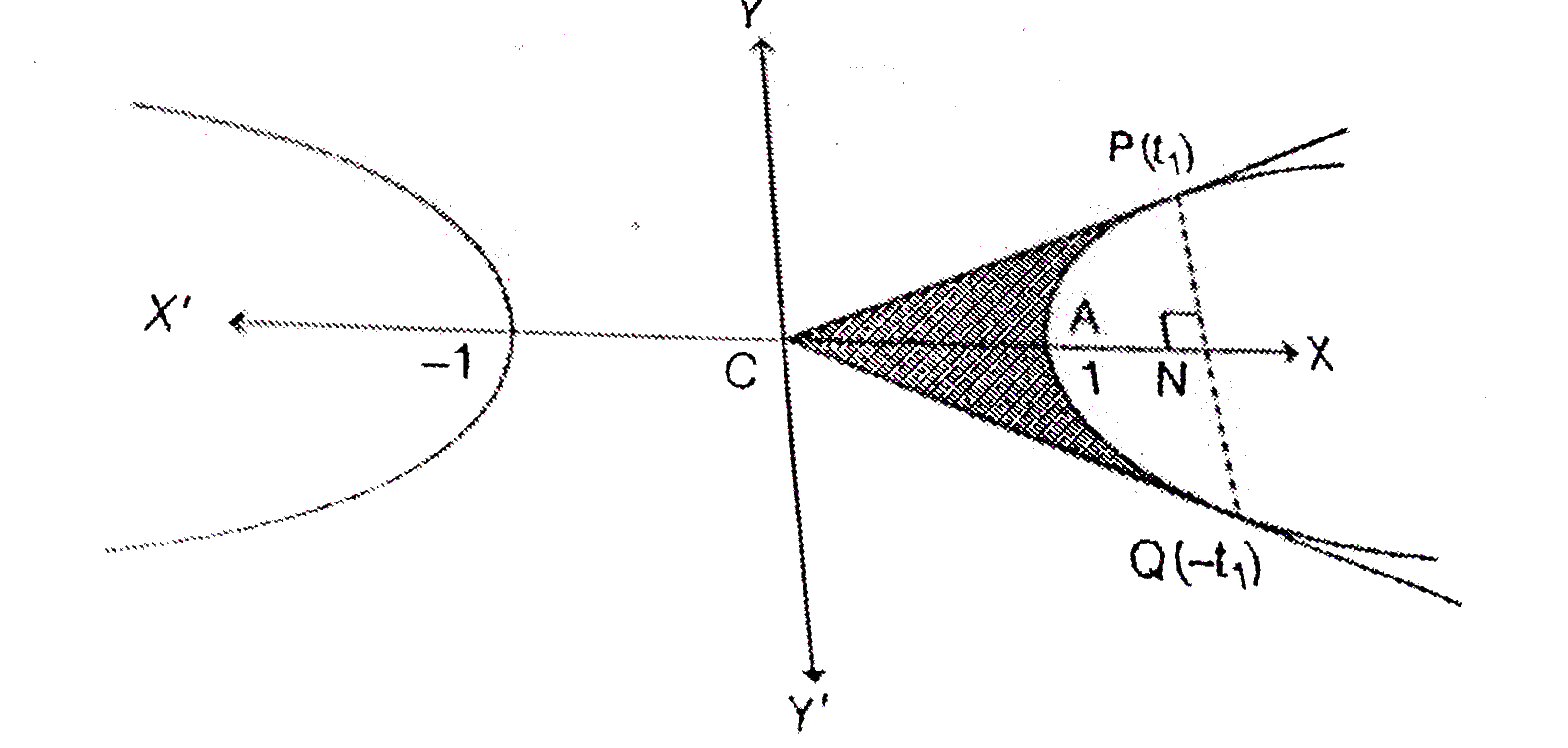
For any real `t ,x=1/2(e^t+e^(-t)),y=1/2(e^t-e^(-t))` is a point on the hyperbola `x^2-y^2=1` Show that the area bounded by the hyperbola and the lines joining its centre to the points corresponding to `t_1a n d-t_1` is`t_1dot`

Text Solution

Verified by Experts

The correct Answer is:
`(e^(2t_(1))-e^(-2t_(1)))/(4)-(1)/(4) (e^(2t_(1))-e^(-2t_(1))-4t_(1))`

Let `P=((e^(t_(1))+e^(-t_(1)))/(2),(e^(t_(1))-e^(-t_(1)))/(2))`
`and Q=((e^(-t)+e^(t_(1)))/(2),(e^(-t_(1))-e^(t))/(2))`
We have to find the area of the region bounded by the curve `x^(2)-y^(2)=1` and the lines joining the centre `x=0, y=0 ` to the points `(t_(1)) and (-t_(1)).`

`=2["area of "Delta PCN -int_(1)^((e^(t_(1))+e^(-t_(1)))/(2))ydx]`
`=2[(1)/(2)((e^(t_(1))+e^(-t_(1)))/(2))((e^(t_(1))-e^(-t_(1)))/(2))-int_(1)^(t_(1))y (dy)/(dx)*dt]`
`=2[(e^(2t_(1))-e^(-2t_(1)))/(8)-int_(0)^(t_(1))((e^(t)-e^(-t))/(2))dt]`
`=(e^(2t_(1))-e^(-2t_(1)))/(4)-(1)/(2) int_(0)^(t_(1))(e^(2t)+e^(-2t)-2)dt`
`=(e^(2t_(1))-e^(-2t_(1)))/(4)-(1)/(2)[(e^(2t))/(2)-(e^(-2t))/(2)-2t]`
`=(e^(2t_(1))-e^(-2t_(1)))/(4)-(1)/(4) (e^(2t_(1))-e^(-2t_(1))-4t_(1))`
Promotional Banner

Similar Questions

Explore conceptually related problems

Find the area bounded by x = at^(2) , y = 2at between the ordinates corresponding to t =1 and t= 2

Show that the locus represented by x=(1)/(2)a(t+(1)/(t)),y=(1)/(2)a(t-(1)/(t)) is a rectangular hyperbola.

if the normal at the point t_(1) on the parabola y^(2) = 4ax meets the parabola again in the point t_(2) then prove that t_(2) = - ( t_(1) + 2/t_(1))

The line x=t meets the ellipse x^2+(y^2)/9=1 at real and distinct points if and only if. |t| 1 (d) none of these

Prove that the length of the intercept on the normal at the point P(a t^2,2a t) of the parabola y^2=4a x made by the circle described on the line joining the focus and P as diameter is asqrt(1+t^2) .

The area bounded by the curves y=x e^x ,y=x e^(-x) and the line x=1 is 2/e s qdotu n i t s (b) 1-2/e s qdotu n i t s 1/e s qdotu n i t s (d) 1-1/e s qdotu n i t s

For the curve x = e^(t) cos t, y = e^(t) sin t the tangent line is parallel to x-axis when t is equal to

Find the locus of the point (t^2-t+1,t^2+t+1),t in Rdot

If t_1a n dt_2 are the ends of a focal chord of the parabola y^2=4a x , then prove that the roots of the equation t_1x^2+a x+t_2=0 are real.

Integrate the functions e^(t)((1)/(t)-(1)/(t^(2)))

