Home
Class 12
MATHS
A rectangle P Q R S has its side P Q par...

A rectangle `P Q R S` has its side `P Q` parallel to the line `y=m x` and vertices `P ,Qa n dS` on the lines `y=a ,x=b ,` and `x=-b ,` respectively. Find the locus of the vertex `Rdot`

Text Solution

Verified by Experts
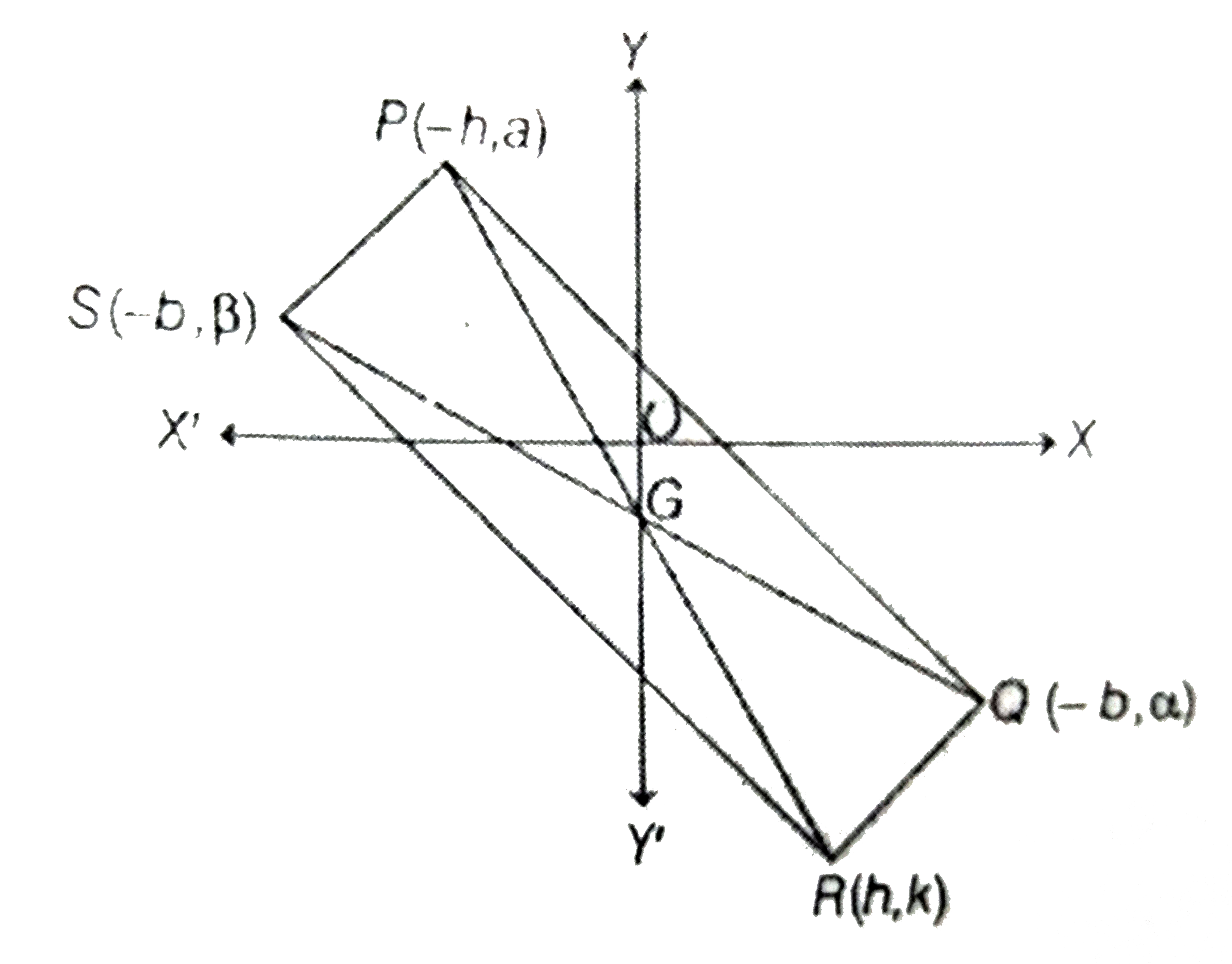
Let the coordinates of `Q` be `(b,alpha)` and that of `S` be `(-b,beta)`. Suppose , `PR` and `SQ` meet in `G`. Since, `G` is mid-point of `SQ`, its `x`-coordinate must be `0`. Let the coordinates of `R` be `(h,k)`.
Since `G`, is mid point of `PR`, the `x`-coordinate at `P` must be `-h` and as `P` lies on the line `y=a`, the coordinates of `P` are `(-h,a)`. Since , `PQ` is parallel to `y=mx`, slope of `PQ=m`
`implies(alpha-a)/(b+h)=m`.........`(i)`
Again `RQbotPQ`

Slope of `RQ=-(1)/(m)implies(k-alpha)/(h-b)=-(1)/(m)`.........`(ii)`
From Eq. `(i)`, we get
`alpha-a=m(b+h)`
`impliesalpha=a+m(b+h)`..........`(iii)`
and from Eq. `(ii)`, we get
`k-alpha=-(1)/(m)(h-b)`
`impliesalpha=k+(1)/(m)(h-b)`.......`(iv)`
From Eqs. `(iii)` and `(iv)` , we get
`a+m(b+h)=k+(1)/(m)(h-b)`
`impliesam+m^(2)(b+h)=km+(h-b)`
`implies(m^(2)-1)h-mk+b(m^(2)+1)+am=0`
Hence, the locus of vertex is
`(m^(2)-1)x-my+b(m^(2)+1)+am=0`
Promotional Banner

Similar Questions

Explore conceptually related problems

A rectangle PQRS has its side PQ parallel to the line y= mx and vertices P, Q , and S on the lines y= a, x=b ,and x= - b , respectively. Find the locus of the vertex R .

A rectangle A B C D has its side A B parallel to line y=x , and vertices A ,Ba n dD lie on y=1,x=2, and x=-2, respectively. The locus of vertex C is (a) x=5 (b) x-y=5 (c) y=5 (d) x+y=5

If P is any point on the plane l x+m y+n z=pa n dQ is a point on the line O P such that O PdotO Q=p^2 , then find the locus of the point Qdot

If P is any point on the plane l x+m y+n z=pa n dQ is a point on the line O P such that O PdotO Q=p^2 , then find the locus of the point Qdot

The area of the triangle formed by the intersection of a line parallel to x-axis and passing through P (h, k) with the lines y = x and x + y = 2 is 4h^2 . Find the locus of the point P.

The line L_1-=4x+3y-12=0 intersects the x-and y-axies at A and B , respectively. A variable line perpendicular to L_1 intersects the x- and the y-axis at P and Q , respectively. Then the locus of the circumcenter of triangle A B Q is (a) 3x-4y+2=0 (b) 4x+3y+7=0 (c) 6x-8y+7=0 (d) none of these

Let a given line L_1 intersect the X and Y axes at P and Q respectively. Let another line L_2 perpendicular to L_1 cut the X and Y-axes at Rand S, respectively. Show that the locus of the point of intersection of the line PS and QR is a circle passing through the origin

Let P be a point on the hyperbola x^2-y^2=a^2, where a is a parameter, such that P is nearest to the line y=2xdot Find the locus of Pdot

A line passing through the origin O(0,0) intersects two concentric circles of radii aa n db at Pa n d Q , If the lines parallel to the X-and Y-axes through Qa n dP , respectively, meet at point R , then find the locus of Rdot

T P and T Q are tangents to the parabola y^2=4a x at Pa n dQ , respectively. If the chord P Q passes through the fixed point (-a ,b), then find the locus of Tdot

