Let `OA=a` and `OB=b`. Then , the coordinates of `A` and `B` are `(a,0)` and `(0,b)` respectively and also, coordinates of `P` are `(a,b)`. Let `theta` be the foot of perpendicular from `P` on `AB` and let the coordinates of `Q(h,k)`. Here, `a` and `b` are the variable and we have to find locus of `Q`.
Given, `AB=cimpliesAB^(2)=c^(2)`
`impliesOA^(2)+OB^(2)=c^(2)impliesa^(2)+b^(2)=c^(2)`........`(i)`
Since, `PQ` is perpendicular to `AB`.
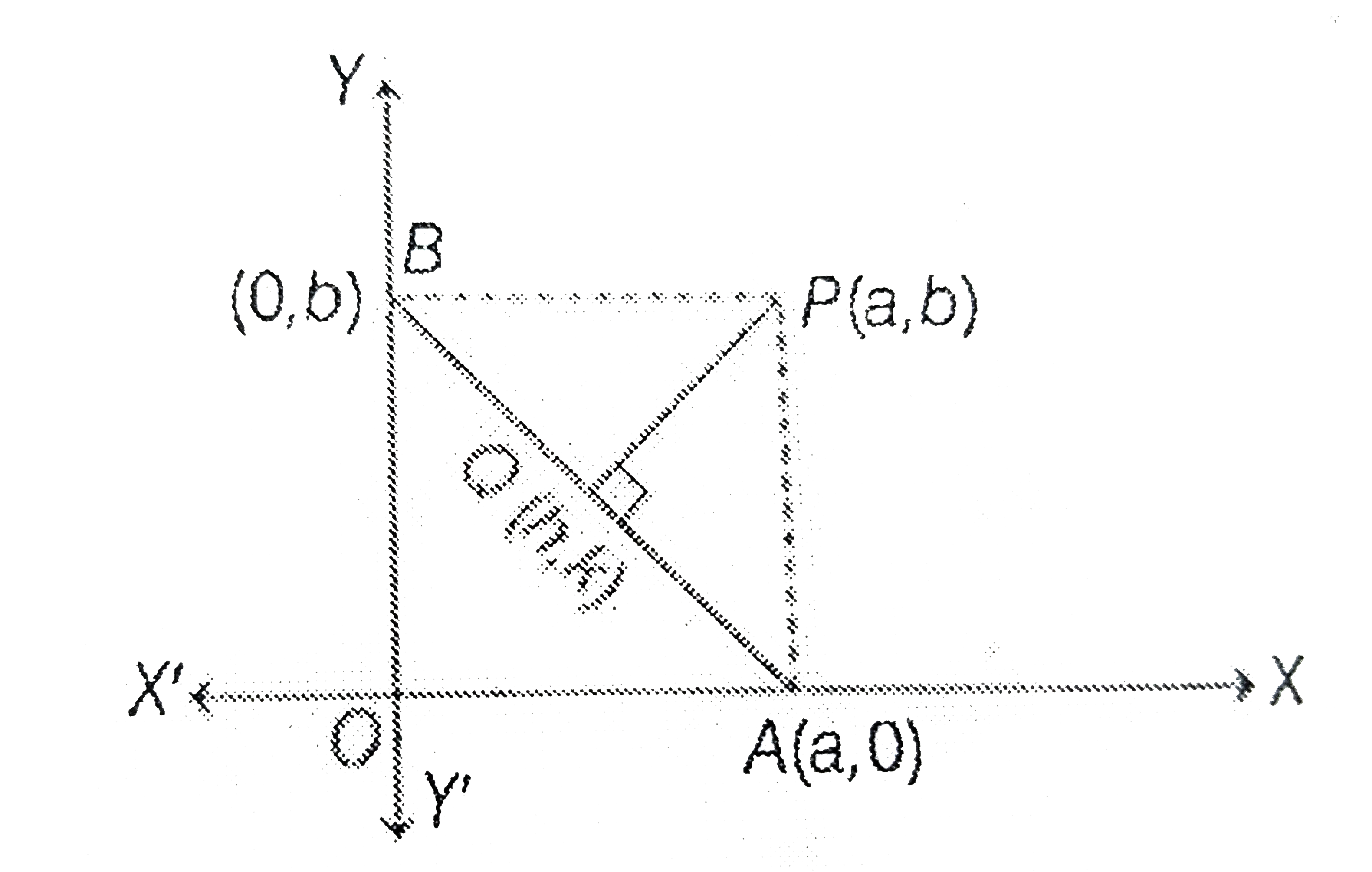
`implies" Slope of" AB*"Slope of"PQ=-1`
`implies(0-b)/(a-0)*(k-b)/(h-a)=-1`
`impliesbk-b^(2)=ah-a^(2)`
`impliesah-bk=a^(2)-b^(2)`.......`(ii)`
Equation of line `AB` is `(x)/(a)+(y)/(b)=1`
Since, `Q` lies in `AB`, therefore
`(h)/(a)+(k)/(b)=1`
`impliesbh+ak=ab`...........`(iii)`
On solving Eqs. `(ii)` and `(iii)`, we get
`(h)/(ab^(2)+a(a^(2)-b^(2)))=(k)/(-b(a^(2)-b^(2))+a^(2)b)=(1)/(a^(2)+b^(2))`
`implies(h)/(a^(3))=(k)/(b^(3))=(1)/(c^(3))` [from Eq. `(i)`]
`impliesa=(hc^(2))^(1//3)` and `b=(kc^(2))^(1//3)`
On substituting the values of `a` and `b` in `a^(2)+b^(2)=c^(2)`,
we get `h^(2//3)+k^(2//3)=c^(2//3)`
Hence , locus of a point is `x^(2//3)+y^(2//3)=c^(2//3)`


