Home
Class 12
MATHS
Line L(1) -=ax+by+c=0 " and " L(2) -= lx...

Line `L_(1) -=ax+by+c=0 " and " L_(2) -= lx+my+n=0` intersect at point P and make an angle `theta` with each other Find the equation of a line different from `L_(2)` which passes through P and makes the same angle `theta " with " L_(1)`.

Text Solution

Verified by Experts
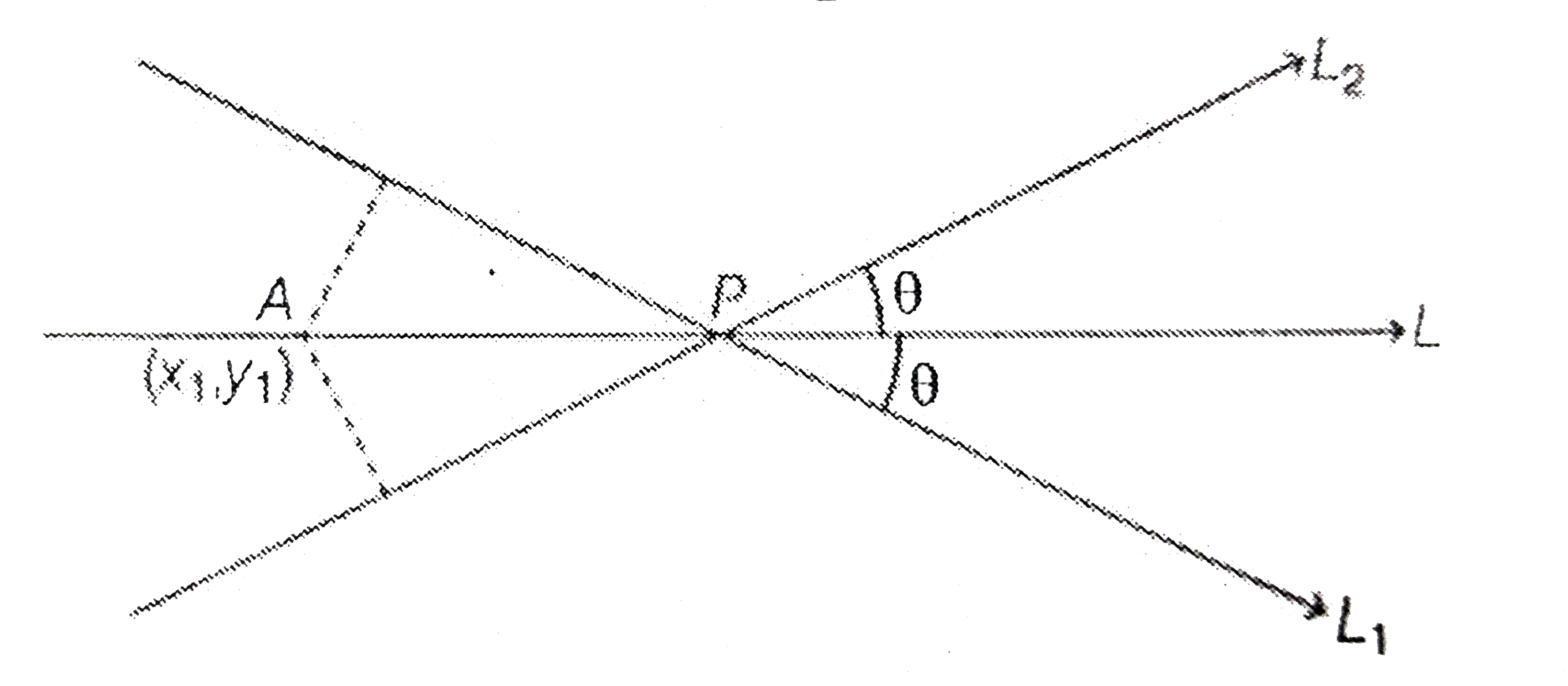
Since, the required line `L` passes through the intersection of `L_(1)=0` and `L_(2)=0`

So, the equation of the required line `L` is
`L_(1)+lambdaL_(2)=0`
i.e. `(ax+by+c)+lambda(lx+my+n)=0`……`(i)`
where, `lambda` is a parameter.
Since, `L_(1)` is the angle bisector of `L=0` and `L_(2)=0`.
`:.` Any point `A(x_(1),y_(1))` on `L_(1)` is equidistant from `L_(1)=0` and `L_(2)=0`
`implies (|lx_(1)+my_(1)+n|)/(sqrt(l^(2)+m^(2)))`
`=(|(ax_(1)+by_(1)+c)+lambda(lx_(1)+my_(1)+n)|)/(sqrt((a+lambdal)^(2)+(b+lambdam)^(2)))`.......`(ii)`
But `A(x_(1),y_(1))` lies on `L_(1)`. So, itmust satisfy the equation of `L_(1)`, ie, `ax_(1)+by_(1)+c_(1)=0`
On substituting `ax_(1)+by_(1)+c=0` in Eq. `(ii)` , we get
`(|lx_(1)+my_(1)+n|)/(sqrt(l^(2)+m^(2)))=(|0+lambda(lx_(1)+my_(1)+n)|)/(sqrt((a+lambdal)^(2)+(b+lambdam)^(2)))`
`implies lambda^(2)(l^(2)+m^(2))=(a+lambdal)^(2)+(b+lambdam)^(2)`
`:. lambda=-((a^2)+b^(2))/(2(al+bm))`
On substituting the value of `lambda` in Eq.`(i)`, we get
`(ax+by+c)-((a^(2)+b^(2))/(2(al+bm))(lx+my+n)=0`
`implies2(al+bm)(ax+by+c)-(a^(2)+b^(2))(lx+my+n)=0`
which is the required equation of line `L`.
Promotional Banner

Similar Questions

Explore conceptually related problems

Lines L_1-=a x+b y+c=0 and L_2-=l x+m y+n=0 intersect at the point P and make an angle theta with each other. Find the equation of a line different from L_2 which passes through P and makes the same angle theta with L_1dot

Find the equation of the straight line which passes through the origin and makes angle 60^0 with the line x+sqrt(3)y+sqrt(3)=0 .

If line l_1 is perpendicular to line l_2 and line l_3 has slope 3 then find the equation of line l_1

If line l_1 is perpendicular to line l_2 and line l_3 has slope 3 then find the equation of line l_2

Find the equation of the lines passing through the point (1,1) and the perpendicular from the origin makes an angle 60^(@) with x-axis.

A line makes the same angle theta , with each of the x and axis. If the angle beta , which it makes with y-axis, is such that sin^(2)beta=3sin^(2)theta , then cos^(2)theta equals:

