Home
Class 12
MATHS
Two sides of a rhombus are along the lin...

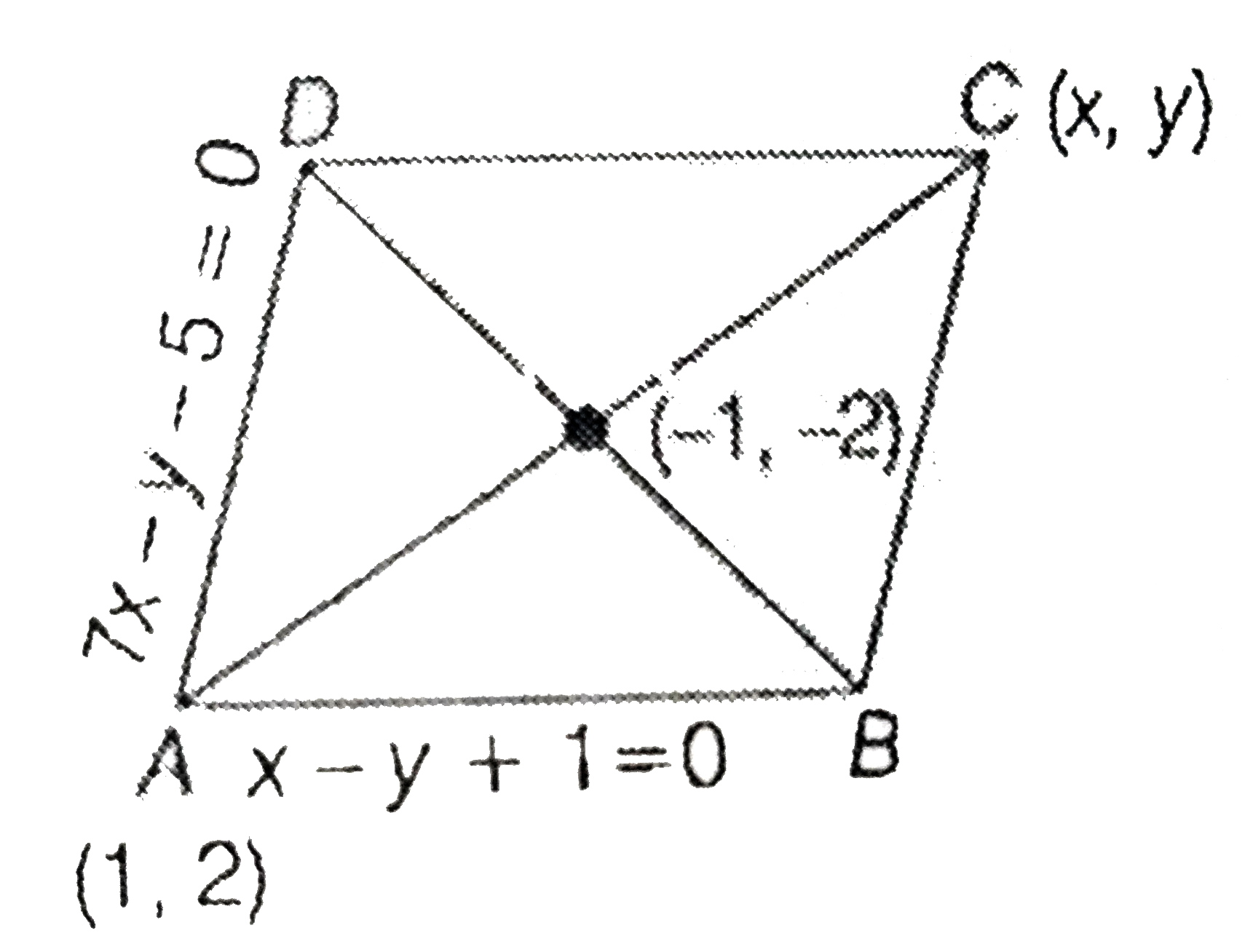
Two sides of a rhombus are along the lines x-y+1=0 and 7x-y-5=0. If its diagonals intersect at (-1, -2), then which one of the following is a vertex of this rhombus?

A

`(-3,-9)`

B

`(-3,-8)`

C

`((1)/(3),-(8)/(3))`

D

`(-(10)/(3),-(7)/(3))`

Text Solution

Verified by Experts

As the given lines `x-y+1=0` and `7x-y-5=0` are not parallel, therefore they represent the adjacent sides of the rhombus.
On solving `x-y+1=0` and `7x-y-5=0`, we get `x=1` and `y=2`. Thus, one of the vertex is `A(1,2)`.

Let the coordinate of point `C` be `(x,y)`.
Then, `-1=(x+1)/(2)` and `-2=(y+2)/(2)`
`impliesx+1=-2` and `y=-4-2`
`impliesx=-3`
`impliesy=-6`
Hence, coordinates of `C=(-3,-6)`
Note that, vertices `B` and `D` will satisfy `x-y+1=0` and `7x-y-5=0`, respectively.
Since, option `(c )` satisfies `7x-y-5=0`, therefore coordinate of vertex `D` is `((1)/(3),(-8)/(3))`.
Promotional Banner

Similar Questions

Explore conceptually related problems

The sides of a rhombus are parallel to the lines x+y-1=0 and 7x-y-5=0. It is given that the diagonals of the rhombus intersect at (1, 3) and one vertex, A of the rhombus lies on the line y=2x . Then the coordinates of vertex A are (8/5,(16)/5) (b) (7/(15),(14)/(15)) (6/5,(12)/5) (d) (4/(15),8/(15))

Two sides of a square lie on the lines x+y=1a n dx+y+2=0. What is its area?

Two sides of a rhombus ABCD are parallel to the lines y = x + 2 and y = 7x + 3 If the diagonals of the rhombus intersect at the point (1, 2) and the vertex A is on the y-axis, then vertex A can be

Two sides of a rhombus lying in the first quadrant are given by 3x-4y=0a n d12 x-5y=0 . If the length of the longer diagonal is 12, then find the equations of the other two sides of the rhombus.

The line 2x+3y=5 , 2x+y=k , 2x-y-1=0

Distance of point (2,3) from the line 2x-3y+9=0 along x-y+1=0

One diagonal of a square is along the line 8x-15 y=0 and one of its vertex is (1, 2). Then the equations of the sides of the square passing through this vertex are a. 23 x+7y=9,7x+23 y=53 b. 23 x-7y+9=0,7x+23 y+53=0 c. 23 x-7y-9=0,7x+23 y-53=0 d.none of these

The diagonals of a parallelogram PQRS are along the lines x+3y =4 and 6x-2y = 7, Then PQRS must be :

The sides of a triangle are the straight lines x+y=1,7y=x , and sqrt(3)y+x=0 . Then which of the following is an interior point of the triangle? (a)Circumcenter (b) Centroid (c)Incenter (d) Orthocenter

The two adjacent sides of parallelogram are y = 0 and y=sqrt3(x-1) . If equation of one diagonal is sqrt3y=(x+1) , then equation of other diagonal is