Home
Class 12
MATHS
Let n1<n2<n3<n4<n5 be positive intege...

Let `n_1

Text Solution

Verified by Experts

The correct Answer is:
7

PLAN Reducing the equation to a newer equation, where sum of variables is less. Thus, finding the number of arrangements becomes easier.
As `n_(1) ge 1, n_(2) ge 2, n_(3) ge 3, n_(4) ge 4 n_(5) ge 5`
Let `n_(1) - 1 = x_(1) ge 0, n_(2) - 2 = x_(2) ge 0, ..., n_(5) - 5 = x_(5) ge 0`
`rArr` New equation will be
`x_(1) + 1 + x_(2) + 2 + ... + x_(5) + 5 = 20`
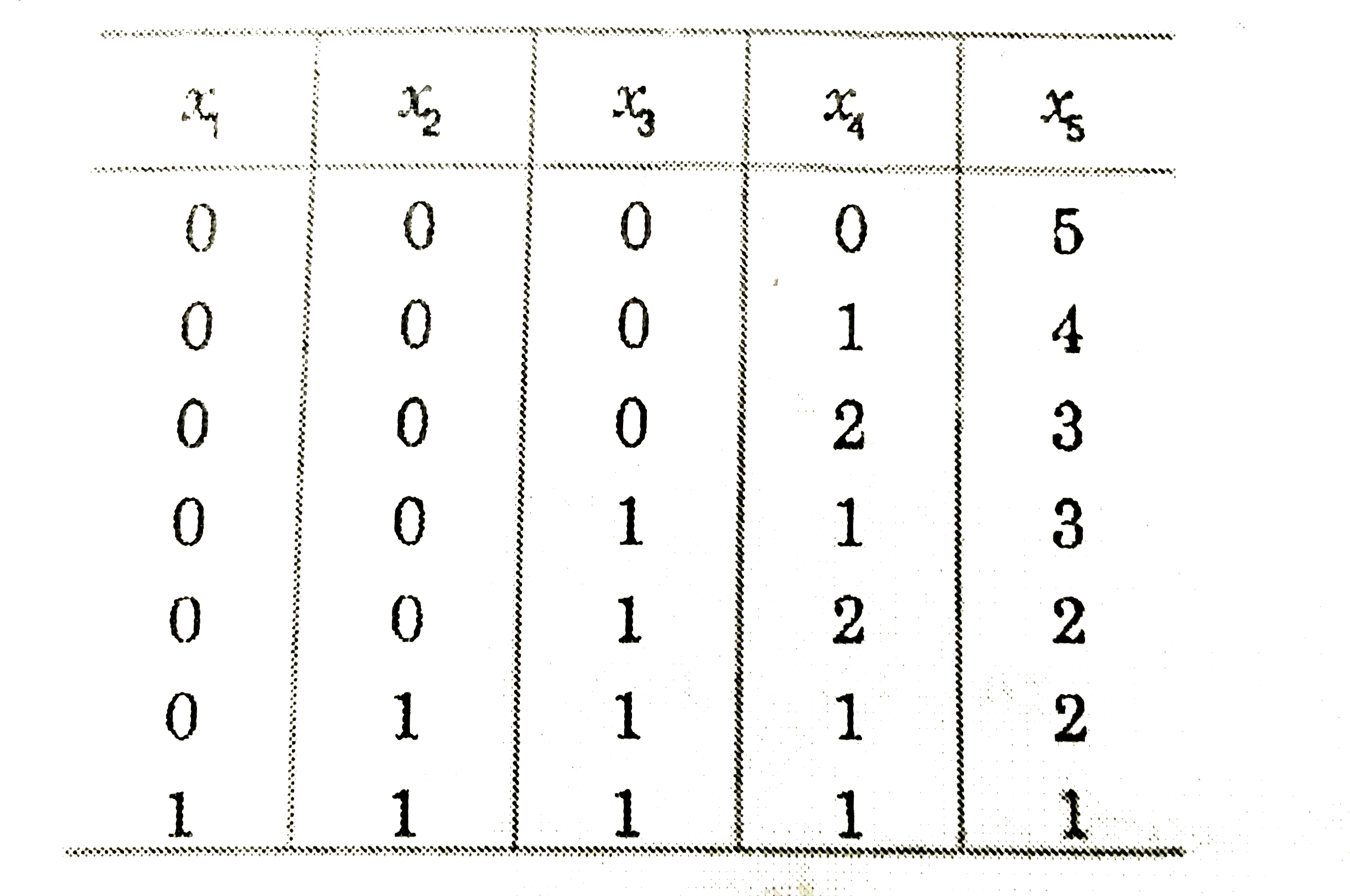
`rArr " " x_(1) + x_92) + x_(3) + x_(4) + x_5) = 20 - 15 = 5`
Now, `x_(1) le x_(2) le x_(3) le x_(4) le x_(5)`

So, 7 possible cases will be there.
Promotional Banner

Similar Questions

Explore conceptually related problems

Let nge1, n in Z . The real number a in 0,1 that minimizes the integral int_(0)^(1)|x^(n)-a^(n)|dx is

Let A_1 , G_1, H_1 denote the arithmetic, geometric and harmonic means respectively, of two distinct positive numbers. For n >2, let A_(n-1),G_(n-1) and H_(n-1) has arithmetic, geometric and harmonic means as A_n, G_N, H_N, respectively.

Let A_1 , G_1, H_1 denote the arithmetic, geometric and harmonic means respectively, of two distinct positive numbers. For n >2, let A_(n-1),G_(n-1) and H_(n-1) has arithmetic, geometric and harmonic means as A_n, G_N, H_N, respectively.

An unbiased normal coin is tossed n times. Let E_(1): event that both heads and tails are present in n tosses. E_(2): event that the coin shows up heads at most once. The value of n for which E_(1) and E_(2) are independent is ______.

Let z_1a n dz_2 b be toots of the equation z^2+p z+q=0, where he coefficients pa n dq may be complex numbers. Let Aa n dB represent z_1a n dz_2 in the complex plane, respectively. If /_A O B=theta!=0a n dO A=O B ,w h e r eO is the origin, prove that p^2=4q"cos"^2(theta//2)dot

Let vectors vec a , vec b , vec c ,a n d vec d be such that ( vec axx vec b)xx( vec cxx vec d)=0. Let P_1a n dP_2 be planes determined by the pair of vectors vec a , vec b ,a n d vec c , vec d , respectively. Then the angle between P_1a n dP_2 is a. 0 b. pi//4 c. pi//3 d. pi//2

Let E_1a n dE_2, respectively, be two ellipses (x^2)/(a^2)+y^2=1,a n dx^2+(y^2)/(a^2)=1 (where a is a parameter). Then the locus of the points of intersection of the ellipses E_1a n dE_2 is a set of curves comprising two straight lines (b) one straight line one circle (d) one parabola

Let E_1a n dE_2, respectively, be two ellipses (x^2)/(a^2)+y^2=1,a n dx^2+(y^2)/(a^2)=1 (where a is a parameter). Then the locus of the points of intersection of the ellipses E_1a n dE_2 is a set of curves comprising (a)two straight lines (b) one straight line (c)one circle (d) one parabola

Let d_1a n dd_2 be the length of the perpendiculars drawn from the foci Sa n dS ' of the ellipse (x^2)/(a^2)+(y^2)/(b^2)=1 to the tangent at any point P on the ellipse. Then, S P : S^(prime)P= (a) d_1: d_2 (b) d_2: d_1 (c) d_1 ^2:d_2 ^2 (d) sqrt(d_1):sqrt(d_2)

Let A_1,A_2,....A_n be the vertices of an n-sided regular polygon such that , 1/(A_1A_2)=1/(A_1A_3)+1/(A_1A_4) . Find the value of n.

