Home
Class 12
MATHS
If S is a set of triangles whose one ver...

If S is a set of triangles whose one vertex is origin and other two vertices are integral coordinates and lies on coordinate axis of area 50 square units, then number of elements in set S is equal to (a) 9 (b) 18 (c) 36 (d) 40

A

36

B

32

C

18

D

9

Text Solution

Verified by Experts

The correct Answer is:
A

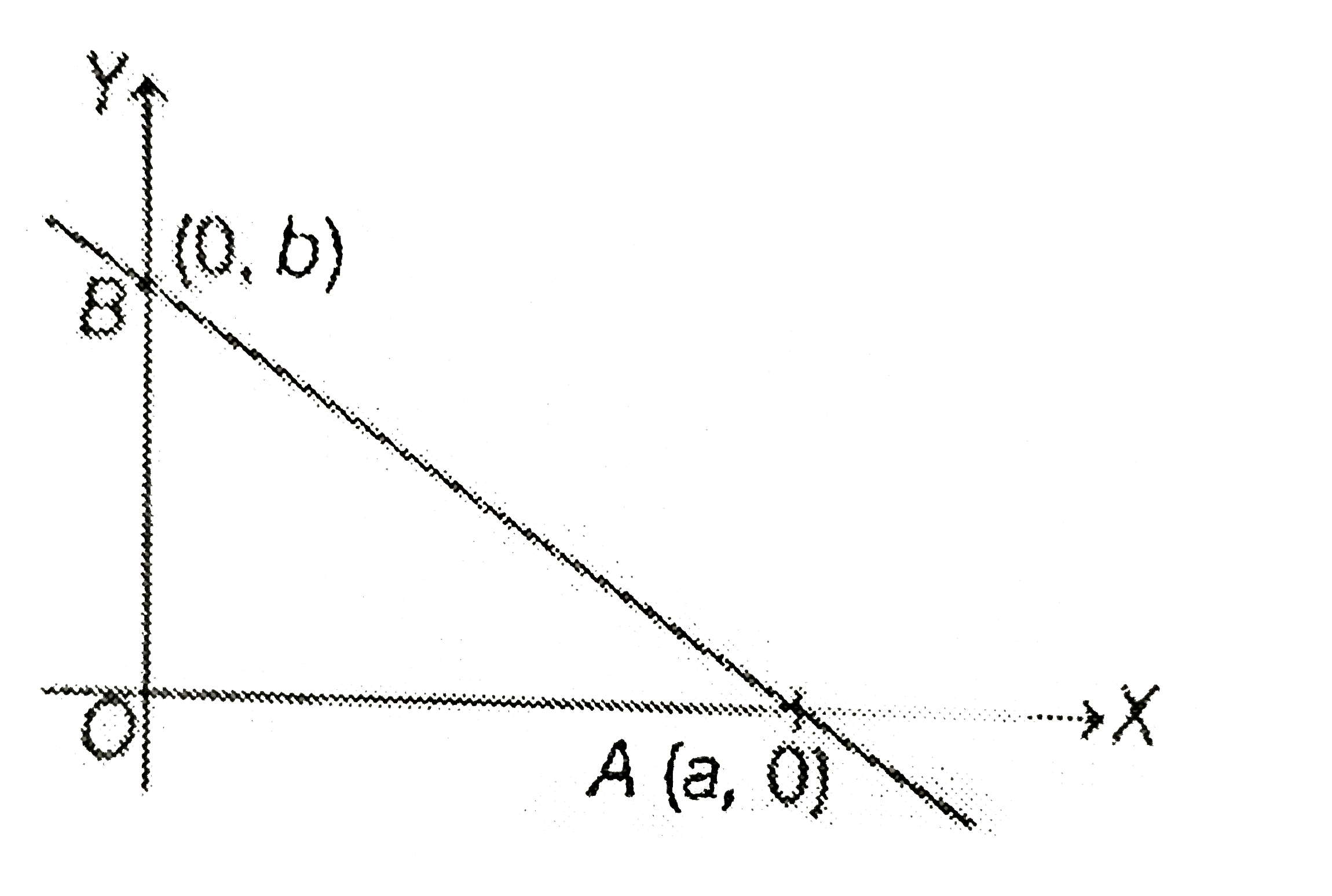
According to given information, we have the following figure.

(Note that as a and b are integers so they can be negative also). Here O(0, 0), A(a, 0) and B(0, b) are the three vertices of the triangle.
Clearly, `OA = |a| " and " OB = |b|`.
`therefore` Area of `DeltaOAB = 1/2 |a||b|.`
But area of such triangles is given as 50 sq units.
`therefore` `1/2 |a||b| = 50`
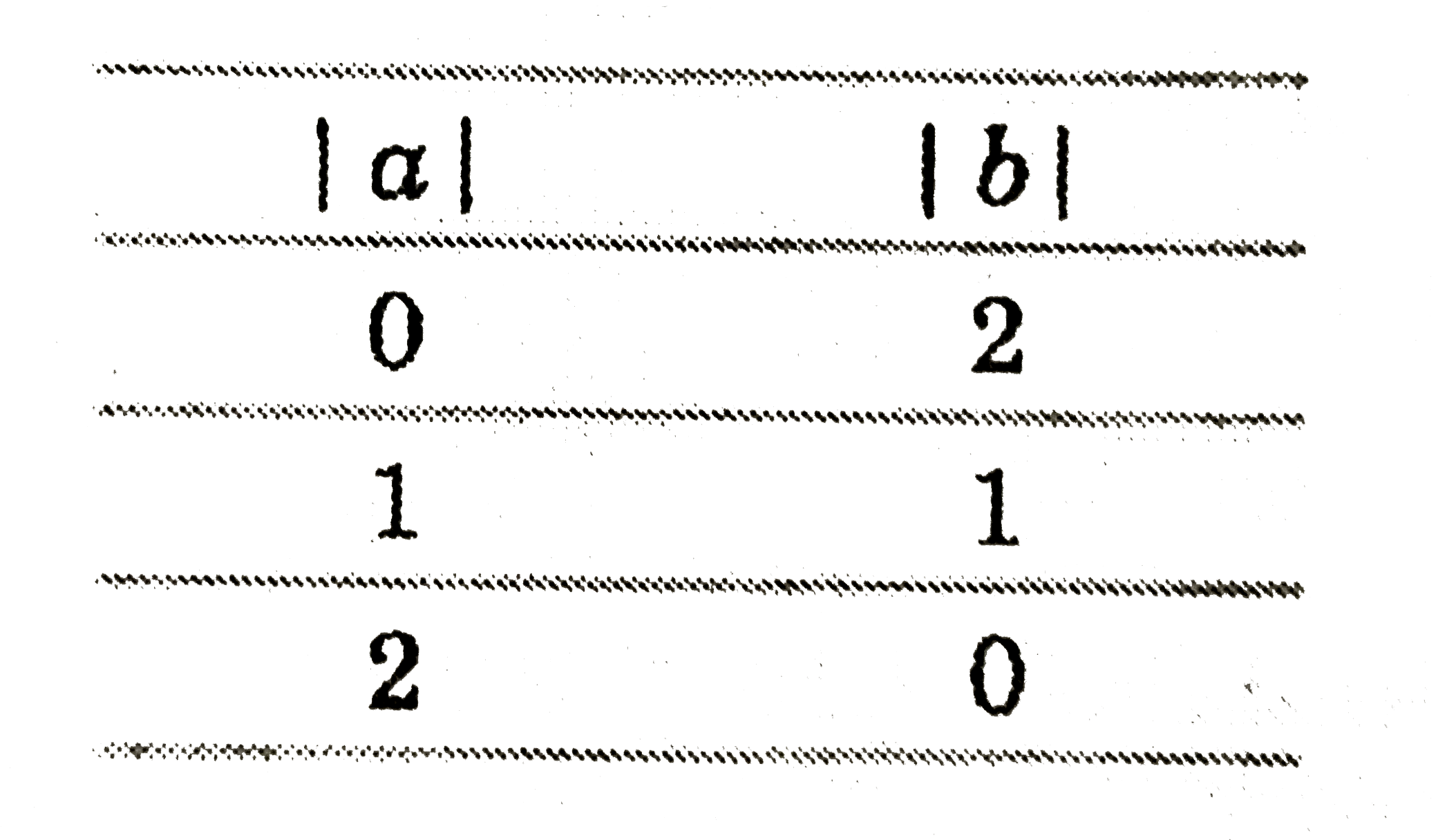
`rArr` `|a||b| = 100 = 2^(2) * 5^(2)`
Number of ways of distributing two 2's in `|a|` and `|b| = 3`

`rArr 3` ways
Similarly, number of ways of distributing two 5's in `|a|` and `|b|` = 3 ways.
`therefore` Total number of ways of distributing 2's and 5's `= 3 xx 3 = 9` ways
Note that for one value of `|a|`, there are 2 possible values of a and for one value of `|b|` there are 2 possible values of b.
`therefore` Number of such triangles possible `= 2 xx 2 xx 9 = 36`.
So, number of elements in S is 36.
Promotional Banner

Similar Questions

Explore conceptually related problems

Let S be the set of all triangles in the xy-plane, each having one vertex at the origin and the other two vertices lie on coordinate axes with integral coordinates. If each triangle in S has area 50 eq. units, then the number of elements in the set S is

If (4,0) and (1, -1) are two vertices of a triangle of area 4 square units, then its third vertex lies on

If the area of the triangle whose one vertex is at the vertex of the parabola, y^(2) + 4 (x - a^(2)) = 0 and the other two vertices are the points of intersection of the parabola and Y-axis, is 250 sq units, then a value of 'a' is

Two sides of a triangle are along the coordinate axes and the medians through the vertices (other than the origin) are mutually perpendicular. The number of such triangles is/are zero (b) two (c) four (d) infinite

ABC is a triangle whose vertices are A(3,4) B(-2,-1) and C(5,3). If G is the centroid and BDCG is a parallelogram then find the coordinates of the vertex D.

A line is drawn perpendicular to line y=5x , meeting the coordinate axes at Aa n dB . If the area of triangle O A B is 10 sq. units, where O is the origin, then the equation of drawn line is (a) 3x-y-9 (b) 5y+x=10 (c) 5y+x=-10 (d) x-4y=10

A (-5,0) and B (3,0) are two of the verti- ces of a triangle ABC. Its area is 20 square units. The vertex Clies on the line x - y = 2. The coordinates of C are

If a plane cuts off intercepts OA = a, OB = b, OC = c from the coordinate axes 9where 'O' is the origin). then the area of the triangle ABC is equal to

Let A (-2,2)and B (2,-2) be two points AB subtends an angle of 45^@ at any points P in the plane in such a way that area of Delta PAB is 8 square unit, then number of possibe position(s) of P is

The number of elements in set of all x satisfying the equation x^(log_3x^2+(log_3x)^2-10)=1/(x^2)i s (a)1 (b) 2 (c) 3 (d) 0