Home
Class 12
MATHS
If alpha = cos^(-1)((3)/(5)), beta = tan...

If `alpha = cos^(-1)((3)/(5)), beta = tan ^(-1)((1)/(3))` , where `0 lt alpha, beta lt (pi)/(2)`, then `alpha - beta` is equal to (A) `tan ^(-1)((9)/( 5sqrt(10))) ` (B) `cos ^(-1)((9)/( 5sqrt(10))) ` (C) `tan^(-1)((9)/(14))` (D) `sin ^(-1)((9)/(5 sqrt(10)))`

A

`tan ^(-1)((9)/( 5sqrt(10))) `

B

`cos ^(-1)((9)/( 5sqrt(10))) `

C

`tan^(-1)((9)/(14))`

D

`sin ^(-1)((9)/(5 sqrt(10)))`

Text Solution

Verified by Experts

The correct Answer is:
D

Given, ` alpha = cos ^(-1) ((3)/(5)) and beta = tan ^(-1) ((1)/(3))`
where, ` 0 lt alpha, beta lt (pi)/(2)`

Clearly, ` alpha = tan ^(-1) ""( 4)/(3)`
So, ` alpha - beta = tan ^(-1) ""( 4)/(3) - tan ^(-1) ""(1)/(3) = tan ^(-2) ((( 4)/(3) - (1)/(3))/( 1 + ((4)/(3) xx (1)/(3))))`
`" " [ because tan ^(-1) x - tan ^(-1) y = tan ^(-1) ""( x- y )/( 1 + xy ), if xy gt - 1 ]`
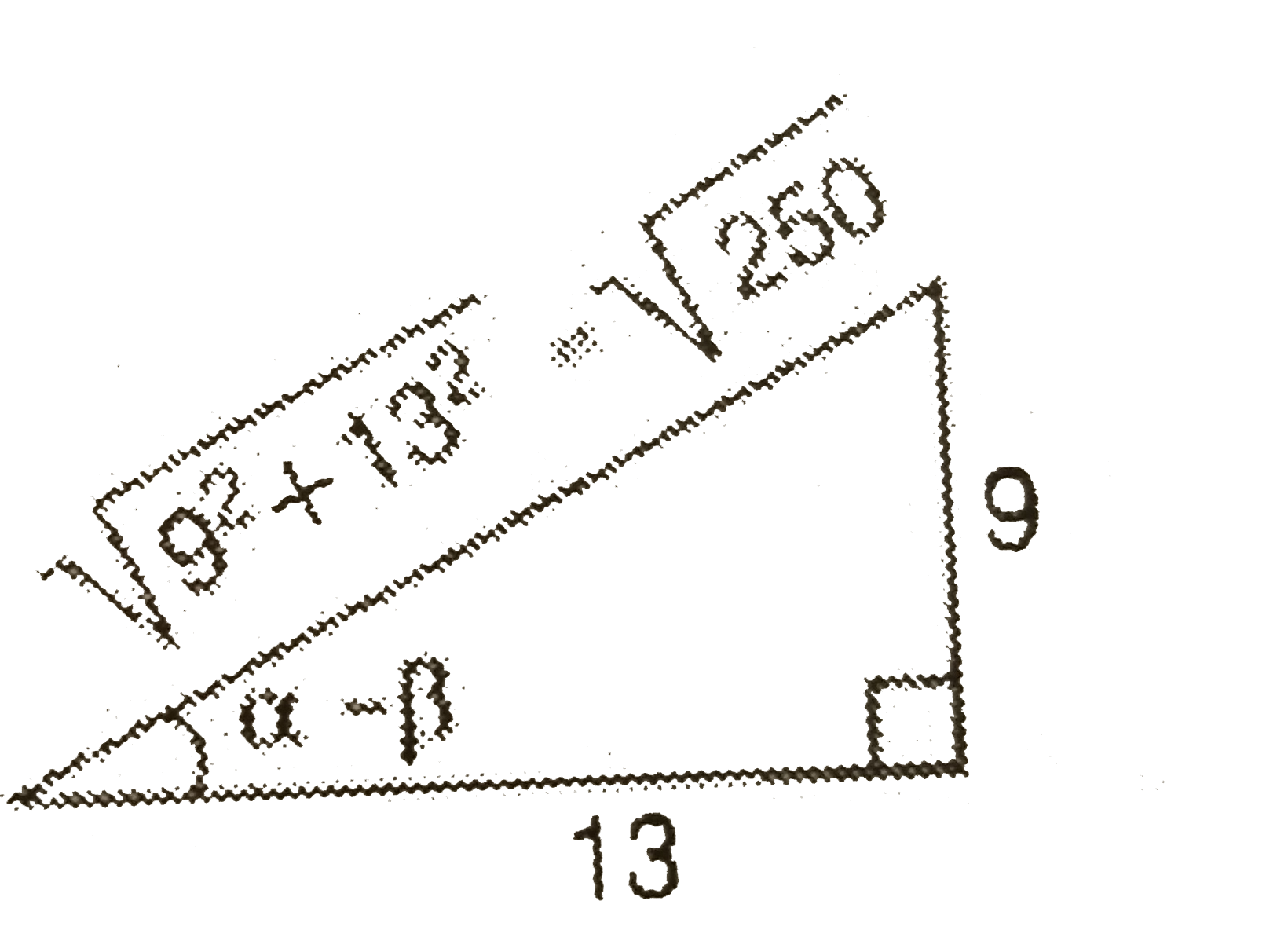
`= tan ^(-1) ""(1)/(1 + (4)/(9)) = tan ^(-1) ""(9)/( 13)`

`= sin ^(-1) ""(9)/( sqrt (9^(2) + 13^(2))) = sin ^(-1) ""(9)/(sqrt( 9^(2) + 13^(2)))= sin ^(-1) ""(9)/(sqrt ( 250))`
` = sin ^(-1) ((9)/( 5 sqrt(10)))`
Promotional Banner

Similar Questions

Explore conceptually related problems

If alpha=tan^(-1)((sqrt(3)x)/(2y-x)),beta=tan^(-1)((2x-y)/(sqrt(3y)))" then "alpha-beta=

If alpha=tan^(-1)(tan""(5pi)/(4))andbeta=tan^(-1)(-tan""(2pi)/(3)), then

2tan^(-1)(-2) is equal to (a) -cos t^(-1)((-3)/5) (b) -pi+cos^(-1)3/5 (c) -pi/2+tan^(-1)(-3/4) (d) -picot^(-1)(-3/4)

Prove that tan^(-1).(1)/(sqrt2) + sin^(-1).(1)/(sqrt5) - cos^(-1).(1)/(sqrt10) = -pi + cot^(-1) ((1 + sqrt2)/(1 - sqrt2))

If -1< x < 0 , then cos^(-1)x is equal to (a) sec^(-1)(1/ x) (b) pi-sin^(-1)sqrt(1+x^2) (c) pi+tan^(-1)(x/(sqrt(1-x^2))) (d) cot^(-1)(x/(sqrt(1-x^2))) .

Evaluate the value of tan^(-1) (-sqrt(3)) +cos^(-1) (1/(sqrt(2))) + sin^(-1) (-(sqrt(3))/2)

If alpha , beta in (0,pi/2), sin alpha =4/5 and cos ( alpha + beta) = ( -12)/(13) then sin beta is equal to

If tan alpha and tan beta are the roots of x^2 + ax + b = 0 , where a ne 0 then sin (alpha + beta) sec alpha sec beta is equal to ……………….

sin alpha+sinbeta=(1)/(4) and cos alpha+cos beta=(1)/(3) the value of sin(alpha+beta)