Home
Class 12
MATHS
if the length of the perpendicular fr...

if the length of the perpendicular from the point
`(beta,0,beta )(betane 0) " to the line " , (x)/1 =(y-1)/(0) =(z+1)/(-1) " is " sqrt((3)/(2)),` then `beta " is equal to "`

A

2

B

-2

C

-1

D

1

Text Solution

Verified by Experts

The correct Answer is:
C

Equations of given line is
`(x)/(1)= (y-1)/(0) =(z+1)/(-1)`
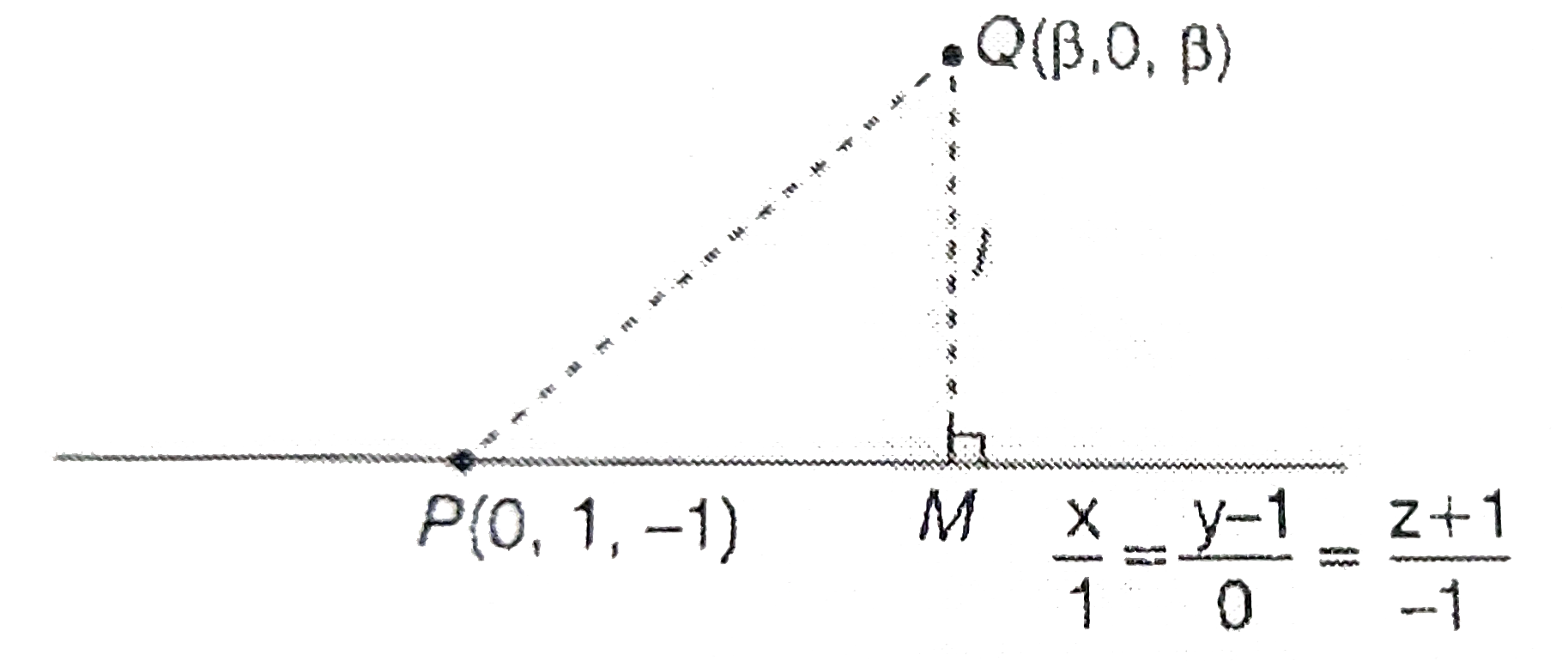
Now one of the point of line is `P (0,1-1 ) ` and the given point is`Q(beta , 0 , beta)`

From the figure the length of the perpendicular
`QM = l = sqrt((3)/(2)) " ""(given)"`
`rArr (|PQ xx PM|)/(|PM|) = sqrt((3)/(2)) " " .....(ii)`
and PM=a vector along given line (1) `=hat(i) - hat(k)` ltbr. so `PQxx PM = |{:(hat(i) ,,hat(j) ,,hat(k)),( beta ,,-1,,beta+1),(1,,0,,-1):}|`
`= hat(i) - hat(j) (-beta- beta-1) + hat(k) = hat(i) + (2beta + 1)^(2) hat(k)`
` " Now " (|PQ xx PM|)/(|PM|) = (sqrt(1+(2beta+1)^(2)+1)/(sqrt(2))) " "......(iii)`
From Eqs . (ii) and (iii) we get
`sqrt((1+(2beta +1)^(2)+1)/(2)) = sqrt((3)/(2)) rArr .(1+(2beta +1)^(2) +1)/(2) =(3)/(2)`
`rArr (2beta +1)^(2) =1 rArr 2beta +1 = +-1`
`rArr 2beta + 1= 1 " or " 2beta +1= -1 rArr beta = 0 " or " beta =-1`
Promotional Banner

Similar Questions

Explore conceptually related problems

The perpendicular distance from the point (1,-1) to the line x + 5y-9=0 is equal to

The foot of the perpendicular from A (1, 0, 0) to the line (x-1)/2=(y+1)/(-3)=(z+10)/8 is

Prove that the product of the lengths of the perpendiculars drawn from the points (sqrt(a^(2)-b^(2)), 0) and (-sqrt(a^(2)-b^(2)), 0) to the line (x)/(a)cos theta+(y)/(b)sin theta=1 is b^(2)

Prove that the product of the lengths of the perpendiculars drawn from the points (sqrt(a^(2) - b^(2)) , 0) " and " (- sqrt(a^(2) - b^(2)), 0) to the line x/a cos theta + y/b sin theta = 1 " is " b^(2) .

If the line (x-2)/(3)=(y-1)/(-5)=(z+2)/(2)" lies in the plane "x+3y-az+beta=0" then "(alpha,beta) is

IF cot ( alpha + beta ) =0 then sin ( alpha + 2 beta ) is equal to

IF cos ( alpha + beta ) =0 then sin ( alpha + 2 beta ) is equal to

If alpha and beta are the roots of the equation x^(2) -1 =0 " then " (2alpha)/(beta ) + (2 beta)/(alpha) is equal to ..........

If alpha and beta are the roots of the equation x^(2)-ax+b=0 ,find Q(b) (1)/(alpha)+(1)/(beta)

