Home
Class 12
MATHS
If overset(to)(a) , overset(to)(b) , ove...

If `overset(to)(a) , overset(to)(b) , overset(to)(c ) " and " overset(to)(d)` are the unit vectors such that
`(overset(to)(a)xx overset(to)(b)). (overset(to)(c )xx overset(to)(d)) =1 " and " overset(to)(a), overset(to)(c ) = .(1)/(2) , ` then

A

`overset(to)(a) , overset(to)(b), overset(to)(c )` are non -coplanar

B

` overset(to)(a), overset(to)(b), overset(to)(d)` are non- coplanar

C

`overset(to)(b) , overset(to)(d)` are non-parallel

D

`overset(to)(a), overset(to)(d)` are parallel and `overset(to)(b), overset(to)(c )` are parallel

Text Solution

Verified by Experts

The correct Answer is:
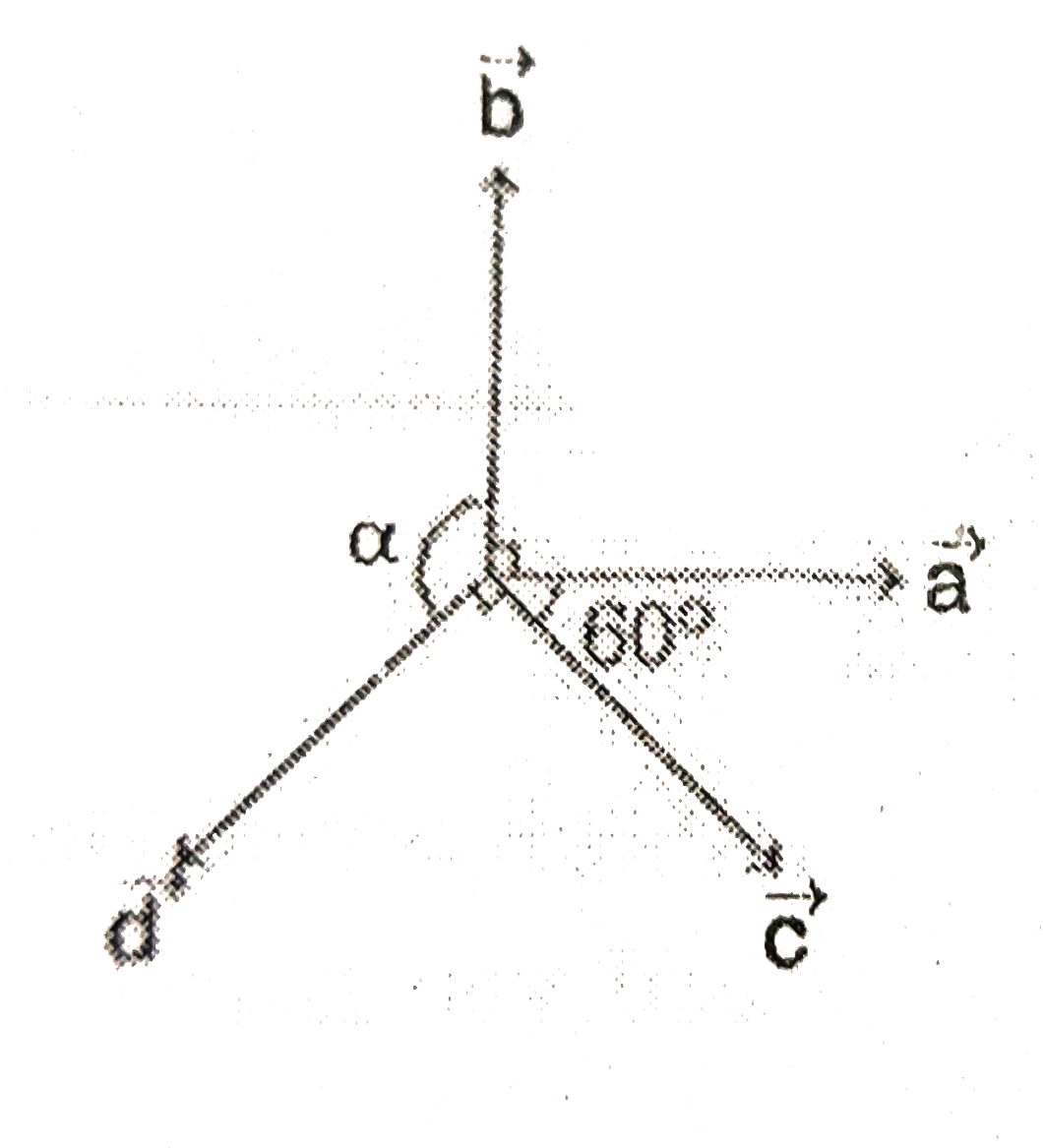
C

Let angle between `vec(a) " and " vec(b) be 0_(1) , vec(c ) and " vec( d) " be " 0_(2) " and " vec(a) xx vec(b)` and `vec(b) xx vec(d)` be 0 .
Since `(vec(a) xx vec(b)). (vec(c ) xx vec(d)) =1`
`rArr sin 0_(1) ." sin "0_(2) ". " cos0 =1`
`rArr 0_(1) =90^(@) , 0_(2) =90^(@) , 0 =0^(@)`
`rArr vec(a) bot vec(b) , vec( c) bot vec(d) , (vec(d) xx vec(d)) ||(vec(c ) xx vec( d))`
`So., vec(a) xx vec(b) = k (vec( c) xx vec(d)) " and " vec(a) xx vec(b) = k(vec(c ) xx vec(d))`
`rArr (vec(a) xx vec(b)) ". " vec(c ) = k (vec( c) xx vec(d)) .(vec(c )`
and `(vec(a) xx vec(b)) ". " vec(d) = k (vec(c ) xx vec(d)) "."vec(d)` ltbgt `rArr (vec(a),vec(b),vec(c )" and " vec(a) ,vec(b), vec(d) ` are coplanar vectors so options (a) and (b) are incorrect.
Let `vec(b)||vec(d) rArr vec(b) =+- vec(d)`
As `(vec(a)xx vec(b)) .(vec(c ) xx vec(d)) =1 rArr (vec(a) xx vec(b)). (vec(c ) xx vec(b)) =+-1`
`rArr [vec(a) xx vec(b) vec(c) vec(b)] =+-1 rArr [vec(c ) vec(b) vec(a) xx vec(b) ]=+-1`
`rArr vec(a ) ." vec(a) =+-1 " "[:' vec(a) "." vec(b) =0]`
Which is a contradiction so
option (c ) is correct.
Let option (d) is correct.

`rArr vec(d) =+- vec(a)`
and `vec( c) = +- vec(b) `
As `(vec( a) xx vec(d))"." (vec(c) xx vec(d)) =1`
`rArr (vec(a) xx vec(d)) .(vec(b)xx vec(a)) =+-1`
Which is a contradiction so option (d) is incorrect,
Alternatively , options (c ) and (d) may be observed from the given figure .
Promotional Banner

Similar Questions

Explore conceptually related problems

If overset(to)(a),overset(to)(b),overset(to)(c ),overset(to)(d) are four distinct vectors satisfying the conditions overset(to)(a)xxoverset(to)(b)=overset(to)(c )xx overset(to)(d) " and " overset(to)(a)xxoverset(to)(c ) = overset(to)(b)xx overset(to)(d) then prove that , overset(to)(a).overset(to)(b)+overset(to)(c ). overset(to)(d) ne overset(to)(a). overset(to)(c)+overset(to)(b).overset(to)(d) .

If overset(to)(a) , overset(to)(b) " and " overset(to)(c ) are three non- coplanar vectors then (overset(to)(a) + overset(to)(b) + overset(to)(c )) . [( overset(to)(a) + overset(to)(b)) xx (overset(to)(a) + overset(to)(c ))] equals

If overset(to)(a) , overset(to)(b) " and " overset(to)( c) are unit coplanar vectors then the scalar triple product [2 overset(to)(a) - overset(to)(b), 2 overset(to)(b) - overset(to)(c ) ,2 overset(to)(c ) - overset(to)(a)] is

A,B,C and d are four points in a plane with position vectors overset(to)(a),overset(to)(b),overset(to)(c ) and overset(to)(d) respectively such that (overset(to)(a)-overset(to)(d)).(overset(to)(b)-overset(to)(c))=(overset(to)(b)-overset(to)(d))(overset(to)(c)-overset(to)(a))=0 The point D then is the .... of the DeltaABC

The scalar overset(to)(A) .[(overset(to)(B) + overset(to)( C)) xx (overset(to)(A) + overset(to)(B) + overset(to)( C))] equals

Let overset(to)(a),overset(to)(b),overset(to)(c ) be unit vectors such that overset(to)(a)+overset(to)(b)+overset(to)(c ) = overset(to)(0). Which one of the following is correct ?

Let overset(to)(a) , overset(to)(b) " and " overset(to)( c) be three non-zero vectors such that no two of them are collinear and (overset(to)(a) xx overset(to)(b)) xx overset(to)( c) = (1)/(3) |overset(to)(b)||overset(to)(c )|overset(to)(a). If 0 is the angle between vectors overset(to)(b) " and " overset(to)(c ) then a value of sin 0 is

If overset(to)(a) " and " overset(to)(b)_(1) are two unit vectors such that overset(to)(a) +2overset(to)(b) and 5overset(to)(a) -4overset(to)(b) are perpendicular to each other then the angle between overset(to)(a) " and " overset(to)(b) is

For any three vectors overset(to)(a), overset(to)(b) " and " overset(to)(C ) (overset(to)(a) - overset(to)(b)). {(overset(to)(b)-overset(to)(c))xx(overset(to)(c)-overset(to)(a))} = 2overset(to)(a).(overset(to)(b)xx overset(to)(c))

if overset(to)(a), overset(to)(b) " and " overset(to)(c ) are unit vectors satisfying |overset(to)(a)-overset(to)(b)|^(2)+|overset(to)(b)-overset(to)(c)|^(2)+|overset(to)(c)-overset(to)(a)|^(2)=9 |2overset(to)(a) +5overset(to)(b)+5overset(to)(c)| is equal to

